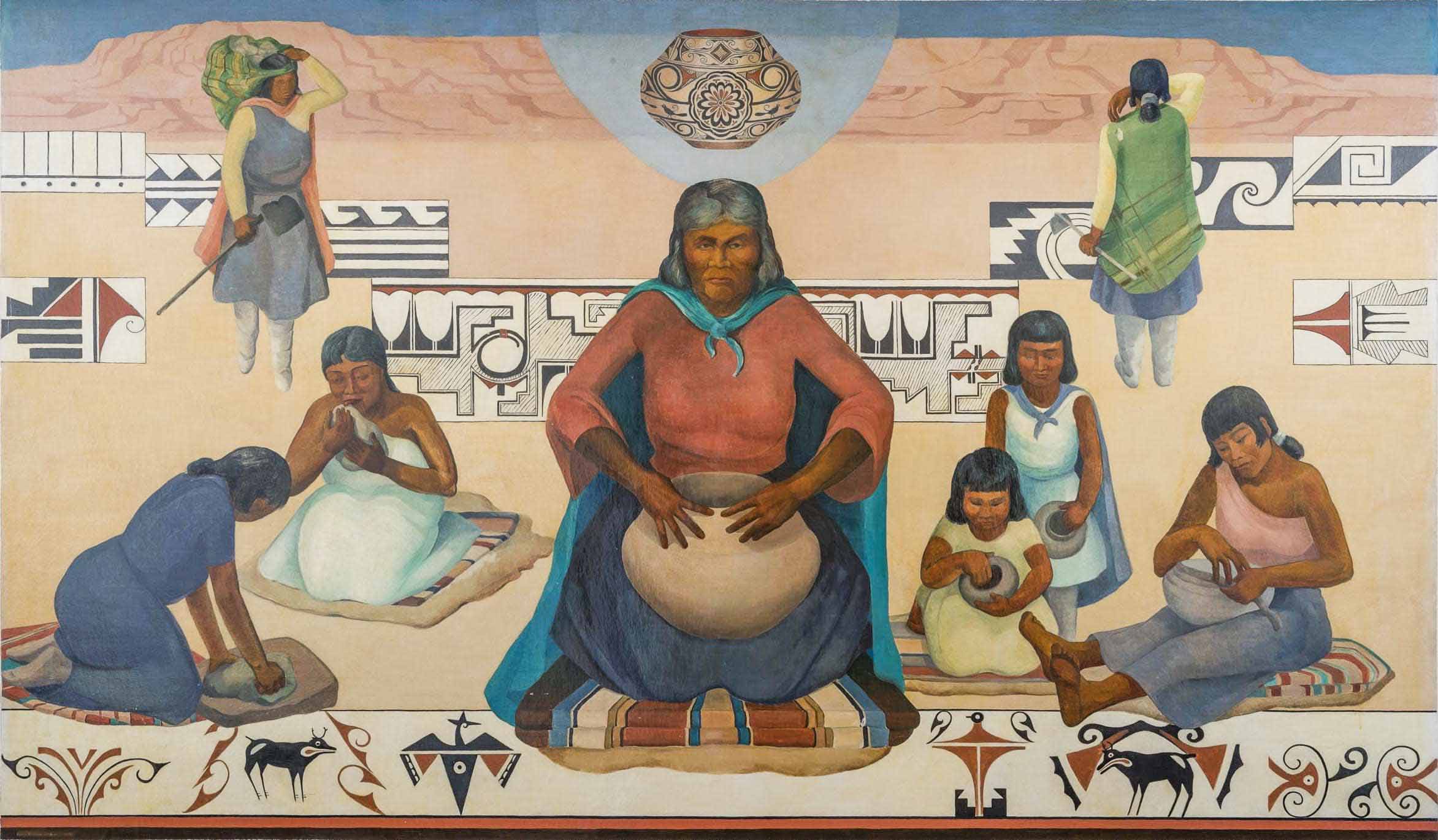
Zuni Pottery Makers

“In this mural the artist has attempted to . . . put on canvas for the observers to see what the Zuni pottery maker has in her conscious and subconscious mind as she makes her pot, the traditions of gathering and working the clay, the religious beliefs and fervor, the history of her people and their traditions which go to make up this her work [sic],” wrote Anna Keener Wilton1 of her painting Zuni Pottery Makers in a 1942 thesis for her master’s degree from the University of New Mexico.2

In her essay, Keener Wilton positions Zuni Pottery Makers as a documentary painting—based on anthropological and ethnographic research, at least one interview with a potter, and, presumably, her own firsthand observations—that illustrates the A:Shiwi (Zuni) pottery-making process step by step. Keener Wilton’s mural is organized around a central master potter (more on her later). As she explains it, the narrative begins with the figure in the top right starting her journey to gather clay from the distant mesas by, “in accordance with the tradition of the pot maker . . . cast[ing] over her shoulder a stone, so that her strength may not fail her.” The same figure is depicted at top left “returning with a load of clay, as much as a hundred and fifty pounds in her blanket, the ends tied and banded across her forehead.” Keener Wilton continues, “in the left foreground we see the next step of the process, the clay being kneaded,” and explains that potters knead the clay to such a fine texture “that the fingers can no longer guide the senses; then it is tested with the tongue as portrayed by the figure above the kneader.” Finally, “to the observer’s right are to be seen the youthful apprentices, forming in the age-old method of their ancestors, the pots of modern Zuni.”3

Zuni Pottery Makers also documents the evolution of A:Shiwi pottery designs. As Keener Wilton writes: “By the use of panels in the composition the artist has attempted to portray the various stages in the development of pottery design from the earliest known period to the present day.” Early designs are replicated in the upper left, later designs in the upper right, and contemporary designs in the middle. “Along the border at the base of the composition are six relatively modern designs . . . of a religious nature.” She also states that she “wishes to point out that every example of design portrayed on the mural has been found in existence in or near Gallup, New Mexico” (though certain designs have been questioned by present-day potters).

In addition to diagramming the process and development of A:Shiwi pottery, Keener Wilton puts forth several major contentions in her essay: a) for a Zuni potter, “her work is born with her”; b) Zuni pottery is the highest form and full expression of Zuni culture; and, c) Zuni potters are great artists. In support of these statements, she places at the center of her mural a potter referred to in her essay as “Mrs. Poncho”4—one of her primary sources for her thesis. Mrs. Poncho is shown demonstrating “how she . . . measures [the pot] by spreading her hands so as to obtain the exact spacing for the design she has visualized,” which is pictured above her head “surrounded by a halo.” In her essay, Keener Wilton quotes Mrs. Poncho as saying, “I always know just how the jar will look before I start to paint it. I just think and think; then I draw what I think.” She goes on to assert her artistic genius as being able to conceive of the pot and design in unison and defends against assumptions of “mere decoration.”

Zuni Pottery Makers was likely installed in the wall of the original County Commission chambers of the historic McKinley County Courthouse soon after it was built. It still hangs in that location, which is now the District Attorney’s office.

Untitled (Kit Carson at Cañon de Chelly)

This is the final painting in a seven-part series of Southwestern history murals that the Gallup public schools commissioned J. R. Willis to paint through the Public Works of Art Project between 1935 and 1936—and that still hang in the Gallup High School library.

Willis concludes his series with an image of one of the last American military offensives against Native peoples in the Southwest. Starting in 1863, Kit Carson, at the command of the US Army, led the forced removal of Diné (Navajo) people to Fort Sumner/Bosque Redondo Reservation. Carson employed a “scorched earth” coercion strategy, destroying Diné homes and food sources. In 1864, he waged a final assault in Canyon de Chelly, where Diné people had taken refuge, which culminated in what is known as the Long Walk, a violent march of Diné people hundreds of miles to Bosque Redondo Reservation.

Willis’s mural whitewashes the historical narrative. In it, Carson appears as a somewhat passive armed guard, simply keeping order and guiding the Diné people to their destination. For their part, the Diné people—erroneously and stereotypically depicted in Plains-style buckskin clothing—appear fully cooperative and hardly distressed.

Untitled (The Coming of the Americans)

This is the sixth in a seven-part series of Southwestern history murals that the Gallup public schools commissioned J. R. Willis to paint through the Public Works of Art Project between 1935 and 1936—and that still hang in the Gallup High School library.

Willis dedicated the first five murals in his series to roughly 100 years of Spanish colonization of the Southwest in the 16th century. With this mural, he fast-forwards about 250 years to the mid-1800s and the end of the Mexican-American War (skipping over 200 years of Spanish colonial administration, the Pueblo Revolt, and Mexican Independence in the process).

This mural draws on stereotyped narratives of western expansion and American progress. A crew of “pioneers” strides directly toward the viewer, heralding a new world order. Willis seems well aware of his intended audience, encouraging local student-viewers to identify with the image by setting the scene in Gallup—the iconic landmarks of Pyramid Rock and Church Rock are clearly visible in the background.

Untitled (Juan de Oñate at El Morro)

This is the fifth in a seven-part series of Southwestern history murals that the Gallup public schools commissioned J. R. Willis to paint through the Public Works of Art Project between 1935 and 1936—and that still hang in the Gallup High School library.

Juan de Oñate, known as the first Spanish governor of New Mexico, was notorious in his own time as a cruel tyrant. His reign was so brutal that five years after his resignation, in 1612, he was charged by the Spanish viceroy with thirty crimes and convicted of twelve. His punishment was banishment from New Mexico, four years’ exile from Mexico City, and a monetary fine (given his wealth and political connections, Oñate was able to secure a pardon from a new king in 1623).

One of the crimes for which Oñate was convicted, and the one for which he is most infamous, was excessive force against the Acoma. In 1599, Oñate put the Acoma people “on trial” for attacking a group of Spanish conquistadors and killing twelve (including Oñate’s nephew). Finding them guilty, Oñate sentenced all Acoma residents over age twelve to twenty years of servitude. Additionally, he ordered that men over twenty-five years of age have one foot cut off.

Willis’s portrayal of Oñate reveals none of his criminality or disgrace. On the contrary, for his mural, Willis adopted a long-standing convention for portraits of military commanders and national leaders (from George Washington to Napoleon Bonaparte): Oñate sits confidently atop a white horse, turned three-quarters to face the viewer. Willis further monumentalizes Oñate by choosing what is now known as El Morro National Monument as his backdrop—the colossal rock formation imbues a sense of majesty.

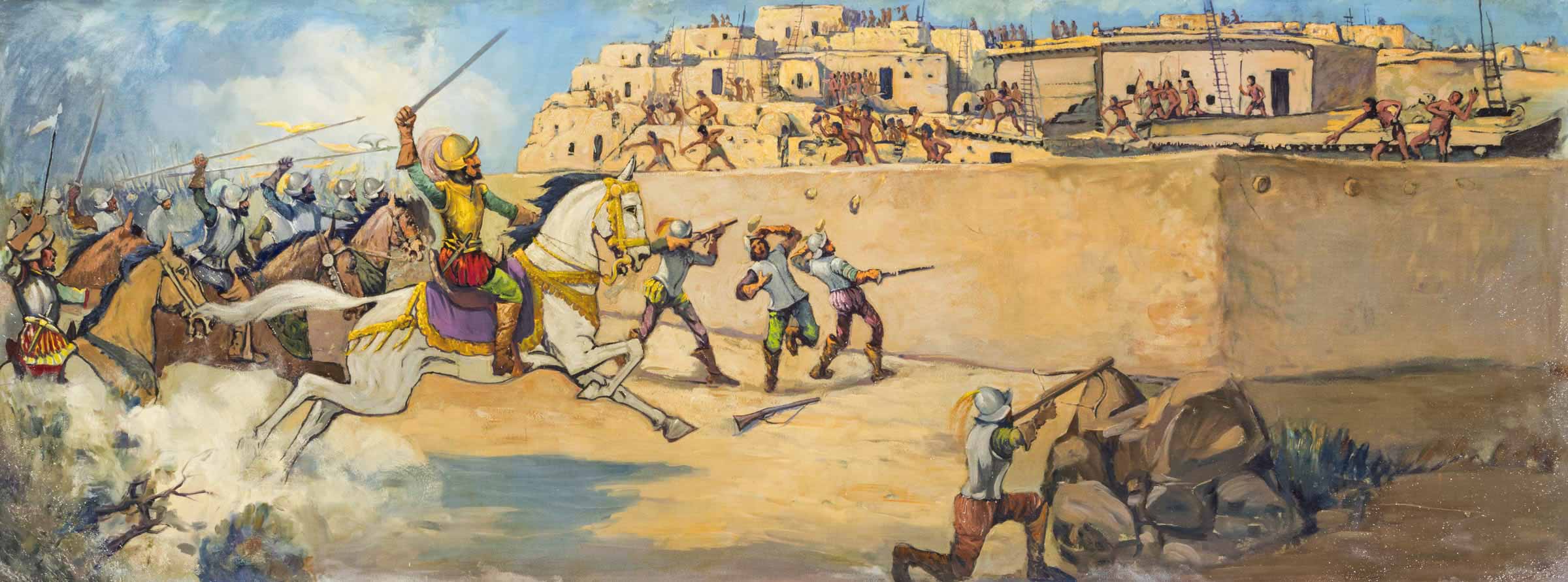
Untitled (Francisco Vasquez de Coronado at Hawiku)

This is the fourth in a seven-part series of Southwestern history murals that the Gallup public schools commissioned J. R. Willis to paint through the Public Works of Art Project between 1935 and 1936—and that still hang in the Gallup High School library.

Willis’s background as a Hollywood set painter is on full view in this highly theatrical rendition of Francisco Vásquez de Coronado’s assault on the ancestral A:Shiwi (Zuni) village of Hawiku (Coronado’s 1540 expedition was the second attempt by Spaniards to locate the so-called Seven Golden Cities of Cibola). In Willis’s conception, the Spanish conquistador rides valiantly into battle encased in golden armor and astride a white horse. This heroic treatment only accounts for the victor’s perspective.

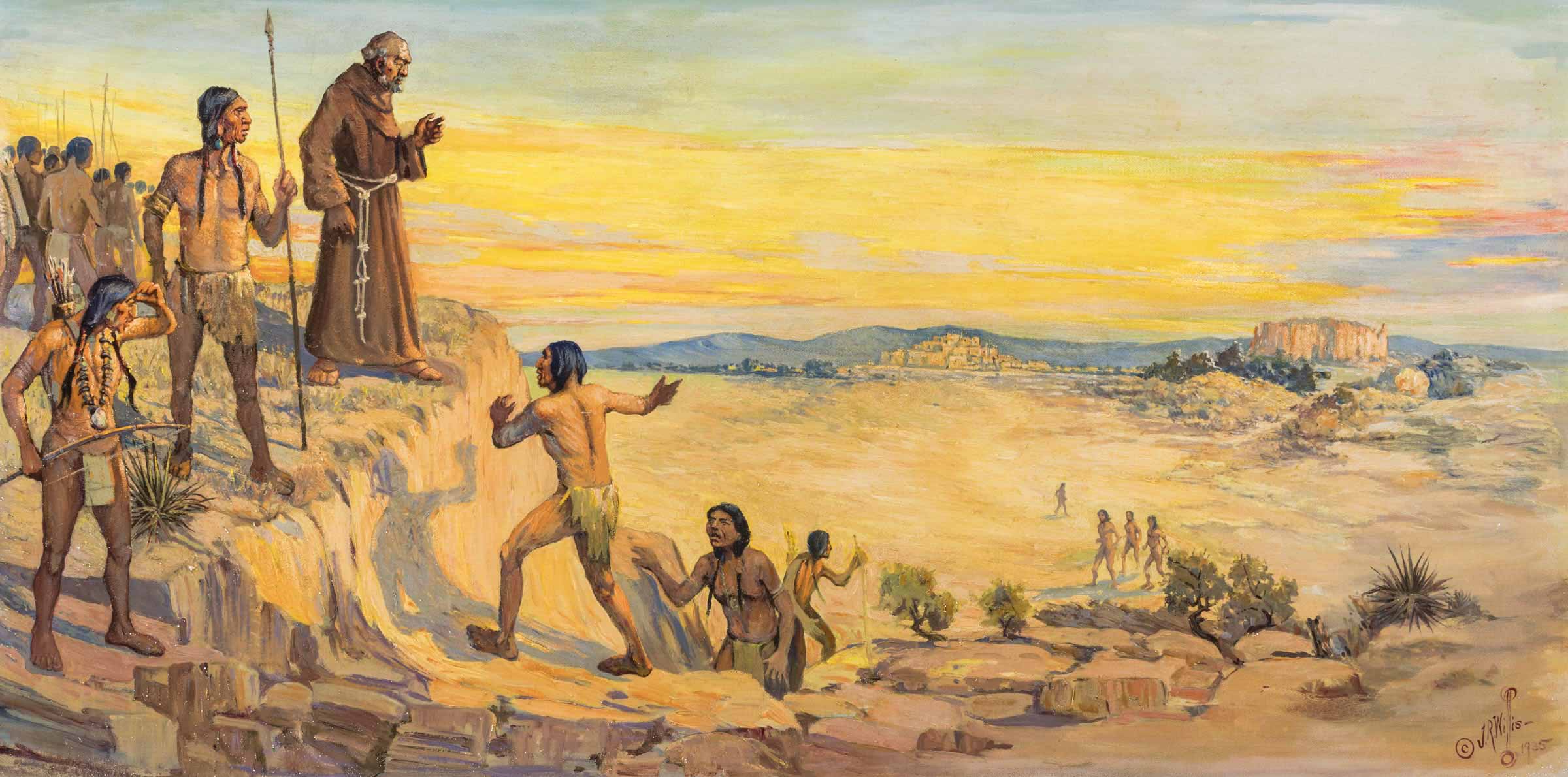
Untitled (Fray Marcos de Niza Sees Zuni)

This is the third in a seven-part series of Southwestern history murals that the Gallup public schools commissioned J. R. Willis to paint through the Public Works of Art Project between 1935 and 1936—and that still hang in the Gallup High School library.

Here, Willis fictionalizes the story of Fray (Friar) Marcos de Niza’s sighting of the Pueblo of Zuni (an event fictionalized in much the same way by Niza himself). Sent to find the rumored “Seven Golden Cities of Cibola” in what is now northwest New Mexico in the late 1530s, Niza declined to do more than glance at the Pueblo of Zuni from a distance after he was told that his advance scout (Estebanico, an enslaved Black Moroccan who had previously been part of the Cabeza de Vaca expedition) had been killed by its residents. His report of a large city full of riches, however, spurred Francisco Vásquez de Coronado’s expedition in 1540.

The image of Niza being welcomed with open arms into the Pueblo is a fabrication, a Eurocentric historical rewrite that denies issues of conflict and conquest. Likewise, Willis portrays A:Shiwi (Zuni) people in a primitivist and entirely inaccurate way, wearing loincloths and carrying spears and bows and arrows. This depiction serves the dominant narrative of the supremacy and inevitability of European “civilization” used to obscure and justify the violent policies and practices of colonization.

Untitled (The Journey of Cabeza de Vaca)

This is the second in a seven-part series of Southwestern history murals that the Gallup public schools commissioned J. R. Willis to paint through the Public Works of Art Project between 1935 and 1936—and that still hang in the Gallup High School library.

Here, Willis portrays Spanish “explorer” Álvar Núñez Cabeza de Vaca, who spent eight years between 1528 and 1536 traveling along the Gulf of Mexico coast from present-day Florida to present-day Texas as part of a group of only four survivors of the ill-fated Pánfilo de Narváez expedition (the group included Estebanico, an enslaved Black Moroccan, pictured at far left). The group survived with help from the Native American peoples they encountered.

In his mural series, Willis relates Southwest history from a Eurocentric perspective. Despite his haggard appearance, Cabeza de Vaca is a commanding presence in Willis’s mural. His figure forms the apex of a triangular composition and is almost spotlit by the setting sun as he takes a confident, purposeful step forward.

Untitled (Map of the Western Hemisphere)

Between 1935 and 1936, J. R. Willis was commissioned by the Gallup public schools, through the Public Works of Art Project, to create a seven-part mural series on Southwest history (which still hangs in the Gallup High School library). Willis’s murals depict major events of Spanish and American colonization of what is now the United States from a Eurocentric perspective.

This mural begins the series and sets the stage for the history presented with an inaccurate and biased map of Spanish exploration of Central and North America in the 1400s and 1500s. The map conflates and drastically oversimplifies the political geographies of Central and South America and Africa. The same is true of the travel routes of Christopher Columbus (1492–1502), Álvar Núñez Cabeza de Vaca (1527–1536), and Francisco Vásquez de Coronado (1540–1542), with a few curious “loop the loops” thrown in. Cabeza de Vaca and Vásquez de Coronado feature prominently in the mural series.

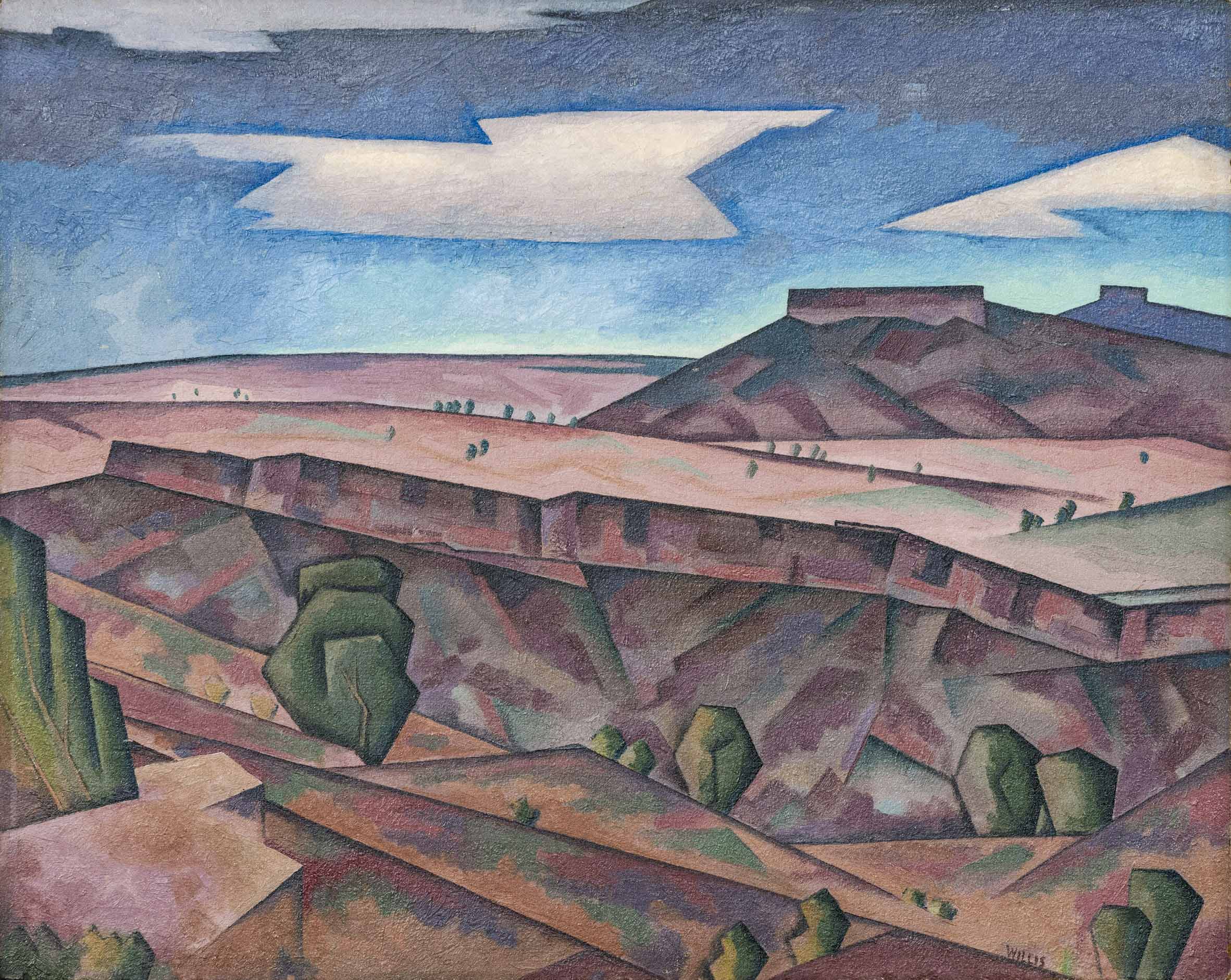
Desert

In the 1930s and 1940s, painter Brooks Willis developed a reputation as an “extreme modernist.”1 The clean lines, hard edges, and sharp angles of Desert certainly live up to this reputation. Yet the soft glow of twilight on the horizon and gradation of light to dark blue in the sky softens the painting’s strict geometry and gives it a more naturalistic ambiance.

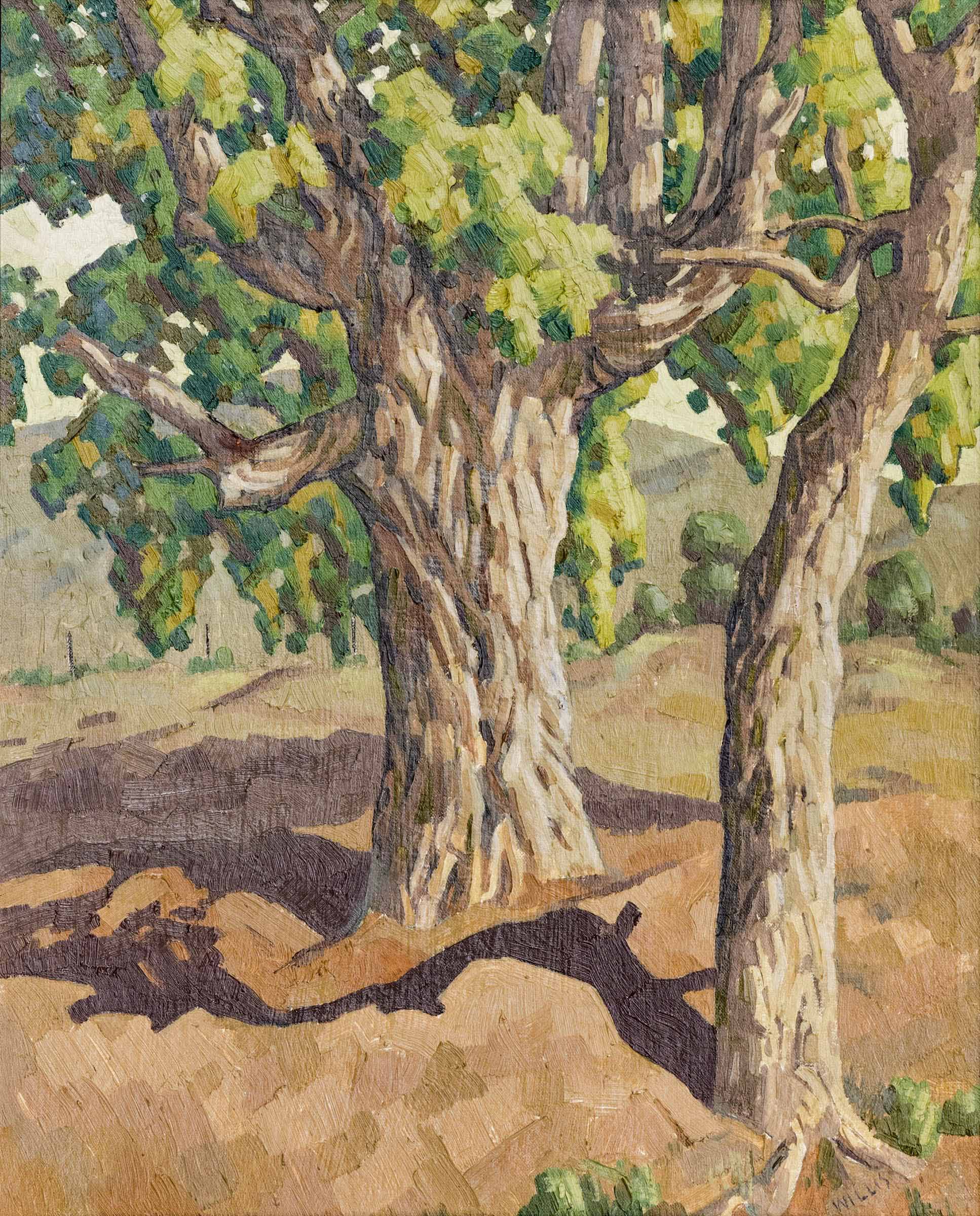
Comparing Desert to Willis’s painting Cottonwoods, made in the same year, reveals how the artist experimented with ideas of modernism. However abstract Desert is in its geometrical composition, it retains much of traditional European painting’s emphasis on depth and perspective. Cottonwoods, however, with its visible brushstrokes and high level of attention paid to the act of applying paint to canvas, rather than to developing an illusion of depth, might actually post a greater challenge to tradition.

Cottonwoods

Cottonwoods is a deceptively simple painting by an artist known in his day as an “extreme modernist.”1 Each individual brushstroke is legible: sunlit trees take form through the masterful placement of light and dark tones side by side in either short, stubby strokes or long, narrow strokes, which gracefully develop a sense of texture.

How Cottonwoods is unapologetically “modern” (by 20th-century standards) is fully understood in comparison to Brooks Willis’s painting Desert, made the same year. Desert takes the more immediately “modern” approach of abstraction, reducing its subject to geometric shapes. Cottonwoods, however, operates not on the level of style but on the level of technique, distilling the very concept of a painting to its most basic materials and methods.

What are you looking for?

Art Collection

Gallup’s New Deal art collection consists of over 120 objects created, purchased, or donated from 1933 to 1942 through New Deal federal art programs administered by President Franklin D. Roosevelt to support artists during the Great Depression.

Main Menu

Image Use Notice: Images of Gallup’s New Deal artworks are available to be used for educational purposes only. Non-collection images are subject to specific restrictions and identified by a © icon. Hover over the icon for copyright info. Read more