


Shalako, which depicts an annual A:shiwi (Zuni) winter festival, is an action-packed, tremendously detailed painting. In it, Jose Rey Toledo captures everything from the central dancers’ movements and regalia to the backdrop with supreme precision. Notice the fine lines delineating each individual bead on the dancers’ necklaces, how headdress feathers have been colored one by one, and how the artist renders the fringe of the woven sashes worn by the two dancers on the left with pinpoint-size brushstrokes. Behind them, more than two dozen onlookers are individually represented, each with distinct facial features, clothing, and postures. Toledo’s meticulousness even extends to the background, where each element is finely articulated, including the perched owl’s feathers.
Artist Demographic: Native American
Sandpainting-style Wall Painting (Ripener)

Pictured here is a Diné (Navajo) sandpainting-style wall painting depicting a “ripener” (sometimes referred to as a “cornbeetle”). This and an identical wall painting flank the interior door of the main entrance1 to the historic McKinley County Courthouse. Reportedly painted by “a young Navajo painter”2 in 1939, the same year the New Deal building opened, these murals depict an insect that derives from Diné cosmology and is associated with blessings. All of the sixteen sandpainting-style wall paintings decorating the lobby of the courthouse have similar associations with blessings and guardianship, and they are all arranged in pairs that flank entrances, lobbies, and passageways in order to protect and grace the space.
Sandpainting-style Wall Painting (Buffalo Person)
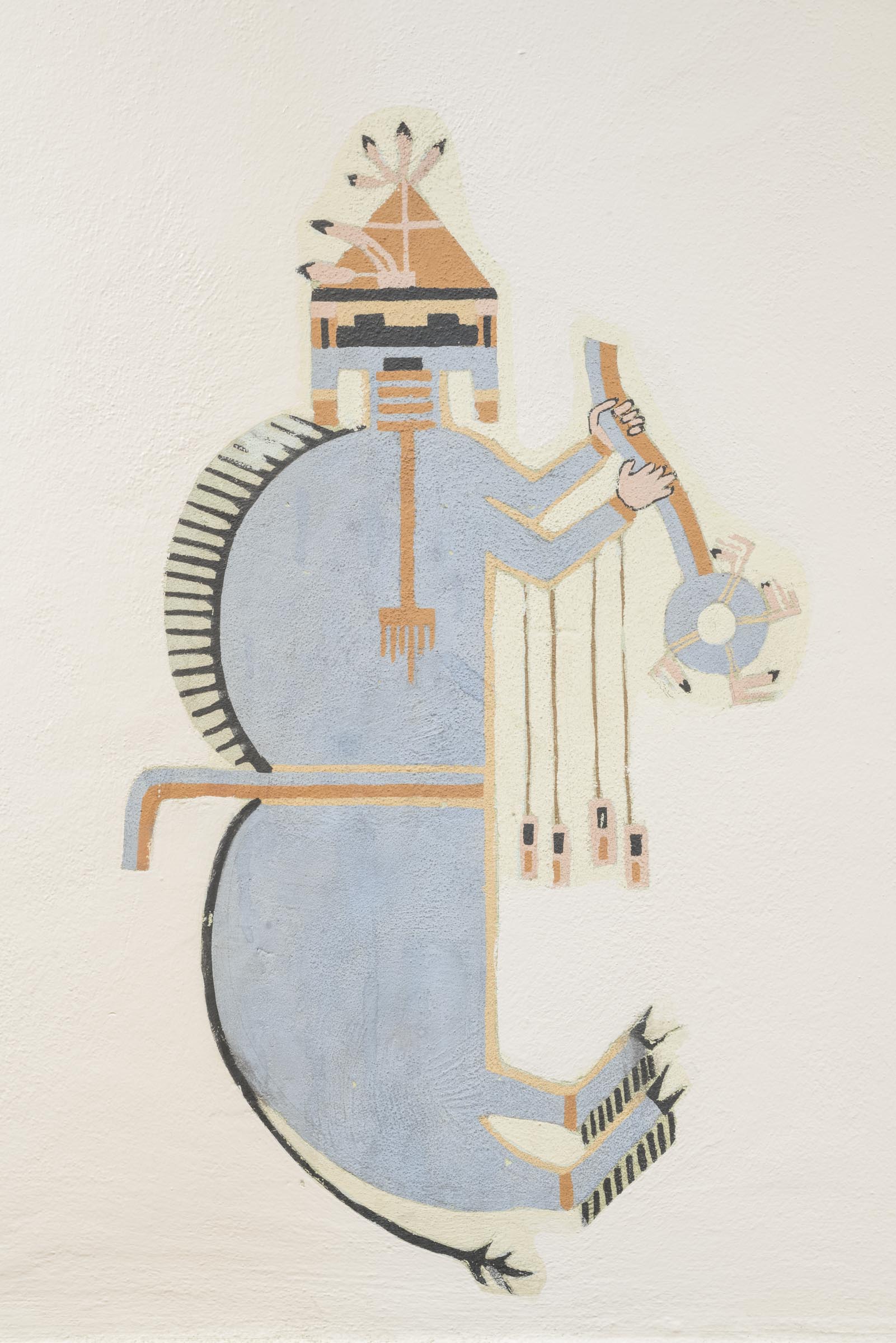
According to a contemporary newspaper report, in July 1939 “state art directors . . . made provision for selection of a young Navajo painter to aid with the murals for the new McKinley county [sic] courthouse”,1 which was a New Deal building that opened that same year. The unidentified artist created a series of sixteen Diné (Navajo) sandpainting-style wall paintings.
This is one of the “buffalo people” paintings—the figure has the body of a buffalo and the head, arms, and hands of a human—that was painted as part of a pair flanking vault doors. Originally, the courthouse’s two vault doors each had a blue figure (as seen here) painted on one side and a yellow figure painted on the other, though one of the blue figures has since been covered over (only three of the four buffalo people paintings remain visible).
Sandpainting-style Wall Painting (Buffalo Person)
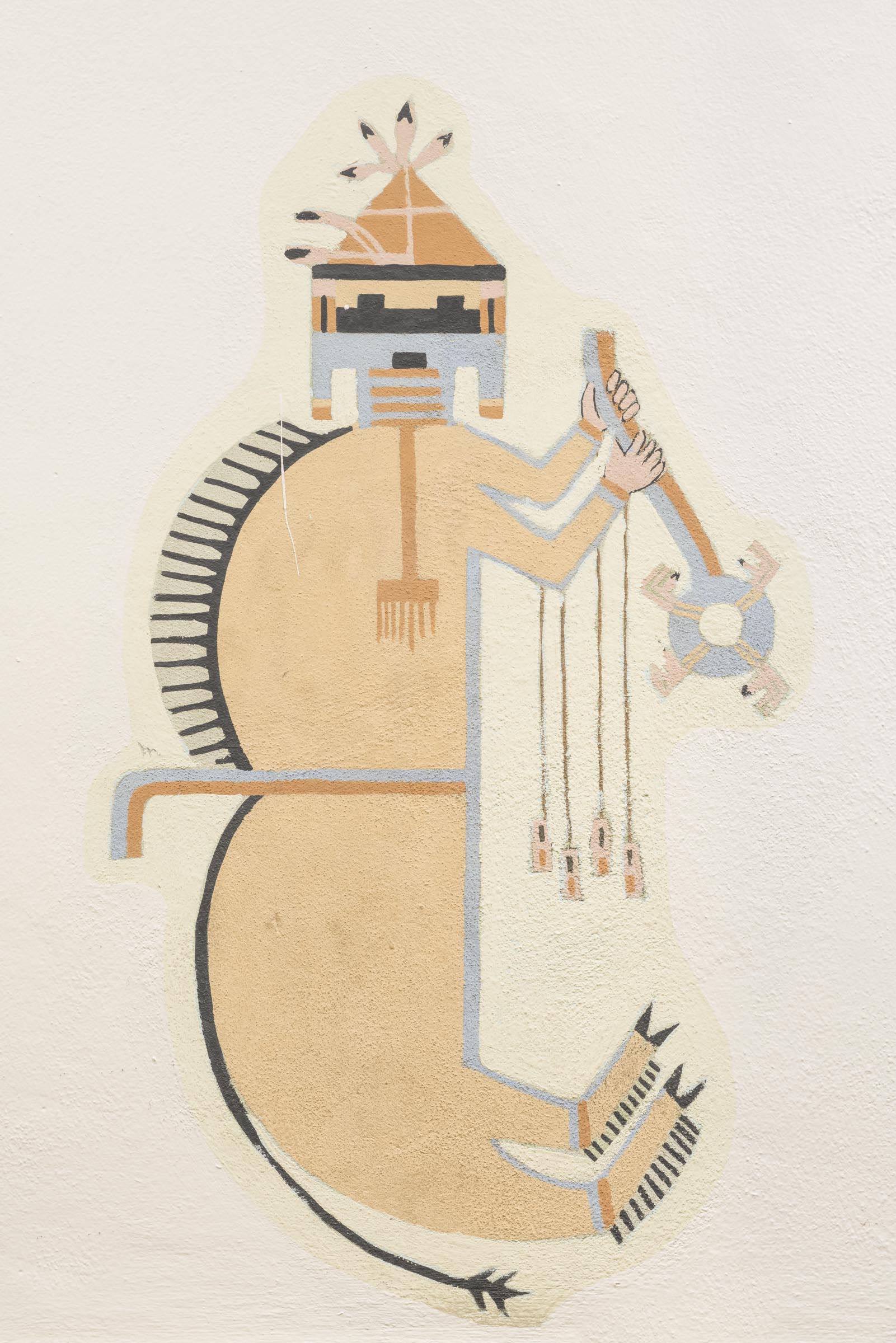
According to a contemporary newspaper report, in July 1939 “state art directors . . . made provision for selection of a young Navajo painter to aid with the murals for the new McKinley county [sic] courthouse”,1 which was a New Deal building that opened that same year. The unidentified artist created a series of sixteen Diné (Navajo) sandpainting-style wall paintings.
This is one of the “buffalo people” paintings—the figure has the body of a buffalo and the head, arms, and hands of a human—that was painted as part of a pair flanking vault doors. Originally, the courthouse’s two vault doors each had a yellow figure (as seen here) painted on one side and a blue figure painted on the other, though one of the blue figures has since been covered over (only three of the four buffalo people paintings remain visible).
Sandpainting-style Wall Painting (Buffalo)
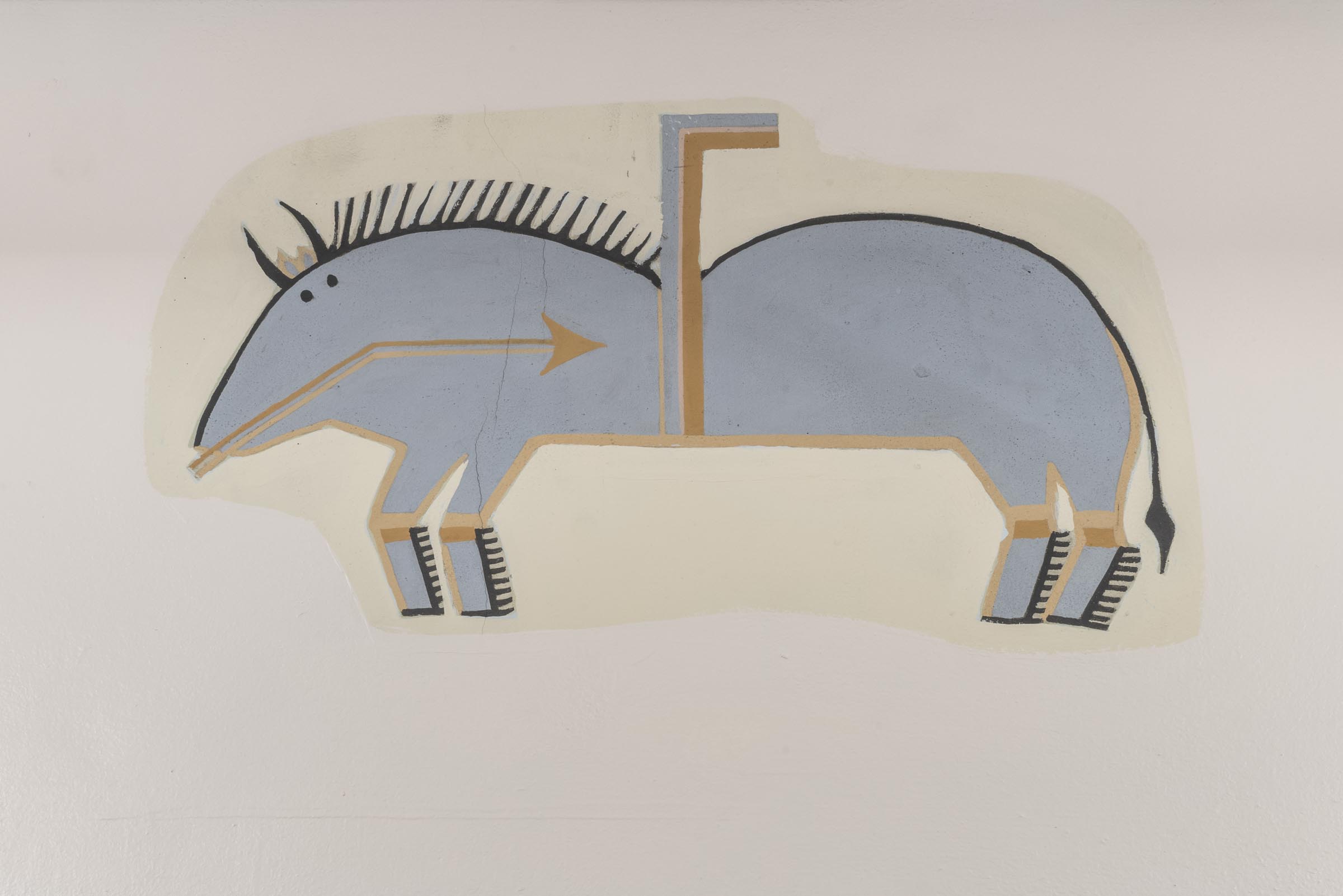
The first-floor lobby of the historic McKinley County Courthouse is decorated “in the round” with sixteen Diné (Navajo) sandpainting-style wall paintings that appear on nearly every wall. The only documentation so far identified for these wall paintings is a July 5, 1939 local newspaper article that states that “state art directors . . . made provision for selection of a young Navajo painter to aid with the murals for the new McKinley county [sic] courthouse” (the courthouse was built through the New Deal and opened in 1939).1
The paintings are organized as pairs and intentionally placed to flank entrances, lobbies, and passageways; most of the designs are traditional symbols of guardianship and blessing. This is an example of one of the buffalo paintings that appears along the lintel of the entrance to the rear staircase. While only three of the four original buffalo paintings have survived, they were originally depicted in sets of two, each with one blue (as seen here) and one yellow buffalo, and painted on either side of the passageway.
Sandpainting-style Wall Painting (Buffalo)

The first-floor lobby of the historic McKinley County Courthouse is decorated “in the round” with sixteen Diné (Navajo) sandpainting-style wall paintings that appear on nearly every wall. The only documentation so far identified for these wall paintings is a July 5, 1939 local newspaper article that states that “state art directors . . . made provision for selection of a young Navajo painter to aid with the murals for the new McKinley county [sic] courthouse” (the courthouse was built through the New Deal and opened in 1939).1
The paintings are organized as pairs and intentionally placed to flank entrances, lobbies, and passageways; most of the designs are traditional symbols of guardianship and blessing. This is an example of one of the buffalo paintings that appears along the lintel of the entrance to the rear staircase. While only three of the four original buffalo paintings have survived, they were originally depicted in sets of two, each with one yellow (as seen here) and one blue buffalo, painted on either side of the passageway.
Sandpainting-style Wall Painting (Sun)

This Diné (Navajo) sandpainting-style wall painting is the counterpart to one painted on the wall opposite in the rear lobby of the first floor the New Deal McKinley County Courthouse in 1939, reportedly by “a young Navajo painter.”1 (These sandpainting-style wall paintings are two of sixteen total such decorations.) This design is perhaps an iteration of the customary Diné sandpainting symbol representing the sun, while its companion painting likely represents the moon. Unlike its companion, however, it was partially removed when an elevator was installed in the building and an arched doorway created to provide access, and is now missing its left portion.
Sandpainting-style Wall Painting (Moon)
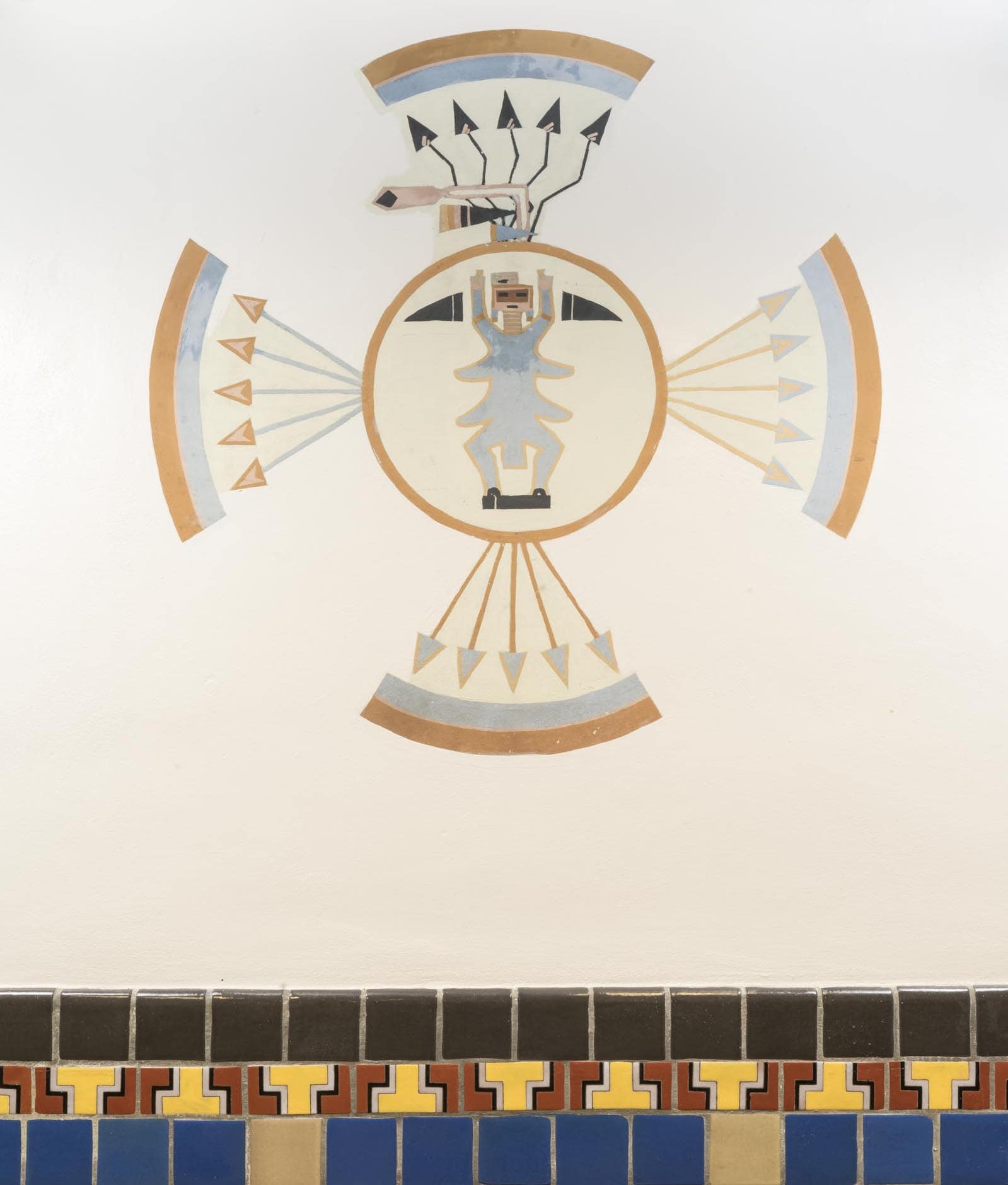
This Diné (Navajo) sandpainting-style wall painting is one of sixteen such murals reportedly painted by “a young Navajo painter”1 in 1939 to decorate the first-floor lobby of the historic McKinley County Courthouse, which was built through the New Deal and opened that same year. It is part of a set of two, as almost all of the courthouse wall paintings are. Its counterpart was painted directly across on the opposite wall. This design is perhaps an iteration of the customary Diné sandpainting symbol representing the moon, while its companion piece likely represents the sun. Unlike its counterpart, however, this painting is still largely intact—look closely to see how efforts have been made to preserve it over time by painting around it (the original wall color appears light green).
Sandpainting-style Wall Painting (Thunder Being)
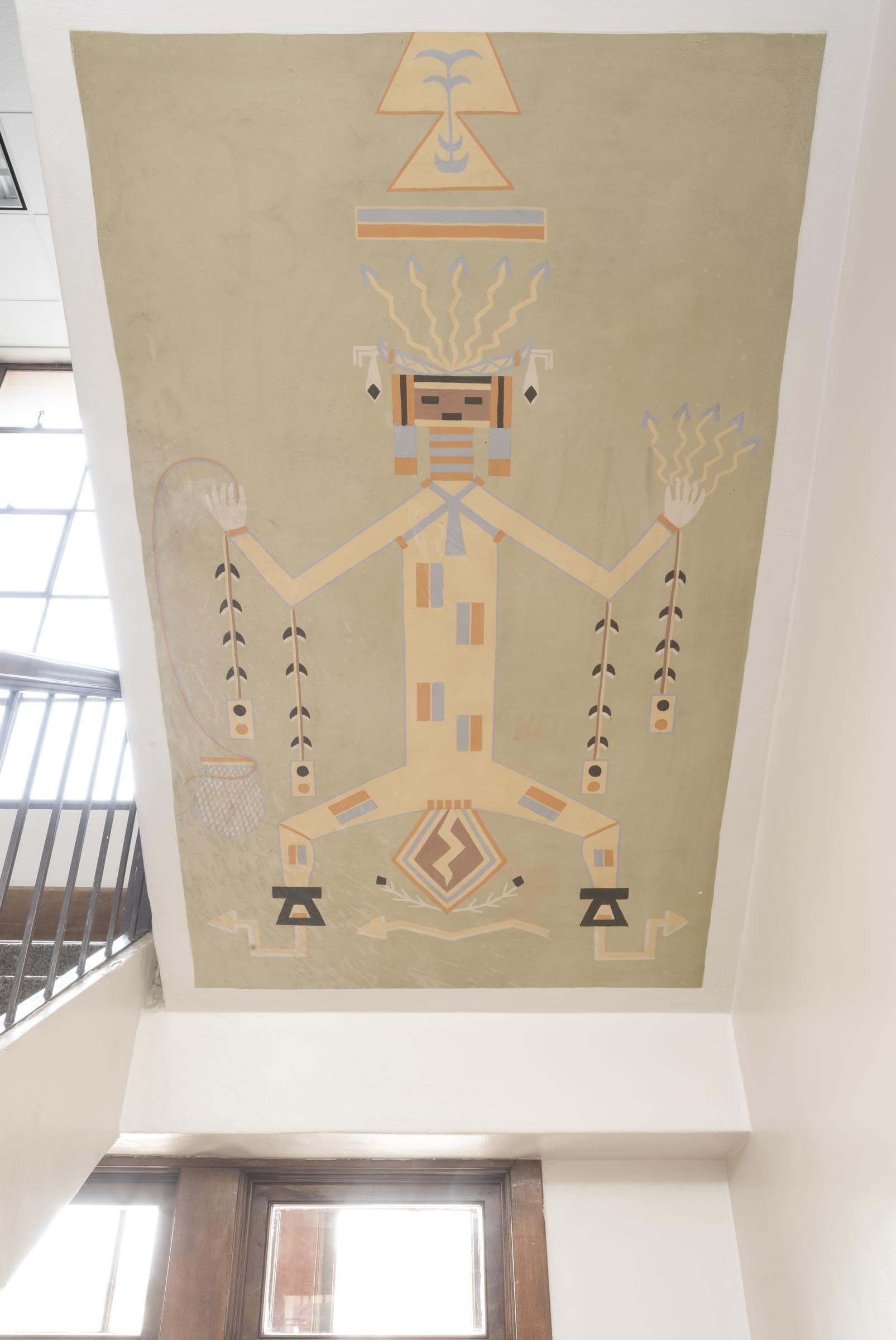
In 1939, according to a newspaper report, “state art directors . . . made provision for selection of a young Navajo painter to aid with the murals for the new McKinley county [sic] courthouse”1 (the now-historic McKinley County Courthouse was built with New Deal funding and opened in 1939). The same article explains that the plan was for “the Navajo painter [to] aid in a sandpainting reproduction on the ceiling of the entrance hall.” The wall painting seen here most closely fits that specific description. It is painted on the ceiling under the second-floor staircase in the building’s back entryway. Because the stairway divides into two at the landing, there is an identical painting on the ceiling across the stairwell.2 The artist created sandpainting pairs throughout the entire first floor, paying particular attention to flanking entrances, lobbies, and passageways with matching sandpainting designs in order, it seems, to bestow the space with protection and blessings.
The design seen here is likely an anthropomorphized “thunder being.” It is generally understood that the zigzag arrows emanating from the head and left hand of the figure represent the sound and reverberation of thunder, while its feet represent storm clouds emitting lighting.
Sandpainting-style Wall Painting (Half Circle)
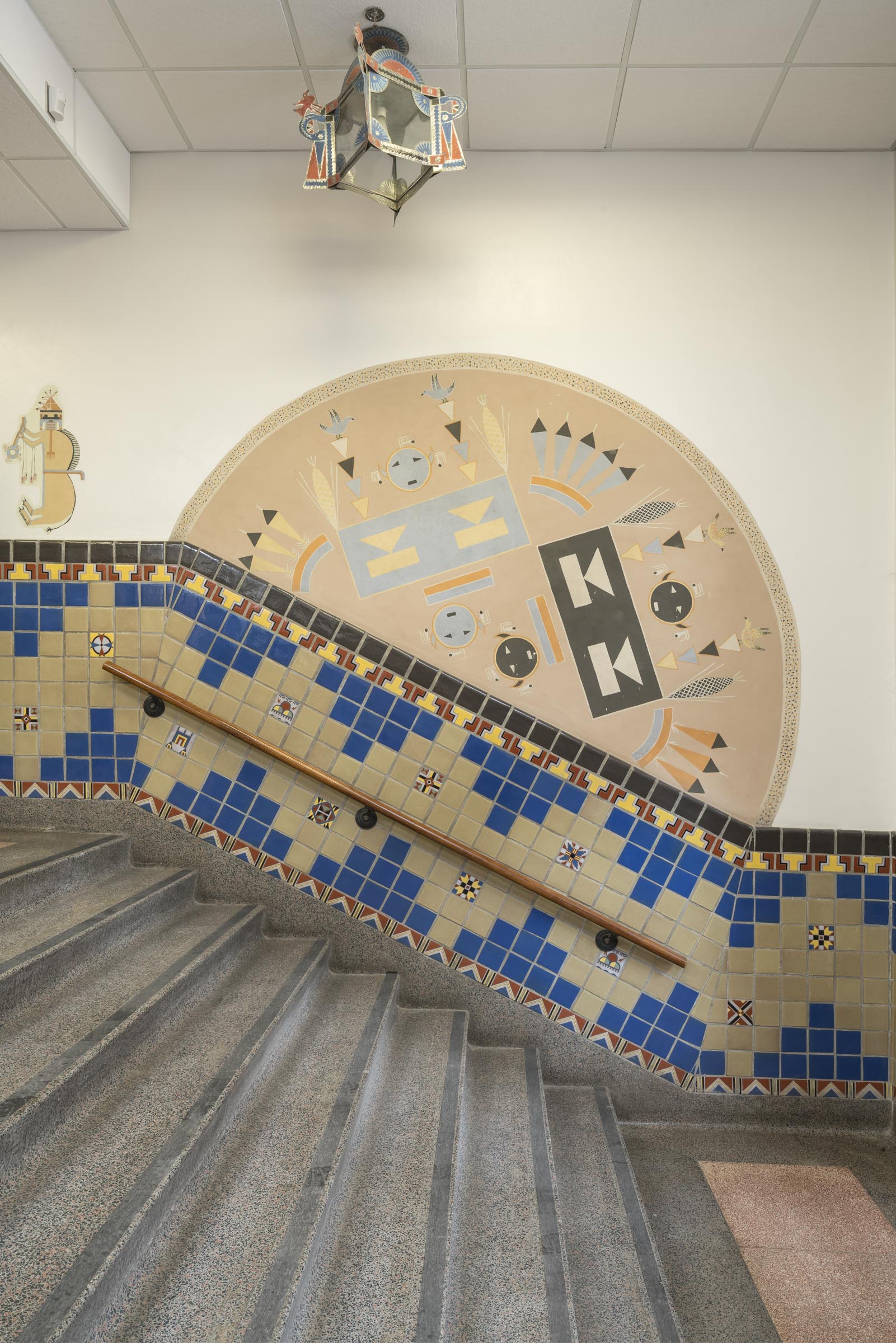
This Diné (Navajo) sandpainting-style wall painting is one of sixteen such murals decorating the first-floor lobby of the historic McKinley County Courthouse. It was reportedly painted by “a young Navajo painter”1 in 1939, the year the New Deal building opened. It is the companion piece to a semicircular mural painted on the wall opposite it (the murals are painted on either side of the building’s entryway staircase). Together, the two murals form a circular composition that references the four cardinal directions, represented by the circles and rectangles colored blue and black (seen here) and yellow and white (seen in the companion piece), which are sacred to the Diné people because the Diné homeland is delineated by northern, southern, eastern, and western mountains (as seen in the Navajo Nation flag).
It is not only this mural and its counterpart that are painted in pairs. Throughout the entire first floor of the courthouse, sandpainting-style wall paintings are composed in sets. Moreover, the artist intentionally placed sandpainting designs and figures so that they flank entrances, lobbies, and passageways, with most symbolically communicating messages of guardianship and blessing. Here, the semicircular mural includes four songbirds, perhaps bluebirds and orioles, which traditionally symbolize good fortune (generally speaking). In this manner, the artist wrapped the entire space in a protective embrace.