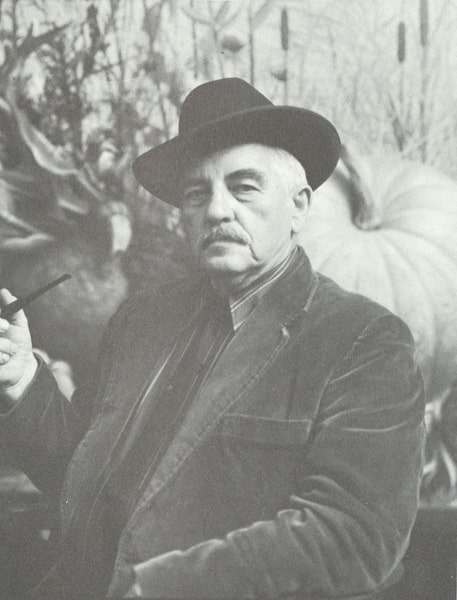
Helmuth Naumer, Sr.

Born and raised in Germany in the heart of the Black Forest, Helmuth Naumer, Sr. dreamed of the American West he knew from “cowboy and Indian” novels by German author Karl May. In 1925, at the age of eighteen, he left for New York. As a naturalized citizen, he spent the next year traveling across America, stopping briefly in Santa Fe, NM before reaching Los Angeles, CA in 1926. Low on funds but still consumed by wanderlust, he joined the Merchant Marine and served at sea for six years. In 1932, he moved to Santa Fe, the town that in his view epitomized the “Old West.” Naumer said he “wanted to make a record of this country before it was overrun, still wild and beautiful because once that’s gone, we can never get it back.” Naumer built a home and studio on San Sebastian Ranch and raised horses. 

Naumer quickly became known for his pastels on black paper. “Pastels are particularly suited for painting Western landscapes,” Naumer said. “Their soft tones match those of the distant mountain ranges and accentuate the delicate shades of our sunsets.”1

Between 1935 and 1936, Naumer was commissioned by the National Parks Service, through the Works Progress Administration, to create artwork for the newly built visitor center at Bandelier National Monument. Naumer said he was paid $45 per month2 to create fourteen pastel scenes depicting views of the Monument and nearby Pueblo villages (still on display at the Monument’s visitor center). For these paintings, the artist spent time living at Kewa (Santo Domingo) Pueblo.3 In 2016, the US Postal Service used Naumer’s painting Administration Building, Frijoles Canyon on a “Forever” stamp as part of a sixteen-piece set commemorating the National Parks Service’s centennial. 

Of his experience as an artist in New Mexico during the New Deal, Naumer said: “It was difficult being an artist here, especially during the Depression when nobody had any money. To get along you had to trade pictures for necessities. I traded for furniture, for cars, for horses and goats.”4

Naumer continued as a prolific pastelist, though he also worked in oils and watercolors over the course of his career. In the late 1930s, he was traveling 1,500 miles each month across the state to paint en plein air (outdoors). “I can’t explain it, but paintings made at the scene sell better than those made in a studio of some imagined landscape,” he said. “Perhaps it’s some detail or shading at the actual scene that would be omitted from a studio painting.”5 He won prizes at the New Mexico State Fair each year he exhibited between 1939 and 1955, and his contemporaries excitedly noted that magazine magnate Henry Luce was one of his collectors. 

In 1938, a newspaper columnist asked Naumer about Hitler’s rise to power. According to the writer, “Naumer’s merry grey eyes instantly became serious and he said: ‘It will probably be two or three years from now—perhaps sooner—but someday things are going to pop wide open in Europe and it will be the worst war this hectic world has ever experienced.’”6 Naumer went on to serve as a staff artist in the Army during WWII. After returning home, Naumer continued to paint and exhibit, and his work became increasingly abstract. 

Describing his career in a 1959 pamphlet, he said that “though born in Europe and having lived in many places in the world, coming to the Southwest was like coming home. Here I found peace and beauty and these I try to paint.”7
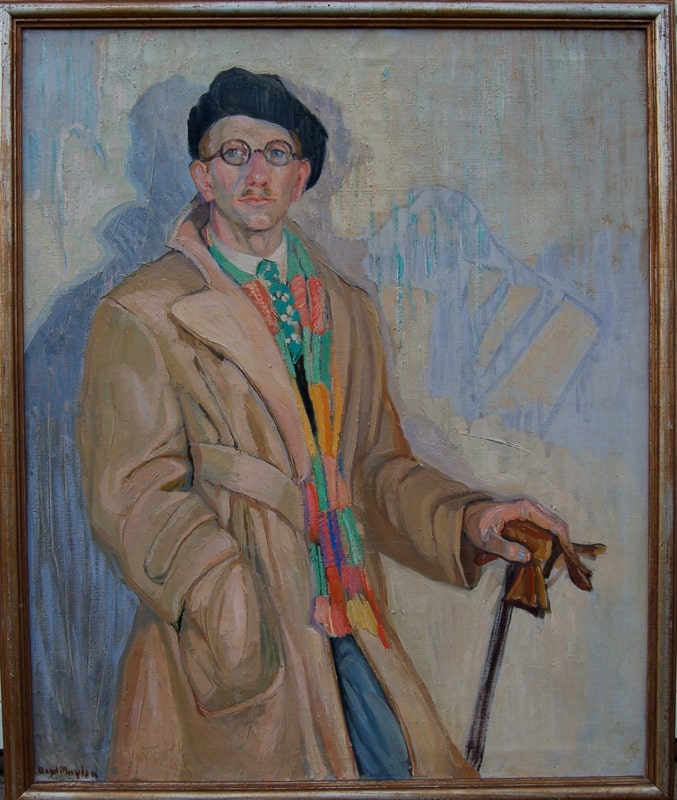
Lloyd Moylan

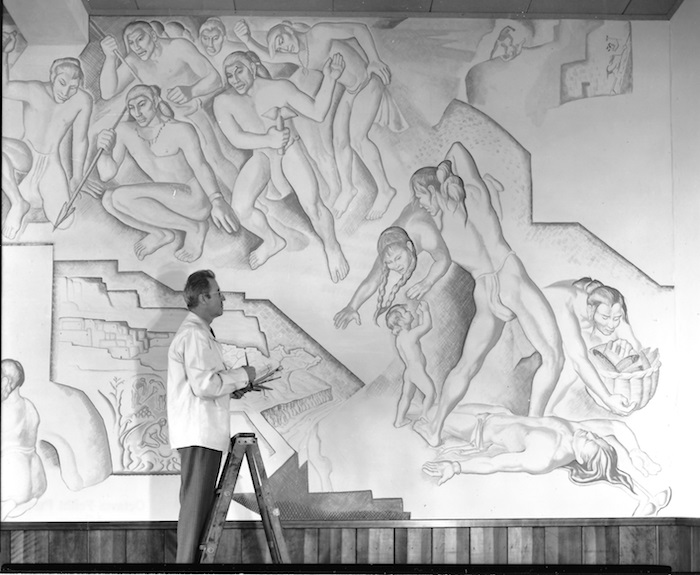
Lloyd Moylan was a very productive New Deal artist. Indeed, he is the best-represented artist in Gallup’s New Deal art collection, which holds nineteen of his easel paintings and prints and one of his largest mural commissions (2,000 square feet)

Moylan first trained in his hometown at the Minneapolis Art Institute before continuing his studies at The Art Students League in New York City. A teaching position at the Broadmoor Art Academy brought him west to Colorado Springs, CO, in 1920. Moylan’s interest in mural painting developed during this time as the result of several trips to Mexico—the Mexican mural movement began in the early 1920s. 

Moylan completed several private mural commissions in Colorado Springs, including for the Antlers Hotel, which involved research travel to Taos, NM. Those visits inspired his move to New Mexico in 1934, where he set up a studio in Alcalde along with D. Paul Jones, who studied at the Broadmoor. In New Mexico, Moylan continued creating murals on a commission basis, for the Ute Theatre (since demolished) for example, but mainly now through the state’s Federal Art Project (FAP). The New Mexico FAP  hired Moylan for large-scale murals at Eastern New Mexico University in Portales and Highlands University in Las Vegas (see “Additional Federal Art Projects” section below) in addition to McKinley County’s historic courthouse in Gallup. As a result of his participation in the New Deal, Moylan became a big believer in the value of public art and murals in particular. In an essay for the Federal Art Project, he wrote that public art “will bring to the surface much that is growth-provoking in the spirit of humanity.”1 

At the conclusion of the New Deal, Mary C. Wheelwright hired Moylan as the first administrator/curator of the Museum of Navajo Ceremonial Art, which she founded in 1937 in Santa Fe (and which is now known as the Wheelwright Museum of the American Indian).

Moylan served in that capacity for twelve years, during which time he gained broad recognition as a painter, building on his reputation as a muralist. Moylan was well known by contemporaries as a premier watercolorist, “cherished modernist,”2 and “specialist in Navajo subject matter.”3 He was a popular and frequent gallery and museum exhibitor, with a following of “Moylan enthusiasts.”4 He was an art judge for the State Fair in 1943, and his work was included in defining exhibitions of the era, including the Museum of New Mexico’s Styles in New Mexico Art traveling exhibition in 1946 as well as its 1955 traveling exhibition Santa Fe Art 1917–1955.

Wheelwright dismissed Moylan from his post in 1954, after which his career diminished. Moylan spent the last decade of his life between California and New Mexico.

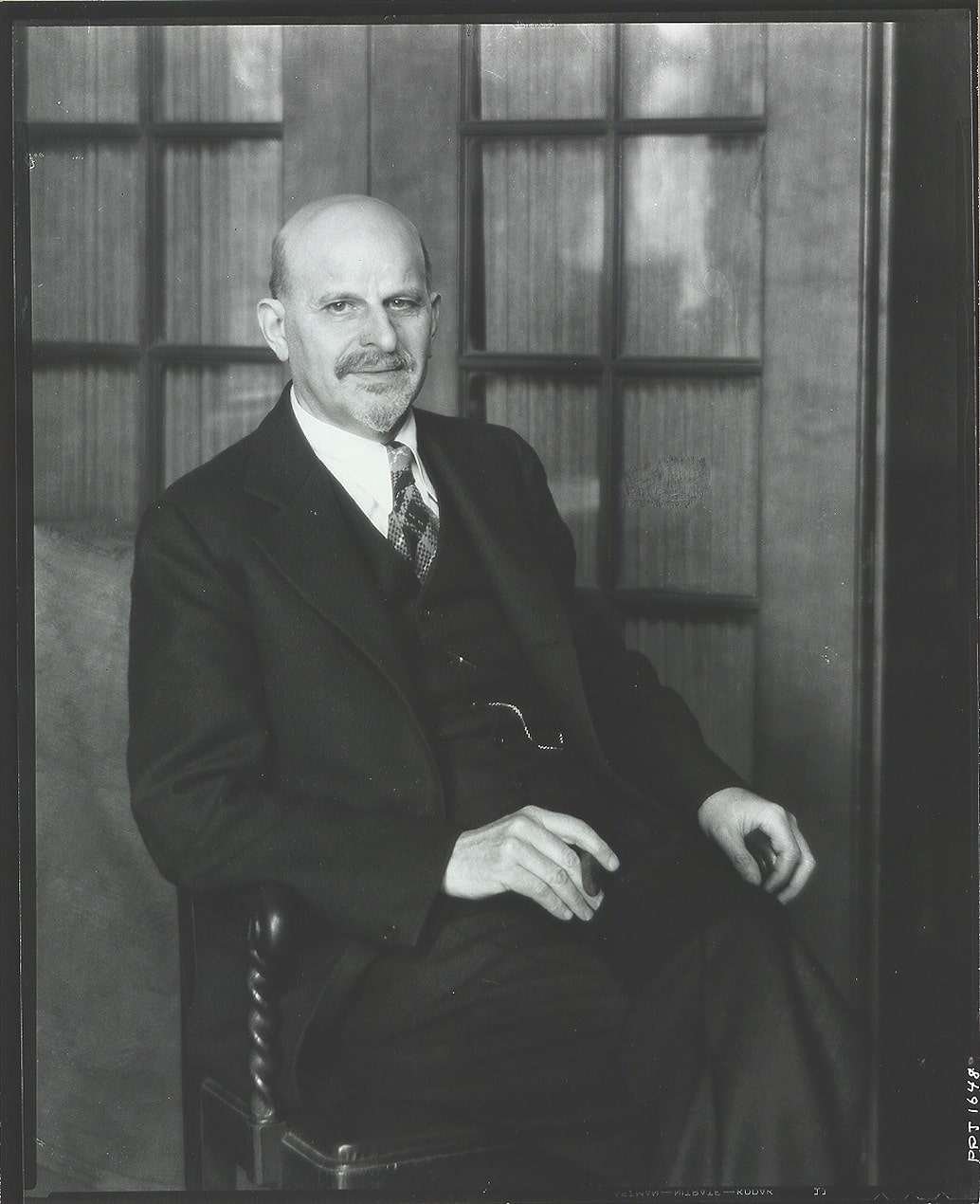
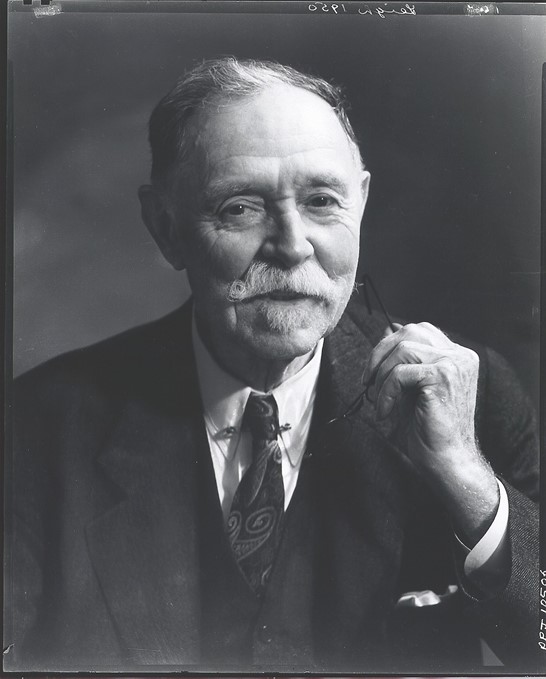
William Robinson Leigh

William Robinson Leigh’s long and impressive career is woven together by the twin threads of adventure and storytelling. Leigh decided on a career in art early. He enrolled in classes at the Maryland Institute (the country’s second oldest art school) at the age of fourteen and studied there for three years before leaving for the Royal Academy in Munich, where he spent over a decade. 

Upon his return to the United States from Germany in 1895, Leigh lived and worked in New York City, where he made a reputation as a book and magazine illustrator, creating images of everything from metropolitan to Martian life. Leigh’s sense of adventure also played out in an immersive cyclorama painting 115 yards in circumference and 15 yards in height.1 In 1906, he seized the opportunity of a trip west offered by the Santa Fe Railroad in exchange for a painting of the Grand Canyon. Leigh completed this commission and five other paintings, and the rest, as they say, is history. He would go on to become one of the country’s most famous Western American painters, earning numerous accolades by the end of his career.   

Leigh once offered this bit of advice to budding artists: “What you paint is more important than how you paint.”3 He lived by his words. For fifty years, Leigh traveled dozens of  times between New York and Arizona, New Mexico, and the mountain West, making hundreds of paintings of the landscape and people. Images of Native Americans feature prominently in his oeuvre—he painted Navajo and Hopi people every summer between 1912 and 1926.

It is also true that Leigh’s paintings captured the nation’s attention for their style in addition to their subject matter. By the 1950s, he had been dubbed “America’s Sagebrush Rembrandt,” admired for his detailed draftsmanship, use of color, and attention to the changing Southwest light. 

His apparent wanderlust and skill also twice took him to Africa on expeditions in 1926 and 1928 with the American Museum of Natural History, for which he painted animals and exhibit backgrounds. Over the course of his career, Leigh wrote and illustrated several books on his travels, including Frontiers of Enchantment: An Artist’s Adventures in Africa and The Western Pony.

Paul Valentine Lantz

Paul Lantz’s art career was fast and furious, at least for the first part. He enrolled at the Kansas City Art Institute at the age of fifteen,1 reportedly the youngest student ever enrolled. Two years later, Lantz moved to New York City and worked as a dishwasher to fund his studies at the Art Students League. One version of the story is that after four years, the stock market crash prompted him to board a freight train to Santa Fe. Another version, recorded in Town & Country magazine, is that he hopped a boxcar to the Southwest after he “too enthusiastically” witnessed a Communist meeting in Union Square.2 In any event, he made his way to New Mexico, his connection to the state being that of Taos Society of Artists member Randall Davey, who had been his teacher in Kansas City. Davey would continue to mentor Lantz and help to facilitate his career for the next decade. 

Lantz lived and painted in Santa Fe and Albuquerque from 1930 to 1939, and in that time left a lasting mark. Lantz’s career operated on two parallel tracks. His living was mostly made as a commercial artist, creating murals and embellishing furniture for La Fonda Hotel, fulfilling portrait commissions, restoring church frescoes, and painting the “Toyland” set for the town of Madrid’s famous Christmas display. At the same time, he pursued his career as a “fine” artist. In 1933, he helped found the Rio Grande Painters, a modernist artist society that successfully organized shows across the state for several years. 

During the New Deal, Lantz was first employed by the Public Works of Art Project as an easel painter. He made landscapes and scenes of Cabeza de Vaca’s exploits to hang in government buildings. Lantz was later employed by the Federal Art Project and in this capacity painted a mural for the Clovis Post Office between 1937 and 1938. Though he made a research trip to Clovis to prepare for the project, the subject matter of which was the history of Clovis, Lantz’s mural was criticized by locals for its lack of accuracy. “Old timers [attacked] it . . .  saying that some of the buildings are in the wrong places and that a water trough, a conspicuous object on the street in the early days, has been omitted entirely from the picture. Others have attacked the appearance of a horse in the mural,” saying that it looked like it only had  three legs. The Clovis News-Journal pointed out that “the animal’s position indicates that the [horse] is single-footing—something a cowboy would not tolerate.”3 Despite such thorough scrutiny, in 1939 Lantz’s art was chosen to represent New Mexico at both the New York World’s Fair and the Golden Gate International Exposition in San Francisco. 

In 1940, to fund a trip to New York City for a show of his work in a Park Avenue gallery, Lantz incorporated himself and sold fifty shares for $10 each in “Paul Lantz Inc.”4 It is unclear if this enterprising move paid off. From New York, Lantz sent a painting back to Santa Fe to be sold at the Museum of New Mexico Art Gallery for $500, with the proceeds going to his shareholders as “dividends.”  Lantz’s business ventures ultimately led to his divorce, and in a 1942 court filing, his wife declared the couple “broke.”5

The second half of Lantz’s career involved travel and mostly commercial artistic production. Lantz served as an artist in the Army during World War II and moved to California afterward. He then spent a decade on a farm in upstate New York and a few years in Mexico City. During this time, he worked as a book illustrator, illustrating more than twenty-five books including the 1942 Newberry Medal winner The Matchlock Gun by Walter D. Edmonds and Little Navajo Bluebird by Ann Nolan Clark. Once he decided to start painting “seriously” again, it was only a few years before he returned to Santa Fe permanently in 1973.

In a 1976 Southwestern Art article, Lantz’s contemporary John Jellico characterized him as a “Modern Old Master,” noting the color, dynamism and “fine pattern of movement” within his work.6

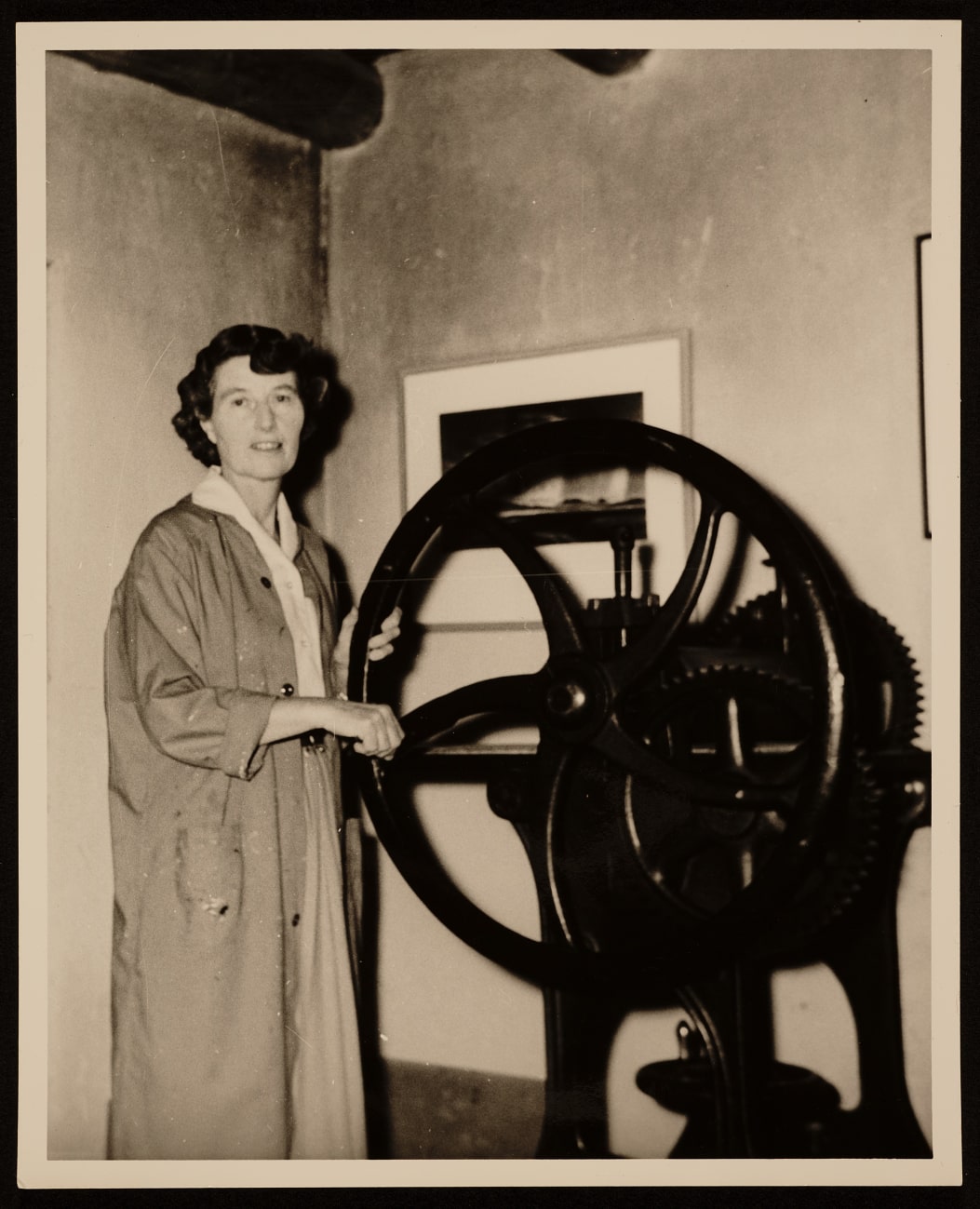
Gene Kloss (Alice Geneva Glasier Kloss)

Born Alice Geneva Glasier, Gene Kloss was already a highly respected California printmaker when she made her first trip to Taos, NM, for her honeymoon with her husband, musician and poet Phillips Kloss, in 1925. She brought her etching press on that trip and made prints from their campsite in Taos Canyon. “We bought a sack of concrete and set it up on a stump in the woods and I printed my plates there,” she explained. Kloss would later claim that she was “a New Mexican from then on.”1 She would spend the next twenty years traveling between California and New Mexico before settling permanently in Taos. 

The New Deal allowed Kloss to continue to succeed as an artist. “[The New Deal] was a very pronounced help to me in my career because the government subsidy alone gave it dignity and importance,” she said in a 1964 interview, continuing, “and their . . . attitudes towards the artist in their free expression and pulling the most out of one to do your best technically, and the amount, and the result of speeding you on your way in your creative work.”2

First, for the Public Works of Art Project, Kloss created a print series of nine New Mexico scenes that were reproduced and distributed to public schools across the state. She was then employed by the Federal Art Project to create etchings, oils, and watercolors. “They went to galleries, museums. Lots of them went to Washington for the offices,” Kloss recalled. Kloss won the Eyre gold medal at the 1936 exhibition of the Pennsylvania Academy of the Fine Arts, and in the two decades following the New Deal, her work was collected by many of the country’s major museums. Her paintings explored the landscapes, cultures, and people of New Mexico, and she appreciated the New Deal’s emphasis on regionalism. “I think it [the New Deal] stimulated an interest in art. Because people in outlying places who had never seen anything had murals in their post office and received some of the easel pictures or prints to hang in their schools and their public buildings. I think it is one thing that started the public interest in art.”3

D. Paul Jones

Not much is known about D. Paul Jones, who appears to have been an introverted artist. While his murals and paintings have survived in New Deal art collections across New Mexico, from Raton to Clayton to Santa Fe to Socorro, the artist’s life, it seems, was lived mostly off the record. Kathy Flynn, self-titled “lead detective” for New Deal art in New Mexico, paints Jones as a restless outsider, perhaps traumatized by military service in France during World War I, writing, “After the war, he took himself to Phoenix and worked in a bank but needed more solitude, nature and art, so he bought some art supplies and food and went into the wild of the Hopi and Navajo country. He learned all about these people, their country and customs and was given [a] Navajo name [meaning Little Dog] because of his gift for imitating animal sounds.”1 

Jones reportedly went on to study at the Broadmoor Art Academy in Colorado Springs, where he met Lloyd Moylan, eventually moving with Moylan in the early 1930s to Alcade, NM, where they shared a studio.

Available records indicate that the New Deal was the most active time in Jones’s career. His formal introduction to the Santa Fe art scene appears to have been through an exhibition of Federal Art Project (FAP) artists at the Museum of New Mexico,2 followed shortly thereafter by a revealing of his FAP mural, Founding of San Juan, The First Capitol of New Spain completed for the Spanish-American Normal School in El Rito, NM (now a campus of  Northern New Mexico College). Contemporary reviews of Jones’s art were typically mixed. One reviewer of Founding of San Juan admired his landscapes while casting doubt on his figure-drawing abilities.3 Santa Fe artist and art critic Alfred Morang described Jones as tending toward a “gloomy color scale,” yet utilizing contrast effectively.4

Perhaps his failure to gain any real traction under the New Deal is why his career seemingly stalled at its conclusion. Jones continued to operate locally, so to speak, as a beloved Española Valley artist for the remainder of his life.

John A. Jellico

John Jellico was an artist, educator, and writer, with a life and career that spanned several states, industries, and genres. 

Born to Austrian immigrants (his gravestone marker notes that his mother was a passenger on the Carpathia when it rescued Titanic shipwreck survivors), Jellico was raised in northern New Mexico and graduated from Raton High School in Raton, NM. He set his sights on the artistic profession from an early age, and worked diligently to achieve his goal. According to an unpublished biography written by his daughter, Nancy Norris Jellico, “his quest for knowledge about art and artists was insatiable and he was never idle. In high school his teachers discovered his art ability and kept him busy with posters, backdrops for plays, and other school artwork. He sketched and painted constantly.”1

Jellico was also aided in his quest during his high school years by Manville Chapman, a noted artist with ties to Taos, NM, originally from Raton. Chapman immediately recognized Jellico’s talent and exchanged art lessons for modeling work. With Chapman’s help, Jellico was able to start selling paintings, adding those earnings to the savings he was putting away for art school from his summer jobs as a ranch hand. 

After graduating high school in 1934, Jellico immediately enrolled in The Art Institute of Pittsburgh. After his first year, he was awarded a scholarship which enabled him to squeeze his next two years into one by taking both day and evening classes. After graduating in 1936, Jellico pursued another year of study at the Phoenix Institute of Art in New York City, where he trained with top illustrators of the period, including Norman Rockwell. Reportedly, Rockwell criticized Jellico’s drawing of horses, to which Jellico retorted that he had no right to do since Rockwell had never lived in the West. Jellico spent the next five years mainly working as a book illustrator and commercial artist, while also showing and selling at Greenwich Village galleries and continuing his education through night classes at the Grand Central School of Art. 

While living in New York City, Jellico maintained his ties to New Mexico, exhibiting in Raton in at least 1938 and 1941. Additionally, according to his daughter’s biography, he spent the summer of 1937 in New Mexico during which he painted a mural for a church in Raton. Perhaps that is also when he became involved in the state’s federal art programs. In an undated, handwritten note to Kathryn Flynn, author of Public Art and Architecture in New Mexico: 1933-1943, Jellico reported that he produced “a large number of easel paintings” for the WPA (Works Progress Administration). He also describes being hired by the WPA to create twenty-seven ceiling decorations with Juanita Lantz for the Raton Public Library (since demolished).2

In 1942, Jellico enlisted and spent the bulk of his military service working under the Chief of Chaplains of the US Air Force and painting murals for sixty-three Air Force chapels.

At the end of WWII, he was offered a job as an instructor at his alma mater, The Art Institute of Pittsburgh, where he would also become the Assistant Director in three years’ time. With the West calling him home, he moved to Denver, CO, in the mid-1950s to help build the Colorado Institute of Art, leading the school until its sale in 1975 (after which it became the Art Institute of Colorado; now closed). 

While fulfilling his role as art educator and administrator, Jellico also authored several instructional books, including How to Draw Horses for Commercial Art (1946) and textbooks for the International Correspondence Schools of Scranton, became a magazine editor and writer, and co-founded a gallery in Santa Fe in 1969, which prompted him to return full-time to painting and exhibiting.

Anna Vaughn Hyatt Huntington

Anna Hyatt Huntington was the foremost female sculptor of her time, producing everything from small medals to monumental works. Though best known for her equestrian monuments, Huntington launched her career with small animal subjects. Hyatt Huntington’s fascination with animals was formed over many visits to the zoo with her father, a professor of paleontology and zoology at the Massachusetts Institute of Technology. Her animal sculptures are noted for their action, energy, verve, subtlety, and realism. As one critic wrote, “Anna Hyatt Huntington displays some of her living animals which are surpassed only by the great Hellenistic masters of animal life. Every beast seems to have waited for this American lady to give it soul.”1 

Like her pouncing, fighting, attacking, howling, and—in the case of the Gallup New Deal Art collection—braying animals, as well as her armor-clad version of Joan of Arc, the artist herself was, by all accounts, a force to be reckoned with. (Indeed, Hyatt Huntington once went as Joan of Arc, in full armor and riding a white horse, to a charity ball event.) By 1912, at the age of thirty-six, she was among the highest-paid professional women in the United States. In 1932, she was among the earliest women artists to be elected to the American Academy of Arts and Letters. Over the course of her career, she received numerous awards and honors. After her 1923 marriage to philanthropist Archer Huntington, the son of railroad magnate Collis Potter Huntington, Hyatt Huntington became a leading patron of American sculpture. With her husband, she established and designed the country’s first public outdoor sculpture garden, Brookgreen Gardens in South Carolina, in 1931. Her sculptures are in the permanent collections of more than 200 museums across the United States as well as overseas.

Albert Lorey Groll

An East Coast-based and European-trained artist, Albert Lorey Groll became a much admired, successful painter of the Southwestern landscape. Groll was part of the first wave of European and European-American artists to venture west and participate in what scholar Joseph Traugott has termed the “culture rush,”1 capturing images of new—to them—places, peoples and cultures.

His career as a Western American artist began in 1904, when he accompanied Brooklyn ethnologist Stewart Culin on an expedition to the territories of Arizona and New Mexico. On that trip he was introduced to Lorenzo Hubbell, owner of the Ganado Trading Post (now known as the Hubbell Trading Post). One of the desert scenes he painted on that trip, titled Arizona, won Groll a gold medal at the Pennsylvania Academy of the Fine Arts in January 1906 and “created a furor when it was exhibited in New York” six months later.2 The artist wrote to Hubbell that his Western paintings “have made a decided hit, both artistically and financially; in fact, my visit to the Southwest has been my lucky stars.” Groll promptly returned to New Mexico that same year to visit Laguna Pueblo, this time taking along his friend and colleague from the Royal Academy in Munich, William Robinson Leigh. Groll is credited with introducing Leigh, who would become another famous Western American artist, to the Southwest. Moreover, as he continued to make frequent trips to and prolifically paint the West, Groll is widely, though not universally, credited for founding the Santa Fe art colony, with the Santa Fe New Mexican reporting in 1923 that “It is said that it was not until Mr. Groll visited Santa Fe that artists came out to New Mexico’s capital to make their residence.”3 

Over the course of four decades, Groll made a name for himself painting vast skies and towering cloud formations on visits to the Grand Canyon, Yellowstone National Park, Hopi Pueblo, Taos, Gallup, and beyond. One reviewer commented in 1922 that “A. L. Groll takes the desert for his subject and paints it under the cloud dotted blue sky which the very mention of his name recalls.”4 And that reputation only grew. By the 1940s, he was being heralded as “the greatest of American sky painters.”5 In addition to achieving broad popularity, his status and legacy as a founding Western American artist was cemented when he was made an affiliate member of the exclusive Taos Society of Artists. Groll’s career developed in lock-step with the Western American art movement, and also represents the origins and formation of that movement. 

In 1941, Groll donated at least three artworks to Gallup’s Federal Art Center for the purposes, as reported in the local newspaper at the time, of forming “a nucleus for a projected permanent museum and art centre [sic] here.” The article goes on to explain that Groll has been “inspired by the gorgeous colors of the skies and also in rock formations near Gallup.”6

Louie Ewing

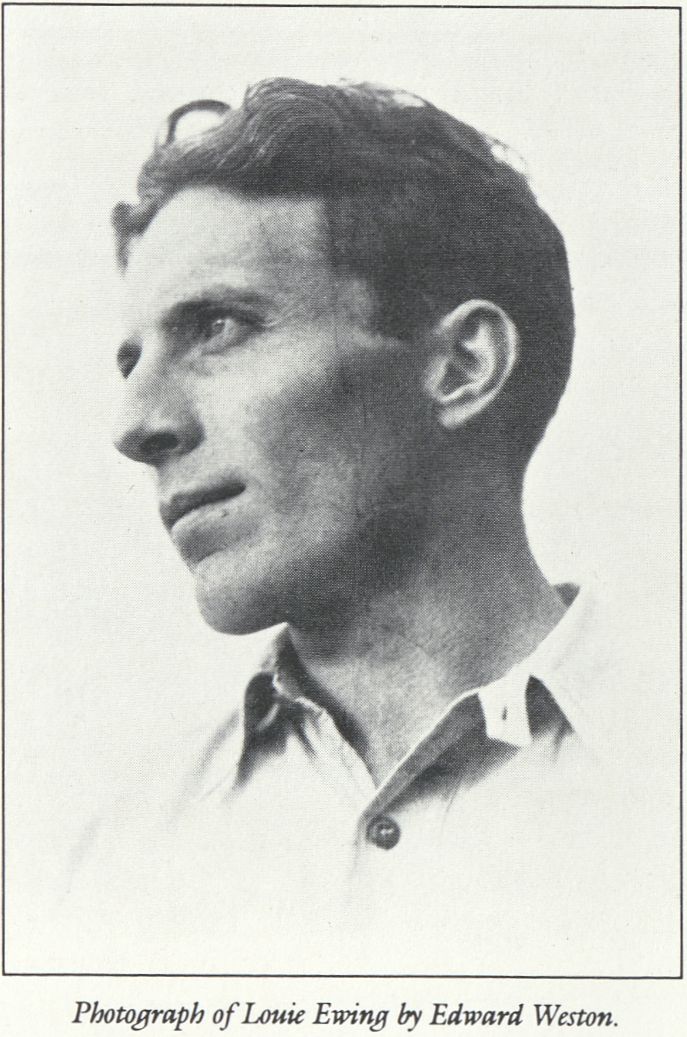
Louie Ewing is best known as a pioneer of silkscreen printmaking in the United States, a reputation he earned as a New Deal artist. Ewing moved to California in 1933, where he studied art at a junior college. He followed one of his instructors to Santa Fe, NM, in 1935, and almost immediately started working for the state’s Federal Art Project (FAP). 

Ewing was first hired by the FAP to work as an engraver on the Portfolio of Spanish Colonial Design. He was then classified as an experimental artist1 and, as such, commissioned by the Project’s director, R. Vernon Hunter, to try new ways of working, including mosaic and silkscreen printing. His best-known contribution to the New Deal is  the Navajo Blanket Portfolio, a set of fifteen silkscreen prints of Navajo weavings.

For the Portfolio project, Ewing was hired in 1939 through the FAP by the Laboratory of Anthropology (founded in 1927 by John D. Rockefeller to study the Southwest’s Indigenous cultures; the Laboratory is now part of the Museum of Indian Arts and Culture) to make prints of its Navajo rug collection for distribution to the United States Indian Arts and Crafts Board “in furthering the improvement of Navajo weaving,” to “Indian service schools” for instructional purposes, and to other public educational institutions such as universities, libraries, and museums.  Ewing first made paintings of the rugs and then was assisted by Eliseo Rodriguez in producing 200 prints of each painting. Silkscreen printing was such a novel technique at the time that it took the artists three days to make their first print. “We [first] made our squeegees, to move the paint across the screen, out of an auto tire because there wasn’t a squeegee invented then,” Ewing recalled. “And then we used a window-cleaning thing and that didn’t work because the oil melted the rubber.”2 Finally, they partnered with a local manufacturer to design and produce equipment that worked.3 Only ten of the original fifteen prints have survived in Gallup’s collection, but the National Gallery of Art has a complete set. 

Ewing credits the New Deal with helping to launch his career, saying it offered “a wonderful chance, from getting out of art school to make a transition to professional, and besides making it possible to eat,”4  and adding that “I could break away from the WPA [Works Progress Administration] and have my own business.”5 

Indeed, he continued as a prolific serigrapher for the next four decades, producing silkscreened posters for the Gallup Inter-Tribal Indian Ceremonial from 1939 to at least 19716 and receiving numerous book commissions from major institutions across the country. Additionally, he taught at the Santa Fe Indian School in the 1940s and introduced artist Harrison Begay to silkscreen printing, a technique Begay would later translate into a successful printmaking business called Tewa Enterprises. After the New Deal, Ewing expanded his repertoire to include oil paintings, watercolor, gouache, and acrylic. He had his first solo show in 1946 at the New Mexico Museum of Art.7

What are you looking for?

Art Collection

Gallup’s New Deal art collection consists of over 120 objects created, purchased, or donated from 1933 to 1942 through New Deal federal art programs administered by President Franklin D. Roosevelt to support artists during the Great Depression.

Main Menu

Image Use Notice: Images of Gallup’s New Deal artworks are available to be used for educational purposes only. Non-collection images are subject to specific restrictions and identified by a © icon. Hover over the icon for copyright info. Read more