

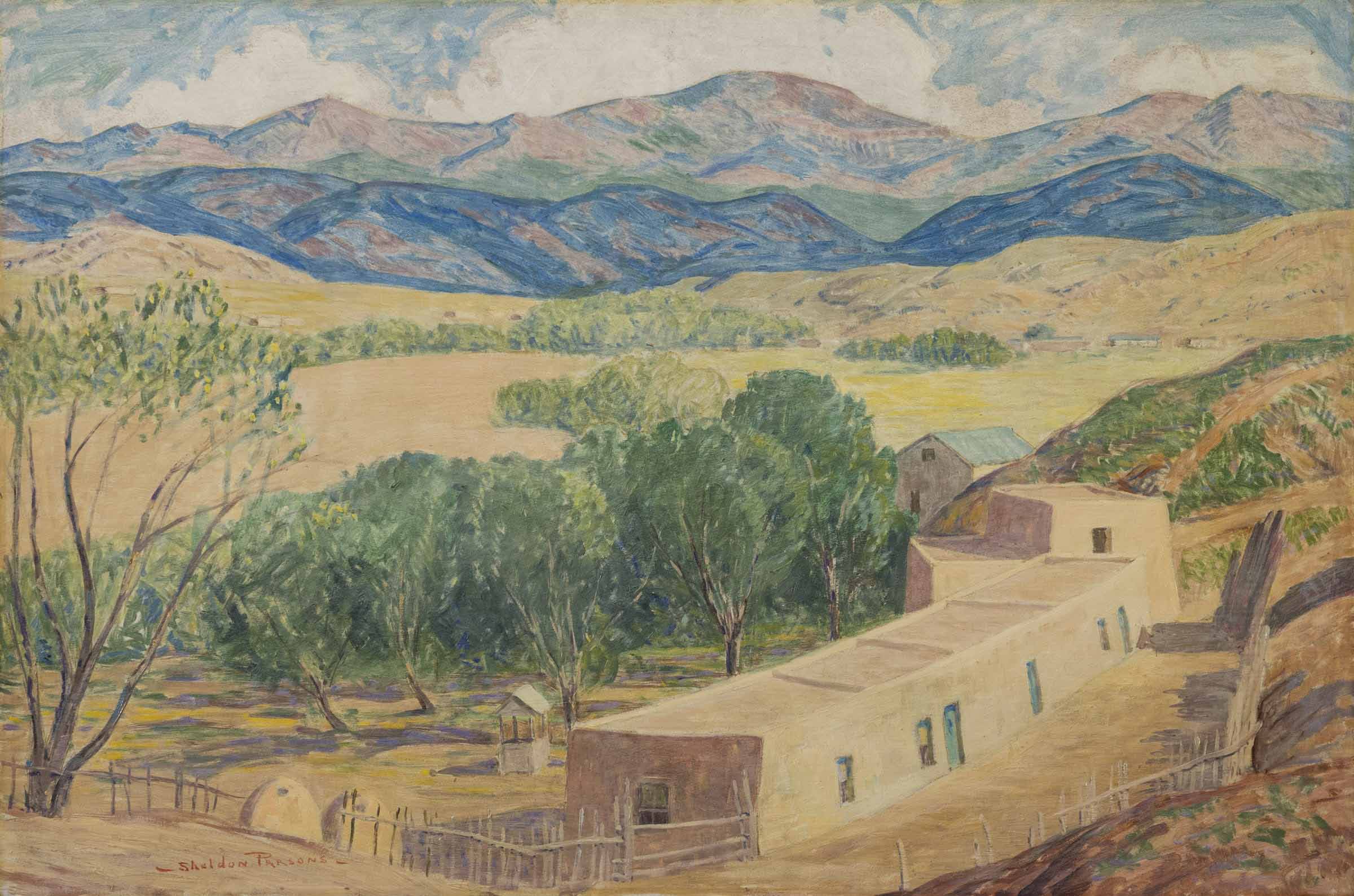
Sheldon Parsons’ career spanned the first half of the 20th century, when one avant-garde art movement after another rose to defy convention and challenge the foundations of Western American art. As an artist and curator, Parsons bridged the professional divide between “realism” and “modernism”—he both promoted traditional standards while being open to new approaches. His more “realistic” side is at play in Nambe Valley, Summer. The painting adheres to the major conventions of Western art: it is composed according to a clearly defined foreground, middle ground, and background; it takes a panoramic perspective on the landscape; its color palette is tightly controlled; and its brushwork delivers a high degree of finish.
Artist Location: Historic McKinley County Courthouse
Casa on the Hill
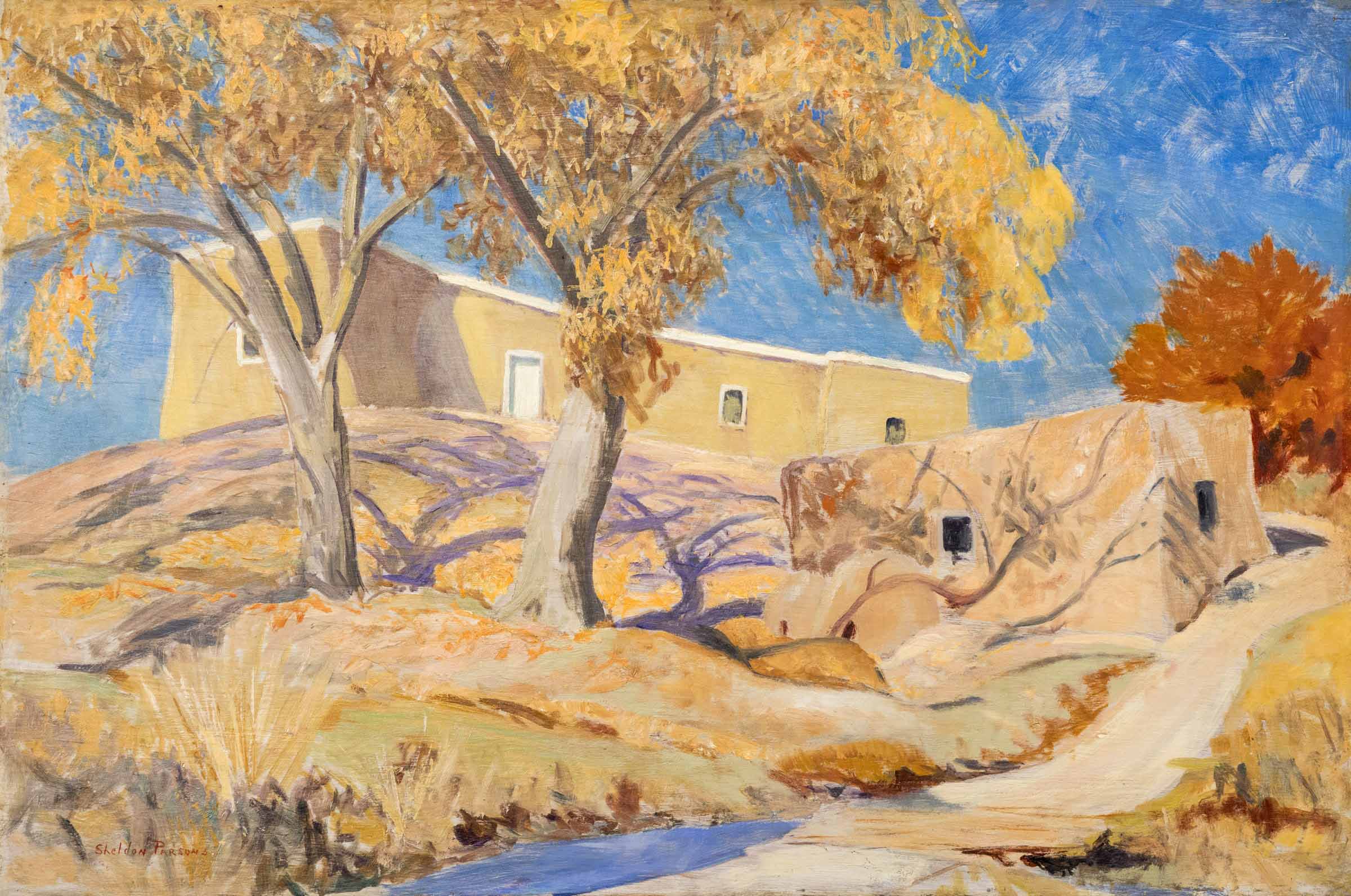
Sheldon Parsons, a leader within the growing Santa Fe artist colony at the beginning of the 20th century, took both sides in the era’s hotly contested artistic debate between “realism” and “modernism” in Western American art, promoting traditional standards without dismissing unconventional ideas. As his career matured, however, Parsons became increasingly experimental in his practice, and bold use of complementary colors became a trademark of the artist’s in his last decade (Parsons died in 1943). In Casa on the Hill, a mix of warm yellow and orange autumn hues stand out against a loosely brushed bright blue sky. Note how the purple shadows cast by towering trees in a latticework pattern on a green-glazed ground make the painting a dance of color.
The Engineer
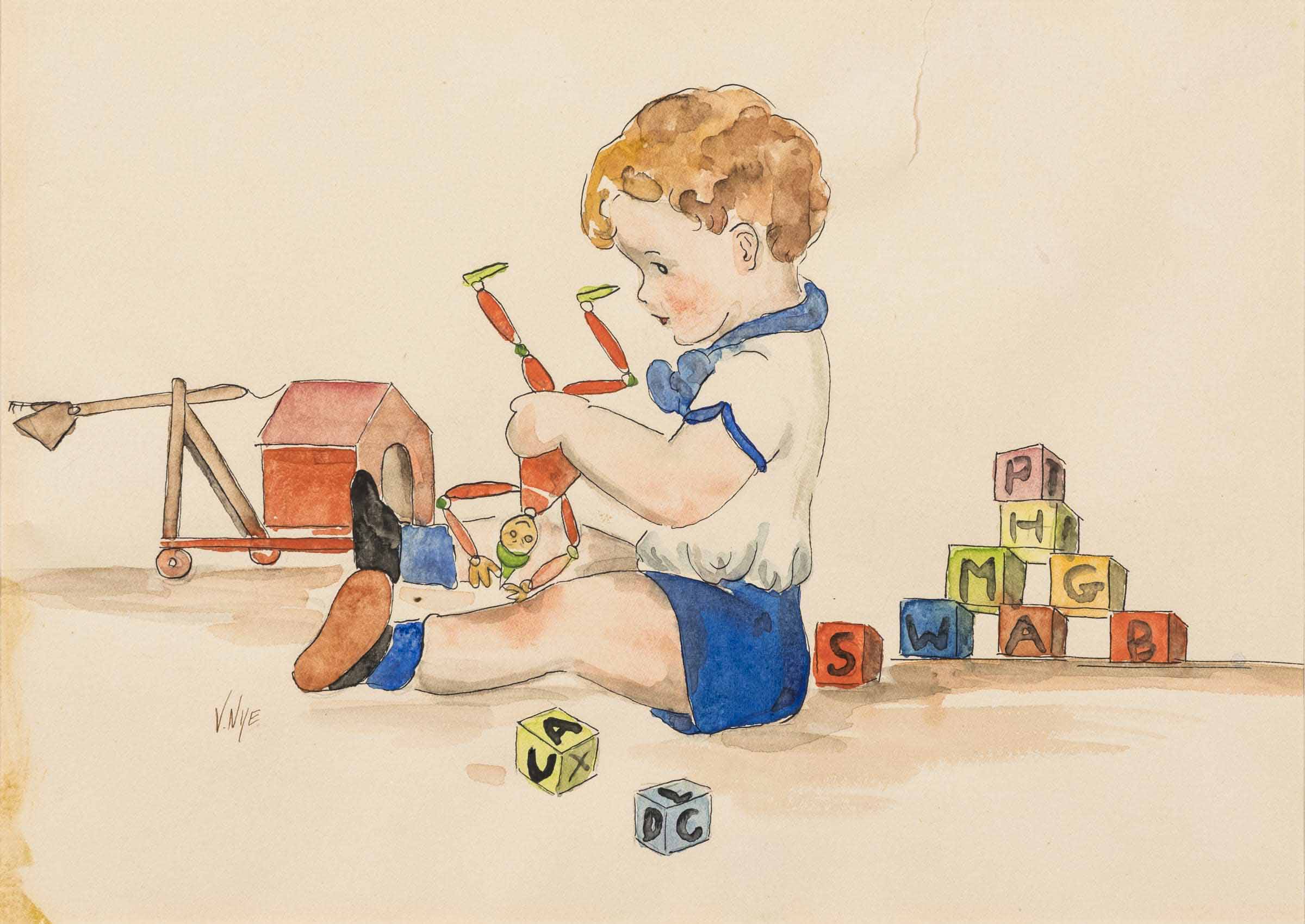
Records indicate Virginia Nye’s art career essentially started and ended with the New Deal. One of her major contributions was hand-coloring printed plates for the Portfolio of Spanish Colonial Design in New Mexico. In The Engineer, we see Nye’s keen eye for illustration, which is especially smart in its use of primary colors to enhance the image of a playful preschooler.
Sandpainting-style Wall Painting (Ripener)

Pictured here is a Diné (Navajo) sandpainting-style wall painting depicting a “ripener” (sometimes referred to as a “cornbeetle”). This and an identical wall painting flank the interior door of the main entrance1 to the historic McKinley County Courthouse. Reportedly painted by “a young Navajo painter”2 in 1939, the same year the New Deal building opened, these murals depict an insect that derives from Diné cosmology and is associated with blessings. All of the sixteen sandpainting-style wall paintings decorating the lobby of the courthouse have similar associations with blessings and guardianship, and they are all arranged in pairs that flank entrances, lobbies, and passageways in order to protect and grace the space.
Sandpainting-style Wall Painting (Buffalo Person)
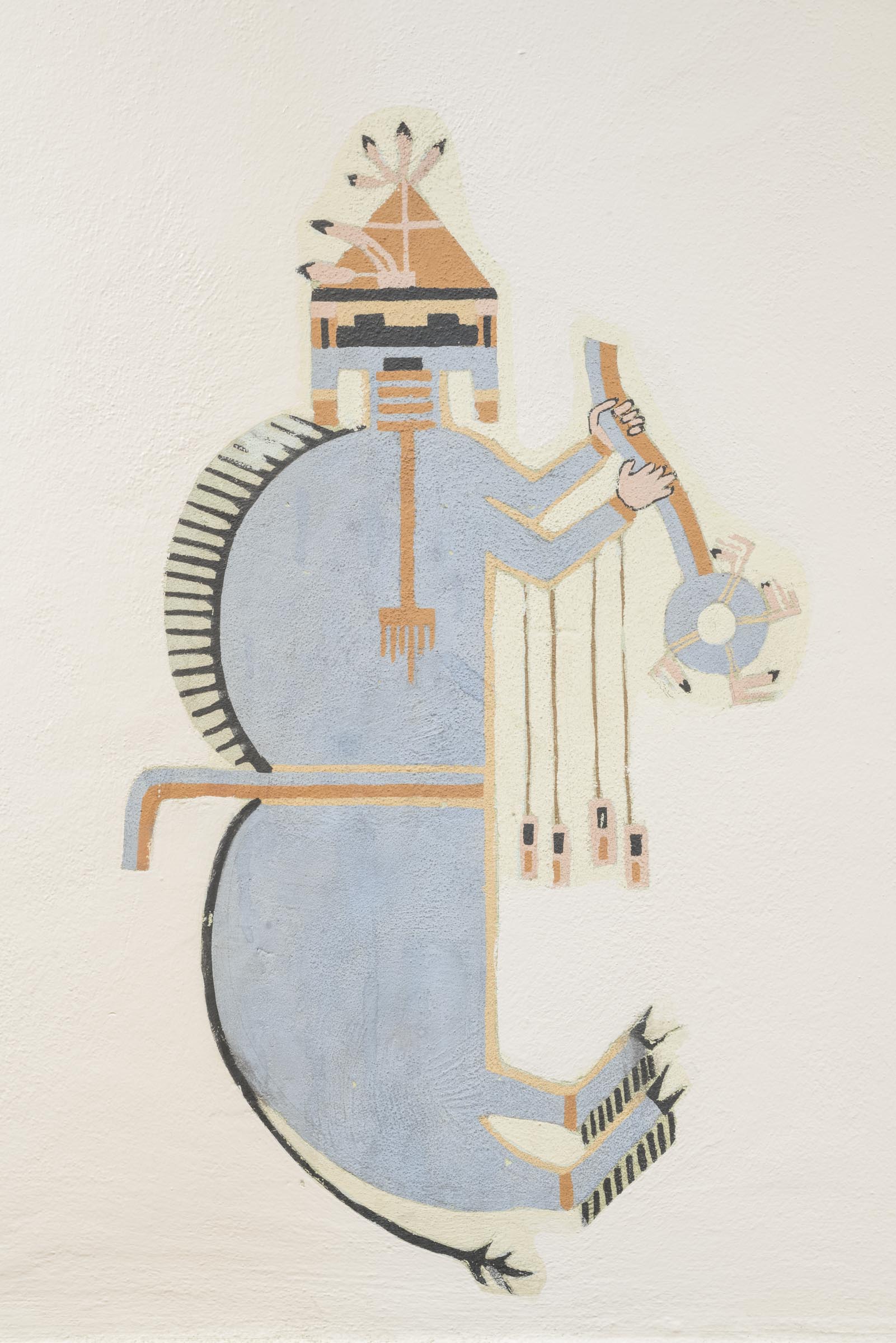
According to a contemporary newspaper report, in July 1939 “state art directors . . . made provision for selection of a young Navajo painter to aid with the murals for the new McKinley county [sic] courthouse”,1 which was a New Deal building that opened that same year. The unidentified artist created a series of sixteen Diné (Navajo) sandpainting-style wall paintings.
This is one of the “buffalo people” paintings—the figure has the body of a buffalo and the head, arms, and hands of a human—that was painted as part of a pair flanking vault doors. Originally, the courthouse’s two vault doors each had a blue figure (as seen here) painted on one side and a yellow figure painted on the other, though one of the blue figures has since been covered over (only three of the four buffalo people paintings remain visible).
Sandpainting-style Wall Painting (Buffalo Person)
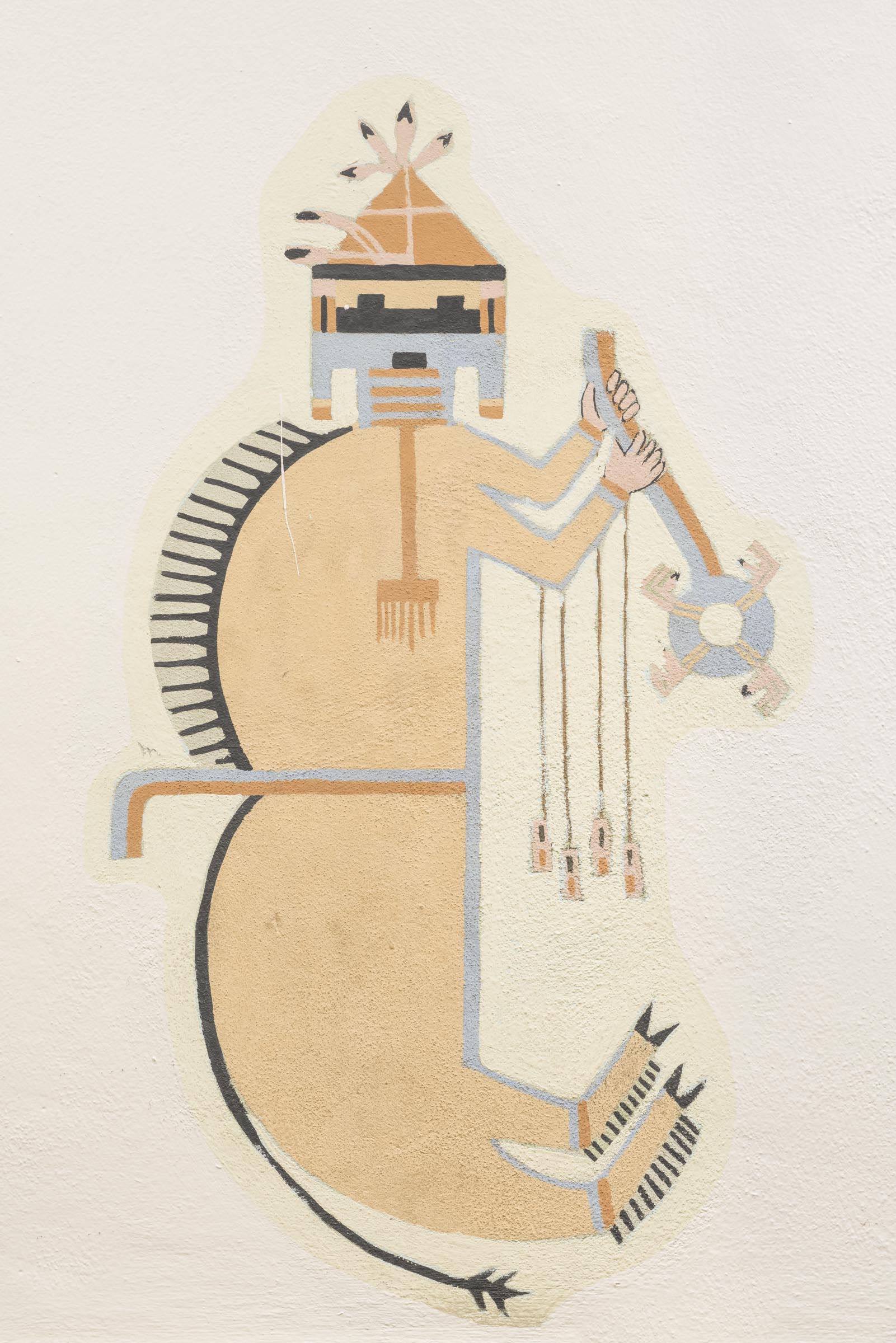
According to a contemporary newspaper report, in July 1939 “state art directors . . . made provision for selection of a young Navajo painter to aid with the murals for the new McKinley county [sic] courthouse”,1 which was a New Deal building that opened that same year. The unidentified artist created a series of sixteen Diné (Navajo) sandpainting-style wall paintings.
This is one of the “buffalo people” paintings—the figure has the body of a buffalo and the head, arms, and hands of a human—that was painted as part of a pair flanking vault doors. Originally, the courthouse’s two vault doors each had a yellow figure (as seen here) painted on one side and a blue figure painted on the other, though one of the blue figures has since been covered over (only three of the four buffalo people paintings remain visible).
Sandpainting-style Wall Painting (Buffalo)
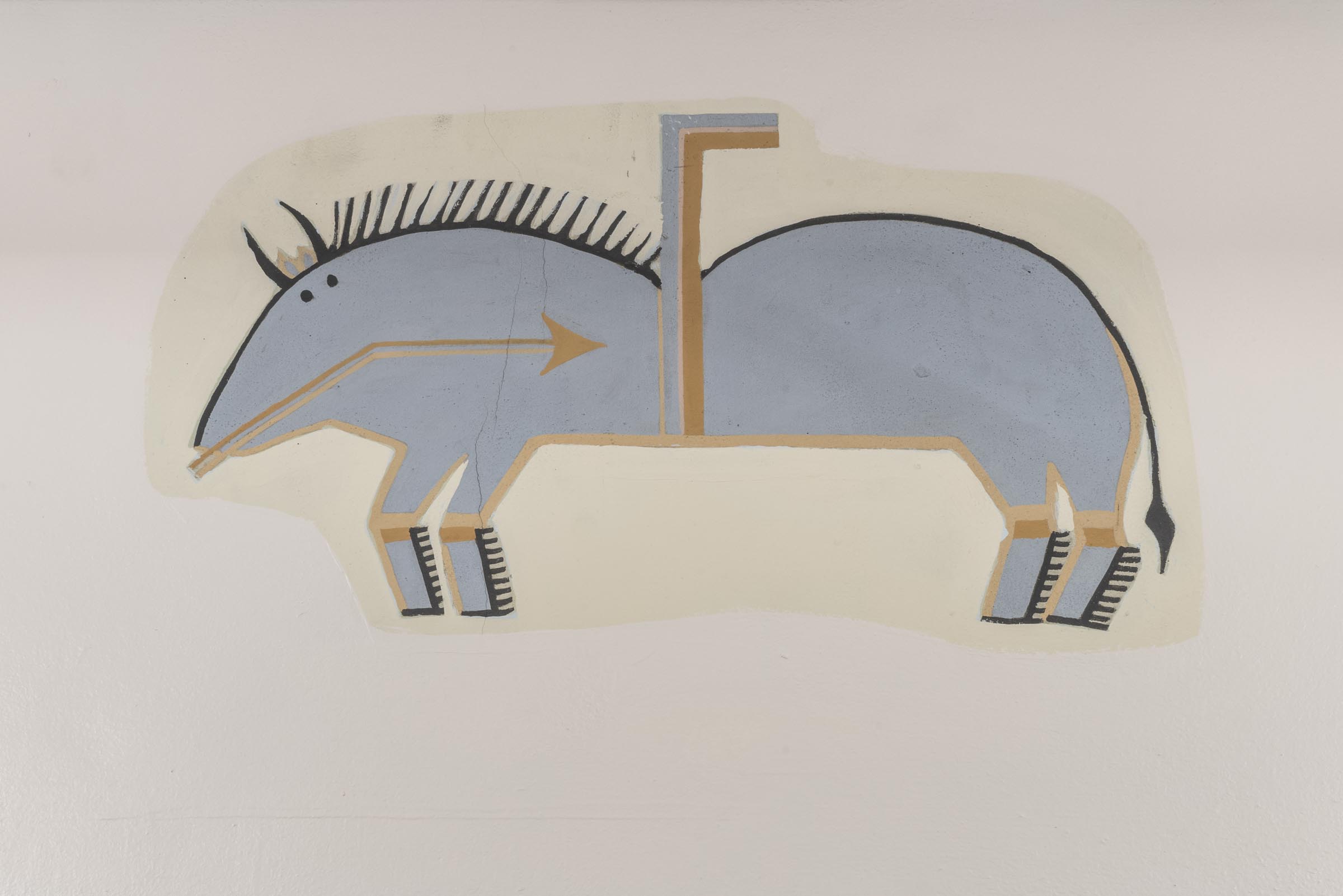
The first-floor lobby of the historic McKinley County Courthouse is decorated “in the round” with sixteen Diné (Navajo) sandpainting-style wall paintings that appear on nearly every wall. The only documentation so far identified for these wall paintings is a July 5, 1939 local newspaper article that states that “state art directors . . . made provision for selection of a young Navajo painter to aid with the murals for the new McKinley county [sic] courthouse” (the courthouse was built through the New Deal and opened in 1939).1
The paintings are organized as pairs and intentionally placed to flank entrances, lobbies, and passageways; most of the designs are traditional symbols of guardianship and blessing. This is an example of one of the buffalo paintings that appears along the lintel of the entrance to the rear staircase. While only three of the four original buffalo paintings have survived, they were originally depicted in sets of two, each with one blue (as seen here) and one yellow buffalo, and painted on either side of the passageway.
Sandpainting-style Wall Painting (Buffalo)

The first-floor lobby of the historic McKinley County Courthouse is decorated “in the round” with sixteen Diné (Navajo) sandpainting-style wall paintings that appear on nearly every wall. The only documentation so far identified for these wall paintings is a July 5, 1939 local newspaper article that states that “state art directors . . . made provision for selection of a young Navajo painter to aid with the murals for the new McKinley county [sic] courthouse” (the courthouse was built through the New Deal and opened in 1939).1
The paintings are organized as pairs and intentionally placed to flank entrances, lobbies, and passageways; most of the designs are traditional symbols of guardianship and blessing. This is an example of one of the buffalo paintings that appears along the lintel of the entrance to the rear staircase. While only three of the four original buffalo paintings have survived, they were originally depicted in sets of two, each with one yellow (as seen here) and one blue buffalo, painted on either side of the passageway.
Sandpainting-style Wall Painting (Sun)

This Diné (Navajo) sandpainting-style wall painting is the counterpart to one painted on the wall opposite in the rear lobby of the first floor the New Deal McKinley County Courthouse in 1939, reportedly by “a young Navajo painter.”1 (These sandpainting-style wall paintings are two of sixteen total such decorations.) This design is perhaps an iteration of the customary Diné sandpainting symbol representing the sun, while its companion painting likely represents the moon. Unlike its companion, however, it was partially removed when an elevator was installed in the building and an arched doorway created to provide access, and is now missing its left portion.
Sandpainting-style Wall Painting (Moon)
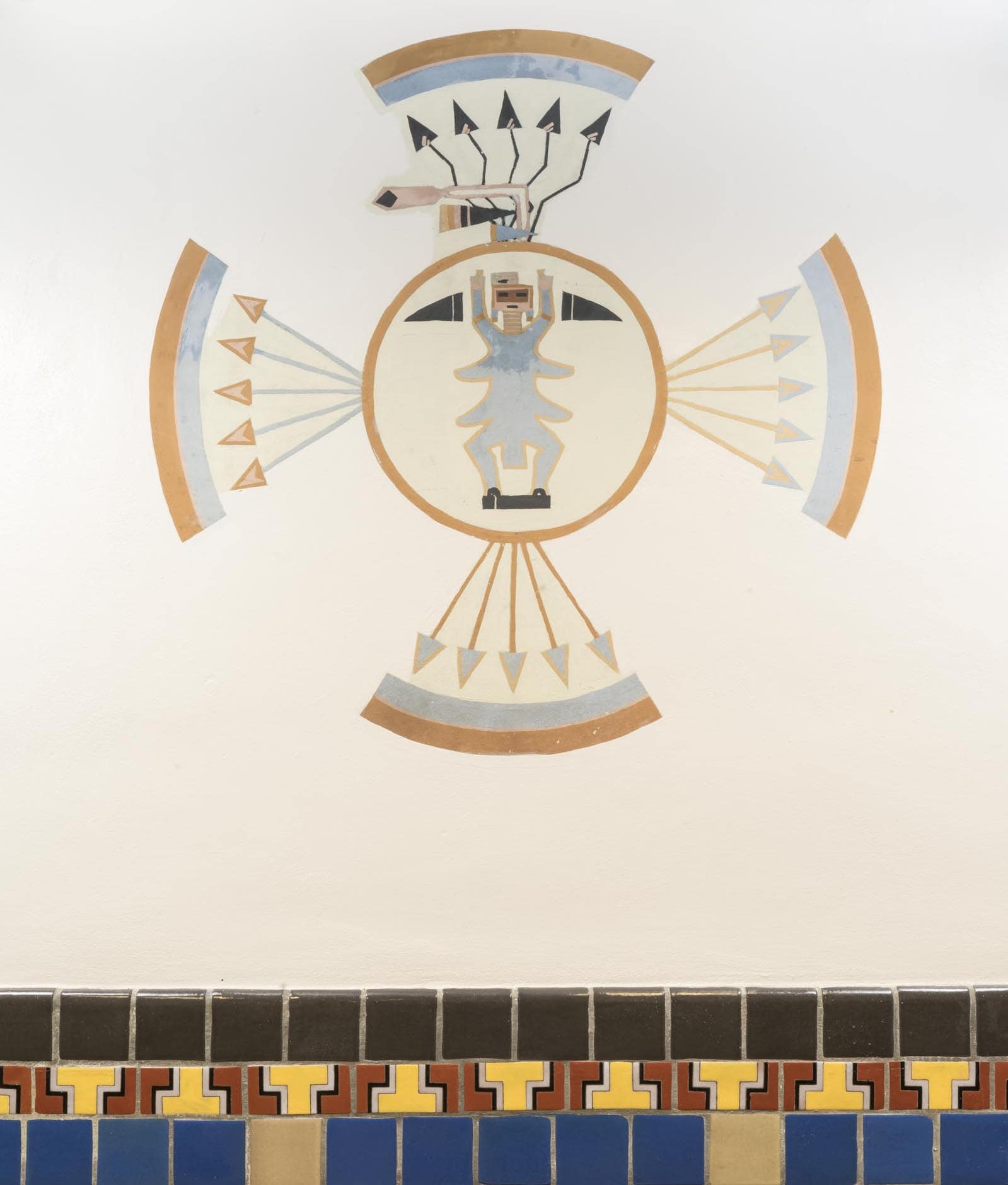
This Diné (Navajo) sandpainting-style wall painting is one of sixteen such murals reportedly painted by “a young Navajo painter”1 in 1939 to decorate the first-floor lobby of the historic McKinley County Courthouse, which was built through the New Deal and opened that same year. It is part of a set of two, as almost all of the courthouse wall paintings are. Its counterpart was painted directly across on the opposite wall. This design is perhaps an iteration of the customary Diné sandpainting symbol representing the moon, while its companion piece likely represents the sun. Unlike its counterpart, however, this painting is still largely intact—look closely to see how efforts have been made to preserve it over time by painting around it (the original wall color appears light green).