

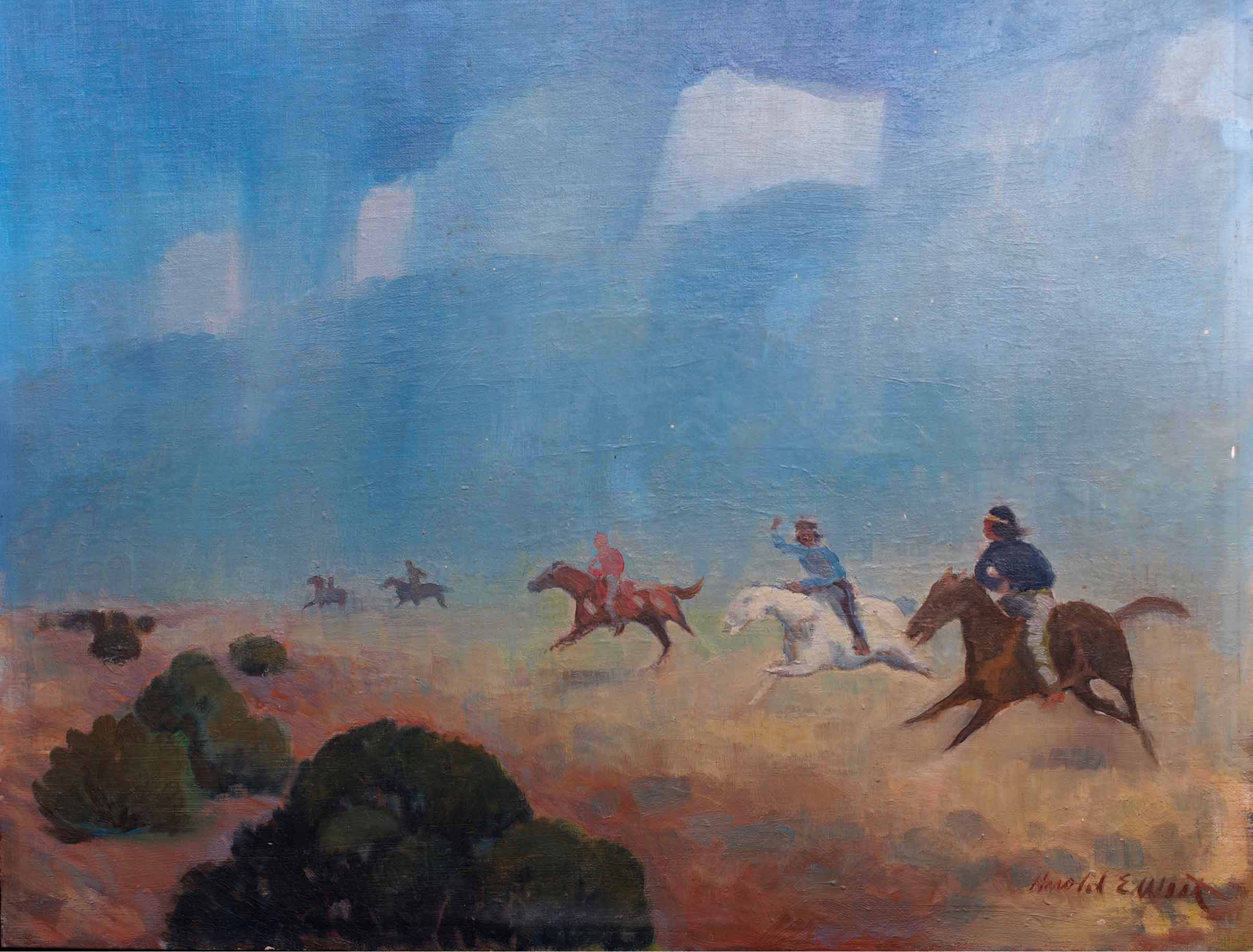
Already established as a commercial printmaker, Harold E. West credits the New Deal for launching his career in painting. Producing work for New Mexico’s Federal Art Project in the late 1930s, he quickly became well known for images of “frontier” life—cowboys, homesteads, ranch animals. In this painting, expert horsemen kick up dust as they race through a range of grass and rabbitbrush. West captures their speed and agility in a blur of brushstrokes and evokes the sensations of a loud stampede of hooves, whooshing air, and an adrenaline-charged shout.
Artist Location: Storage
Poster for the Indian Court Federal Building

In 1939, San Francisco hosted the Golden Gate International Exposition to celebrate the opening of the San Francisco—Oakland Bay and Golden Gate Bridges and the theme of “Pacific Unity.” The Exposition included an “Indian Court” exhibit organized by the newly established Indian Arts & Crafts Board (IACB) with art displays, a vendor marketplace, artist demonstrations, and guided tours. These posters, produced by Louis Siegriest for the IACB in partnership with another New Deal program, the Federal Art Project, promote The Indian Court’s conception and representation of “eight great areas of Indian culture,” including the “Fishermen of the Northwest Coast,…Buffalo Hunters of the Plains,…the Cornplanters of the Pueblos, [and] the Navajo Shepherds”—Gallup’s collection includes only four of the eight total posters. The imagery is borrowed from Indigenous artists, who received little or no recognition. Siegriest created the poster designs but “had nothing to do with the actual process,” meaning he didn’t make the screens or pull the prints; “I would see that they got out,” he recalled. “I think they got out 1,500 of each poster.”1
Poster for the Indian Court Federal Building

In 1939, San Francisco hosted the Golden Gate International Exposition to celebrate the opening of the San Francisco—Oakland Bay and Golden Gate Bridges and the theme of “Pacific Unity.” The Exposition included an “Indian Court” exhibit organized by the newly established Indian Arts & Crafts Board (IACB) with art displays, a vendor marketplace, artist demonstrations, and guided tours. These posters, produced by Louis Siegriest for the IACB in partnership with another New Deal program, the Federal Art Project, promote The Indian Court’s conception and representation of “eight great areas of Indian culture,” including the “Fishermen of the Northwest Coast,…Buffalo Hunters of the Plains,…the Cornplanters of the Pueblos, [and] the Navajo Shepherds”—Gallup’s collection includes only four of the eight total posters. The imagery is borrowed from Indigenous artists, who received little or no recognition. Siegriest created the poster designs but “had nothing to do with the actual process,” meaning he didn’t make the screens or pull the prints; “I would see that they got out,” he recalled. “I think they got out 1,500 of each poster.”1
Poster for the Indian Court Federal Building

In 1939, San Francisco hosted the Golden Gate International Exposition to celebrate the opening of the San Francisco—Oakland Bay and Golden Gate Bridges and the theme of “Pacific Unity.” The Exposition included an “Indian Court” exhibit organized by the newly established Indian Arts & Crafts Board (IACB) with art displays, a vendor marketplace, artist demonstrations, and guided tours. These posters, produced by Louis Siegriest for the IACB in partnership with another New Deal program, the Federal Art Project, promote The Indian Court’s conception and representation of “eight great areas of Indian culture,” including the “Fishermen of the Northwest Coast,…Buffalo Hunters of the Plains,…the Cornplanters of the Pueblos, [and] the Navajo Shepherds”—Gallup’s collection includes only four of the eight total posters. The imagery is borrowed from Indigenous artists, who received little or no recognition. Siegriest created the poster designs but “had nothing to do with the actual process,” meaning he didn’t make the screens or pull the prints; “I would see that they got out,” he recalled. “I think they got out 1,500 of each poster.”1
Poster for the Indian Court Federal Building

In 1939, San Francisco hosted the Golden Gate International Exposition to celebrate the opening of the San Francisco—Oakland Bay and Golden Gate Bridges and the theme of “Pacific Unity.” The Exposition included an “Indian Court” exhibit organized by the newly established Indian Arts & Crafts Board (IACB) with art displays, a vendor marketplace, artist demonstrations, and guided tours. These posters, produced by Louis Siegriest for the IACB in partnership with another New Deal program, the Federal Art Project, promote The Indian Court’s conception and representation of “eight great areas of Indian culture,” including the “Fishermen of the Northwest Coast,…Buffalo Hunters of the Plains,…the Cornplanters of the Pueblos, [and] the Navajo Shepherds”—Gallup’s collection includes only four of the eight total posters. The imagery is borrowed from Indigenous artists, who received little or no recognition. Siegriest created the poster designs but “had nothing to do with the actual process,” meaning he didn’t make the screens or pull the prints; “I would see that they got out,” he recalled. “I think they got out 1,500 of each poster.”1
Rural Rococo

Lloyd Moylan wrote about the value of stylistic experimentation to an artist’s practice in an essay on public art for the Federal Art Project, and Rural Rococo is evidence that he took his own advice. In the forms of a sky-high cottonwood snag and cotton-ball clouds, Moylan seizes the opportunity to try out the whimsical curves and embellishments of the rococo style of 18th-century France, an ocean and a century removed from his own time. Moylan fully commits to interpreting the Western American landscape through a rococo lens, embracing the style’s attention to detail and fondness for natural motifs. As a finishing touch, he adds delicately rendered figures of common American pastoral birds—chickens, a crow, and a mourning dove.
Untitled (Portrait of an Indian)

The Albuquerque Journal reported on a show of John Jellico’s work in 1938 that “11 portraits . . . and seven pictures of Indians” were included in the exhibition.1 This distinction between portraiture and “Indian pictures” reveals the cultural biases and dehumanizing stereotypes of the period, which are evident in Untitled (Portrait of an Indian). The emphasis on the sitter’s distinctive attire—his red headband and cuff bracelet—combined with the loose handling of his facial features dilutes and obscures the representation of individuality.
Navajo Blanket Portfolio – Plate 15

From 1939–1942, the Laboratory of Anthropology in Santa Fe sponsored a New Deal Federal Art Project initiative to create a print portfolio of fifteen Navajo weaving designs drawn from its collections, and hired artist Louie Ewing to orchestrate the effort. The silkscreen printing process was a relatively new technology to the United States, so Ewing, with assistance from fellow artist Eliseo Rodriguez, had to essentially invent his own version of it. Two hundred of each print were produced. Prints were distributed to the Bureau of Indian Affairs and federal government “Indian service schools,” as well as universities, libraries, and museums nationwide for instructional and educational purposes.
Navajo Blanket Portfolio – Plate 14

From 1939–1942, the Laboratory of Anthropology in Santa Fe sponsored a New Deal Federal Art Project initiative to create a portfolio of fifteen Navajo weaving designs drawn from its collections, and hired artist Louie Ewing to orchestrate the effort. The silkscreen printing process was a relatively new technology to the United States, so Ewing, with assistance from fellow artist Eliseo Rodriguez, had to essentially invent his own version of it. Two hundred of each print were produced. Prints were distributed to the Bureau of Indian Affairs and federal government “Indian service schools,” as well as universities, libraries, and museums nationwide for instructional and educational purposes.
Navajo Blanket Portfolio – Plate 12

From 1939–1942, the Laboratory of Anthropology in Santa Fe sponsored a New Deal Federal Art Project initiative to create a portfolio of fifteen Navajo weaving designs drawn from its collections, and hired artist Louie Ewing to orchestrate the effort. The silkscreen printing process was a relatively new technology to the United States, so Ewing, with assistance from fellow artist Eliseo Rodriguez, had to essentially invent his own version of it. Two hundred of each print were produced. Prints were distributed to the Bureau of Indian Affairs and federal government “Indian service schools,” as well as universities, libraries, and museums nationwide for instructional and educational purposes.