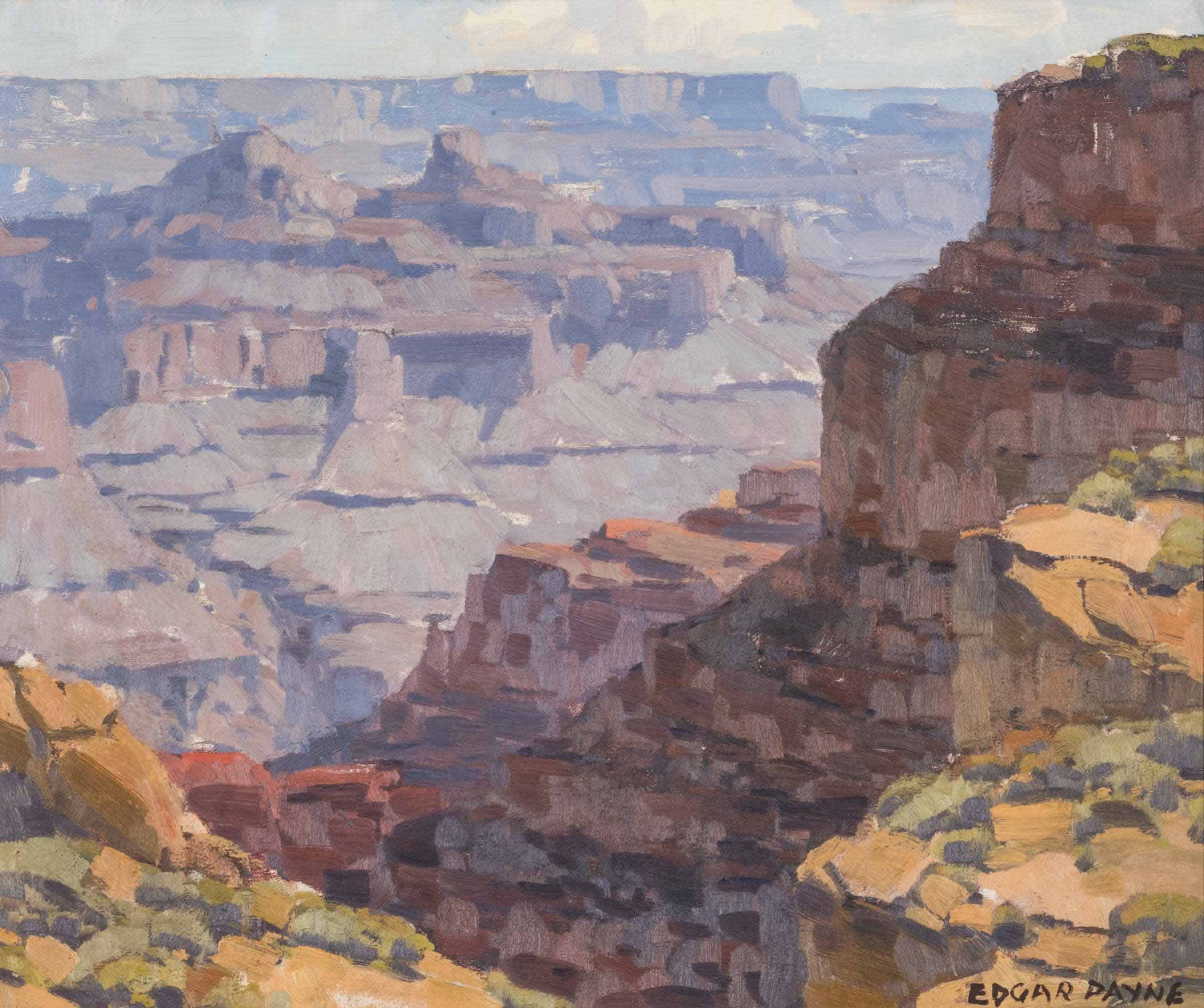
A painting of the Grand Canyon made from a close-up vantage point and picturing layer after layer of rock formations extending into the distance. With only a thin strip of cloudy sky visible along the top edge, the painting gives the sense of that the canyon walls go on forever. The composition contrasts warm tones in the foreground against cool tones in the background. The effect is to give the image a real sense of depth. From front to back: yellow-ish brown rocky outcroppings fill the lower corners of the painting. A reddish brown wall with a zig-zagged silhouette rises along the right edge of the painting behind them. The middle ground is taken up by a grayish-brown mountain-shaped mass of rock with two small peaks. A grayish-purple flat-topped cliff wall runs behind it in the far distance.

Edgar Alwin Payne

Untitled (Grand Canyon)

About 1909–1942

Oil on canvas

24” W x 20” H

About this artwork

Edgar Alwin Payne’s paintings are often designed not just to show the viewer the landscape, but to help them imagine themselves within it. In Untitled (Grand Canyon), Payne positions the viewer a short distance down a canyon wall trail. This perspective is more intimate than an aerial view or the panorama visible from the canyon’s rim. Immersed within the canyon, the viewer is dwarfed by its hugeness but can also appreciate the architectural features of the canyon walls.

Audio description for individuals with low vision. Audio descriptions produced by Art Beyond Sight.

Audio description

Grand Canyon by Edgar Alwin Payne is an oil painting, two feet wide and a foot and a half tall. For more about this painting style and the history of this painting, read the “About this Artwork” section above.

We look into the distance over the rim of the Grand Canyon. The Canyon is composed in five layers, with the rock formations closest to us painted in vibrant shades of tan and ochre, and the colors fading to muted purple-ish and blue-ish grays as we look further into the distance. This use of light and color gives the painting a sense of vastness that does justice to the enormous scale of the Grand Canyon.

In the immediate foreground, the tan and ochre rock formations separate, positioning us, the viewer, as if we are standing at the precipice of a trail that winds down into the depths below. The second canyon wall layer rises to our right and stretches the height of the canvas, its surface textured with block-like brushstrokes in a palette of reddish brown and occasional gray hues, as if cast in shadow. The third layer of the canyon wall only reaches half the height of the painting but is painted in brighter terracotta tones with pinkish-orange highlights, as if spotlit.

The fourth and fifth canyon wall layers complement and balance the composition. Imagine that the canvas is bisected on a diagonal from the upper right to lower left corners. The warm tones of the first three layers populate the bottom triangle of the canvas. The cool tones of the fourth and fifth layers dominate the upper triangle. The fourth layer is bulky, eroded triangular mountain shape with two small peaks painted in desaturated reds, browns and greys. The fifth layer appears as a thin strip of flat-topped mesa that extends almost the entire width of the canvas and is mostly grey. The artist left an inch or so of canvas at the very top of the composition for a sliver of sky adorned with wispy white clouds, offering a tranquil contrast to the rugged terrain below and capturing the majestic and serene essence of the Grand Canyon.

See this artwork in a different light

More artworks by this artist

We are always open to learning more about our collections and updating this website. Does this entry contain inaccurate information or language that you feel we could improve or change? Click here to let us know.

Copyright © 2026 gallupARTS

What are you looking for?

Art Collection

Gallup’s New Deal art collection consists of over 120 objects created, purchased, or donated from 1933 to 1942 through New Deal federal art programs administered by President Franklin D. Roosevelt to support artists during the Great Depression.

Main Menu

Image Use Notice: Images of Gallup’s New Deal artworks are available to be used for educational purposes only. Non-collection images are subject to specific restrictions and identified by a © icon. Hover over the icon for copyright info. Read more