


As a decorative art, tinwork has been practiced in the area that is now New Mexico for over 300 years. Originally developed by 18th-century Spanish colonists, it is a mestizaje, or hybrid, art form. As seen here, the practice combines Spanish motifs of rosettes and scallops with Indigenous designs of parrots and rainbows to create a distinctly “New Mexican” cultural expression.
Color: Gray
Tinwork Light

New Deal art programs were broadly interested in cultivating a unique American artistic identity and in establishing the United States as an arts and cultural center with its own rich legacy and heritage separate from that of Europe. Toward that end, New Mexico’s Federal Art Project (FAP) heavily promoted Spanish Colonial art forms specific to what is now the Southwestern United States. Tinwork was developed by Spanish colonists in what is now New Mexico in the 1700s and became widely practiced after the opening of the Santa Fe Trail in 1821 and the corresponding increase in trade. The New Mexico FAP picked up the mantle of the tradition by directing the state’s workshop programs to train artists in the craft and to produce objects such as this light fixture, frames, and other decorative arts for newly constructed buildings.
The Half-Breed
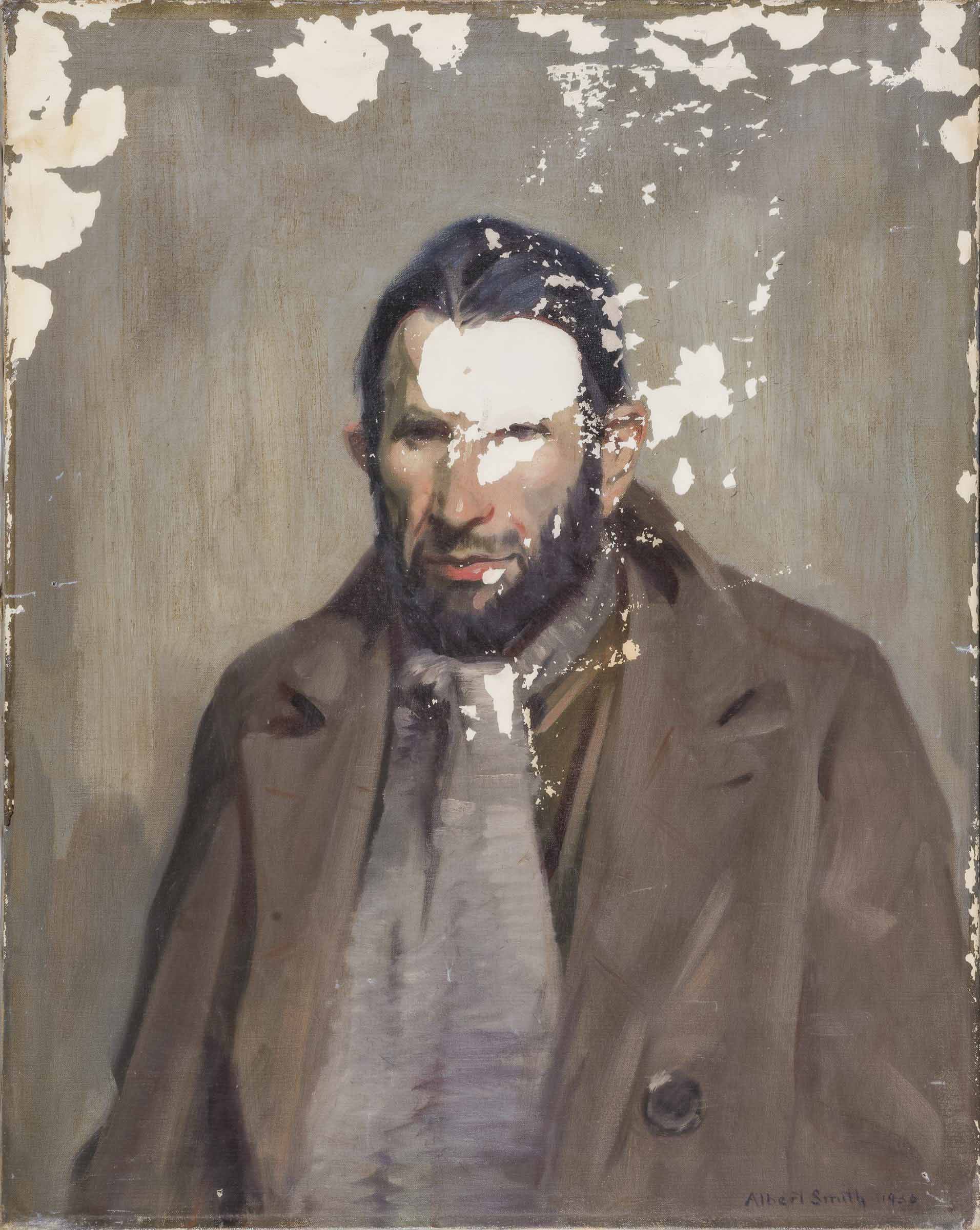
The Half-Breed is a problematic painting, not least because of its title, a derogatory term for a biracial Native American person. The circumstances of its creation are a mystery. Who it pictures and why it was made are not known. The artist likely donated it, along with Chief Deer (Sioux Indian), to the Gallup Art Center. The two paintings are almost identical in size, and the possibility that they are a set raises the question of what Albert Delmont Smith meant to convey by the comparison. The Half-Breed has not been displayed by Gallup’s public library for some time, and suffered damage long ago due to improper storage.
Chief Deer (Sioux Indian)
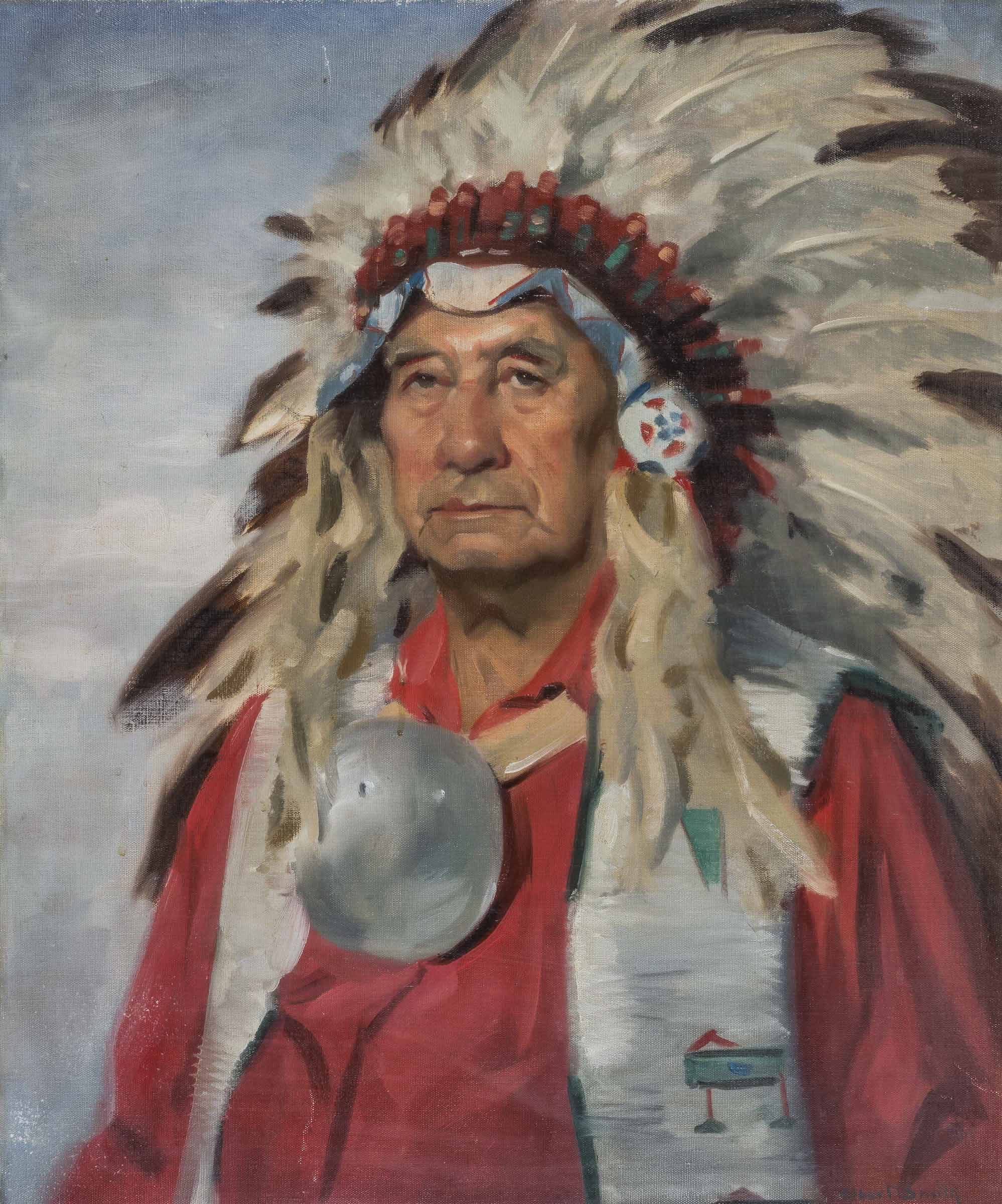
This painting by Albert Delmont Smith, a New York City-based society portraitist, is an enigma. The sitter has not been identified and it is not known for whom or for what reason it was made. It is likely the painting was donated by the artist to the Gallup Art Center, along with The Half-Breed (which may or may not be a companion portrait).
Sandpainting-style Wall Painting

This is one of sixteen wall paintings that decorate the first-floor lobby of the historic New Deal-built McKinley County Courthouse, reportedly made by “a young Navajo painter”1 in 1939 (the same year the courthouse opened). The wall paintings replicate designs and compositions originating from the Diné (Navajo) spiritual practice of sandpainting. The transition of sandpainting from a sacred, private ritual to a secular, public art form occurred at the turn of the 20th century as cultural tourism arose in the Southwest and a market for Native art developed. Diné artists navigated this transition by modifying sandpainting designs to offset their spiritual significance—swapping colors, eliminating certain elements, re-ordering patterns. The mural seen in this image highlights this transition as it incorporates the aesthetics and language of sandpainting with European-derived visual practices. Here, common sandpainting designs and symbols are arranged in a vertical wall composition (sandpaintings were historically created on the ground) to represent a figure in dimensional space—a ceremonial dancer standing on a surface surrounded by plants and/or a landscape.
Dead Cottonwood
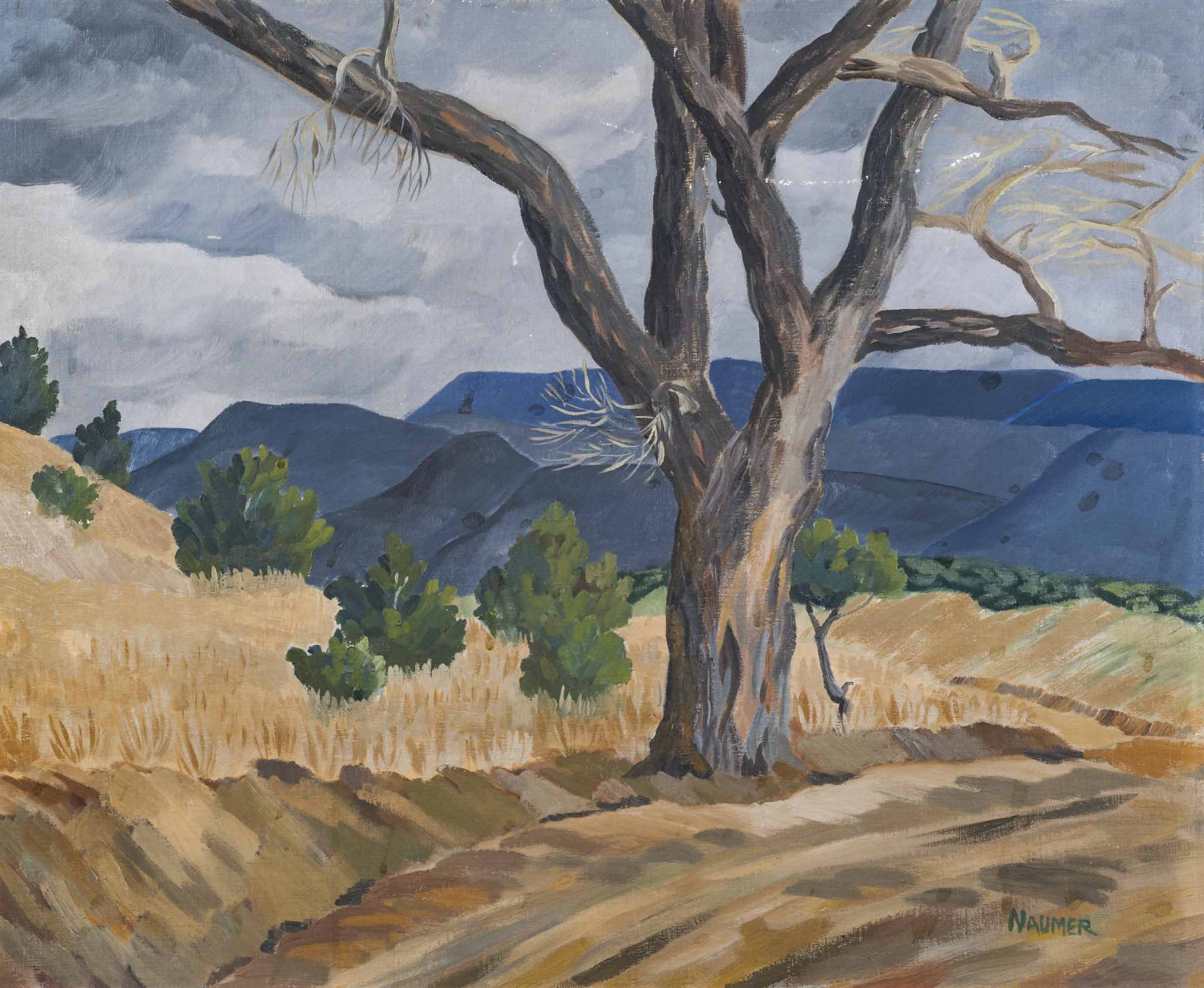
Dead Cottonwood is an unusual painting for Helmuth Naumer, Sr. First, it is in oil, while Naumer mostly worked in and was best known for his pastels. Second, it is relatively drab. One reason Naumer’s pastels were (and are) so popular was that he created them on black paper, which made his vibrant color palette really “pop.” There are inklings of Naumer’s proclivity for complementary colors in Dead Cottonwood: the blues of the mesas in the background complement the yellow hues of the grass in the foreground, and he defines the grain of the cottonwood’s trunk by weaving dabs of terracotta through twists of gray. Yet it is different enough from most of his work to raise questions about what he was thinking. Naumer always said that the Southwest felt instinctively like home, but he was born in Germany. Replying to a question by a journalist in 1938, he expressed concern over Adolf Hitler’s rise to power and predicted the outbreak of a large-scale war.1 Given the time period this work was made—between 1939 and 1943—and the somber subject, title, and colors, perhaps events in Europe weighed heavily on Naumer’s mind when he painted this piece.