
This is the final painting in a seven-part series of Southwestern history murals that the Gallup public schools commissioned J. R. Willis to paint through the Federal Art Project between 1935 and 1936—and that still hang in the Gallup High School library.
Willis concludes his series with an image of one of the last American military offensives against Native peoples in the Southwest. Starting in 1863, Kit Carson, at the command of the US Army, led the forced removal of Diné (Navajo) people to Fort Sumner/Bosque Redondo Reservation. Carson employed a “scorched earth” coercion strategy, destroying Diné homes and food sources. In 1864, he waged a final assault in Canyon de Chelly, where Diné people had taken refuge, which culminated in what is known as the Long Walk, a violent march of Diné people hundreds of miles to Bosque Redondo Reservation.
Willis’s mural whitewashes the historical narrative. In it, Carson appears as a somewhat passive armed guard, simply keeping order and guiding the Diné people to their destination. For their part, the Diné people—erroneously and stereotypically depicted in Plains-style buckskin clothing—appear fully cooperative and hardly distressed.

This is the second in a seven-part series of Southwestern history murals that the Gallup public schools commissioned J. R. Willis to paint through the Federal Art Project between 1935 and 1936—and that still hang in the Gallup High School library.
Here, Willis portrays Spanish “explorer” Álvar Núñez Cabeza de Vaca, who spent eight years between 1528 and 1536 traveling along the Gulf of Mexico coast from present-day Florida to present-day Texas as part of a group of only four survivors of the ill-fated Pánfilo de Narváez expedition (the group included Estebanico, an enslaved Black Moroccan, pictured at far left). The group survived with help from the Native American peoples they encountered.
In his mural series, Willis relates Southwest history from a Eurocentric perspective. Despite his haggard appearance, Cabeza de Vaca is a commanding presence in Willis’s mural. His figure forms the apex of a triangular composition and is almost spotlit by the setting sun as he takes a confident, purposeful step forward.
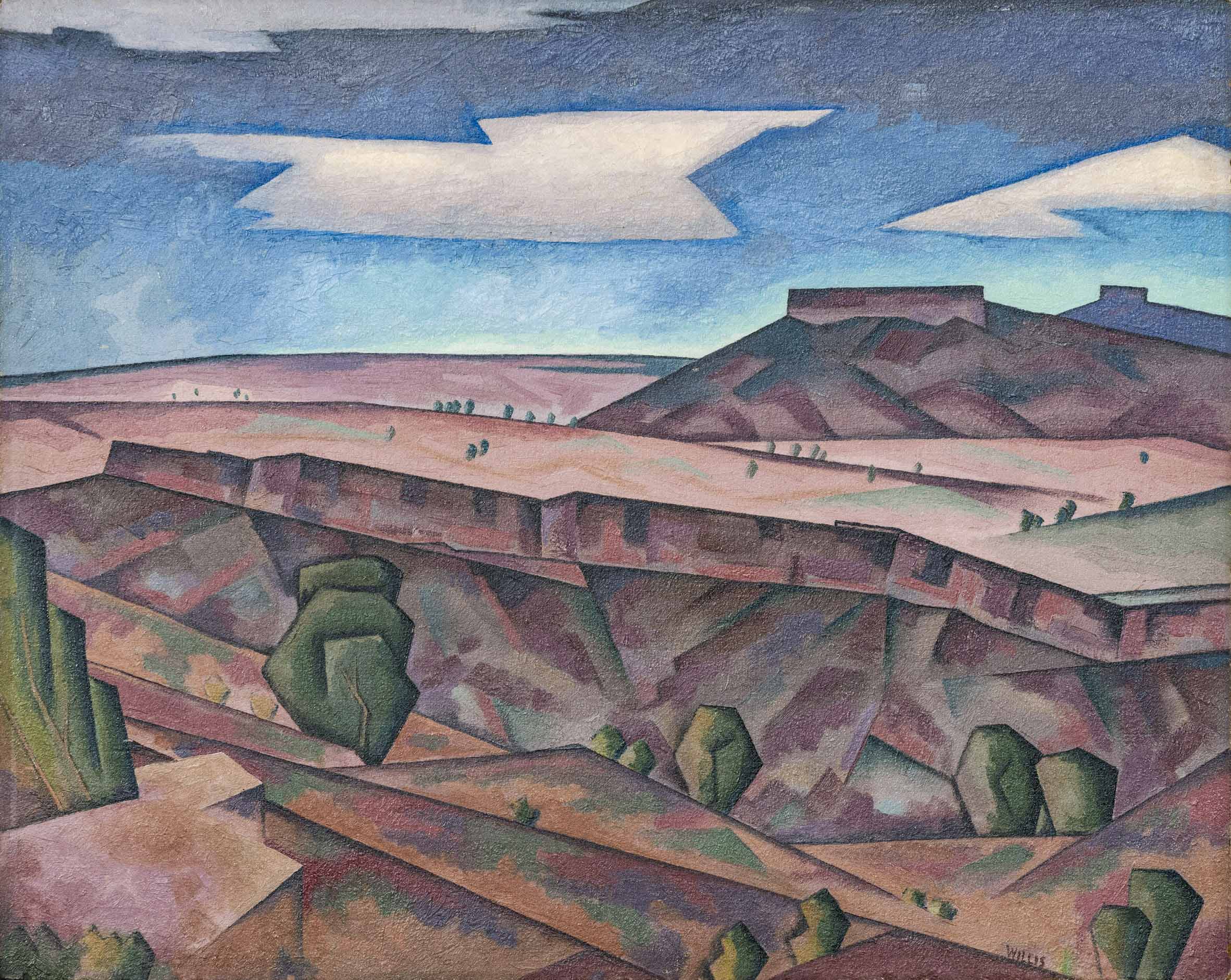
In the 1930s and 1940s, painter Brooks Willis developed a reputation as an “extreme modernist.”1 The clean lines, hard edges, and sharp angles of Desert certainly live up to this reputation. Yet the soft glow of twilight on the horizon and gradation of light to dark blue in the sky softens the painting’s strict geometry and gives it a more naturalistic ambiance.
Comparing Desert to Willis’s painting Cottonwoods, made in the same year, reveals how the artist experimented with ideas of modernism. However abstract Desert is in its geometrical composition, it retains much of traditional European painting’s emphasis on depth and perspective. Cottonwoods, however, with its visible brushstrokes and high level of attention paid to the act of applying paint to canvas, rather than to developing an illusion of depth, might actually post a greater challenge to tradition.
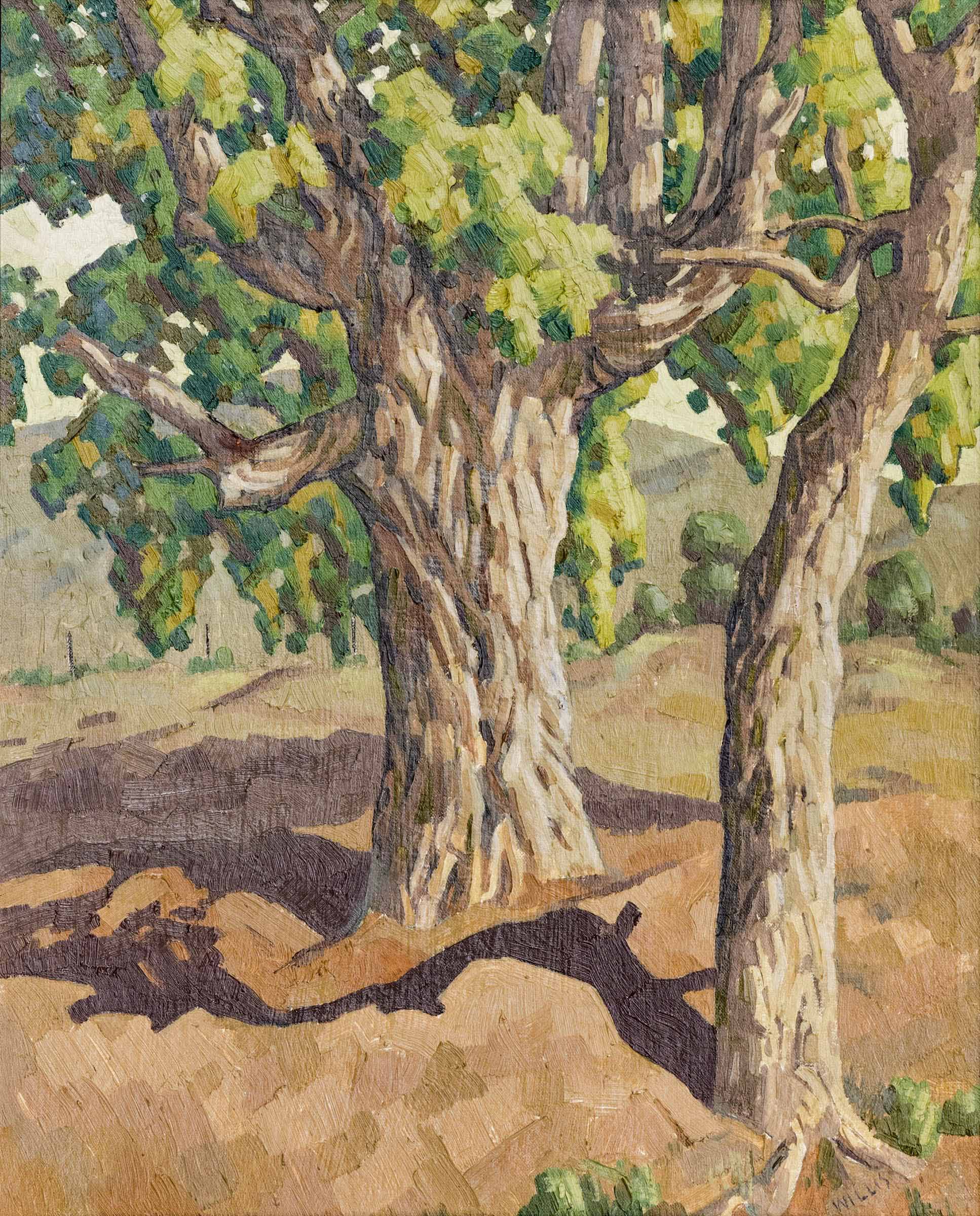
Cottonwoods is a deceptively simple painting by an artist known in his day as an “extreme modernist.”1 Each individual brushstroke is legible: sunlit trees take form through the masterful placement of light and dark tones side by side in either short, stubby strokes or long, narrow strokes, which gracefully develop a sense of texture.
How Cottonwoods is unapologetically “modern” (by 20th-century standards) is fully understood in comparison to Brooks Willis’s painting Desert, made the same year. Desert takes the more immediately “modern” approach of abstraction, reducing its subject to geometric shapes. Cottonwoods, however, operates not on the level of style but on the level of technique, distilling the very concept of a painting to its most basic materials and methods.

Shalako, which depicts an annual A:shiwi (Zuni) winter festival, is an action-packed, tremendously detailed painting. In it, Jose Rey Toledo captures everything from the central dancers’ movements and regalia to the backdrop with supreme precision. Notice the fine lines delineating each individual bead on the dancers’ necklaces, how headdress feathers have been colored one by one, and how the artist renders the fringe of the woven sashes worn by the two dancers on the left with pinpoint-size brushstrokes. Behind them, more than two dozen onlookers are individually represented, each with distinct facial features, clothing, and postures. Toledo’s meticulousness even extends to the background, where each element is finely articulated, including the perched owl’s feathers.
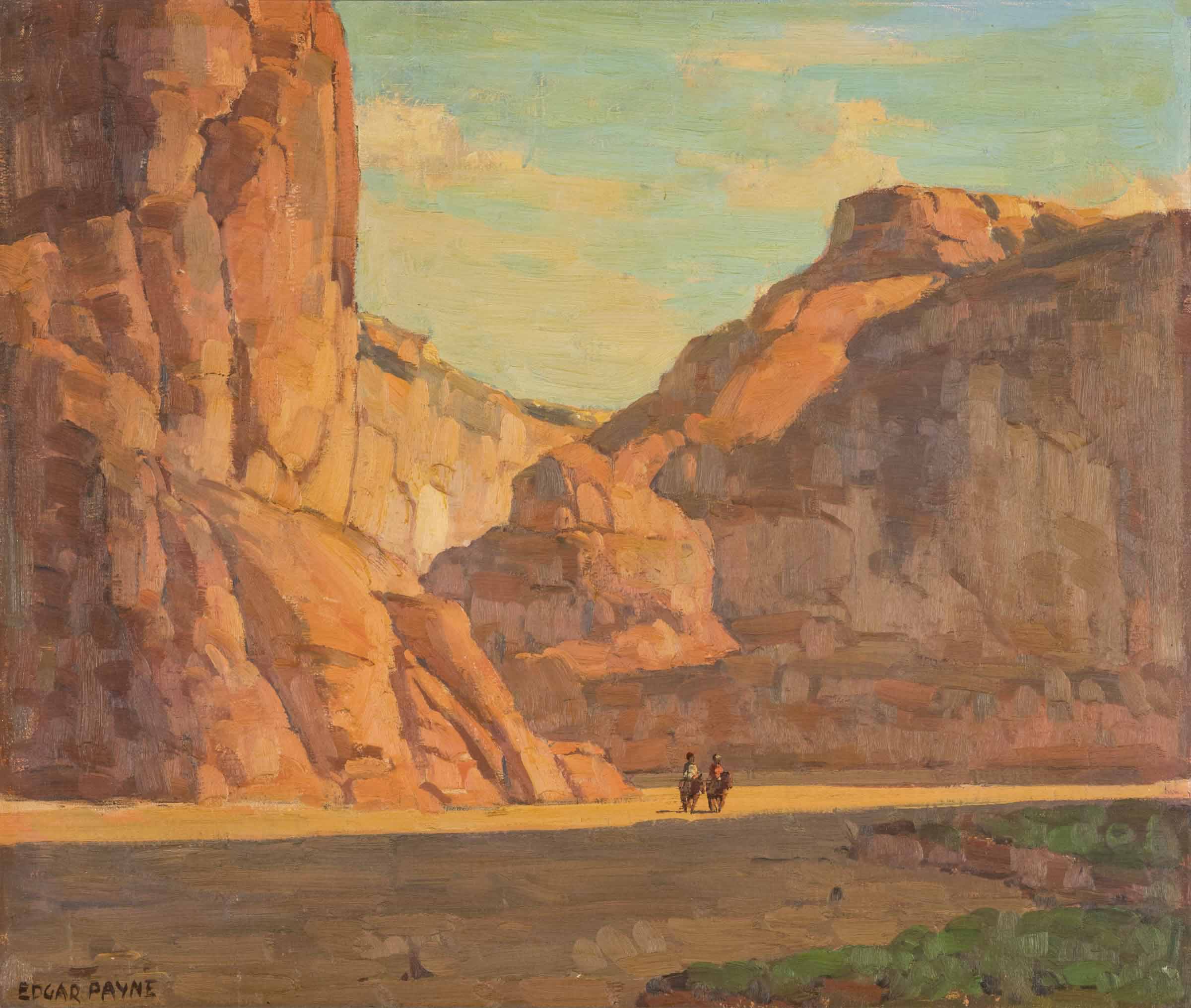
Edgar Alwin Payne first visited and painted Canyon de Chelly—a cluster of several canyons, including Canyon del Muerto, in northeastern Arizona—in 1917.1 Commissioned by the Santa Fe Railroad to record the journey from Albuquerque to California, Payne spent four months exploring the canyons, and the artwork he produced cemented his status as one of the period’s leading Western American artists. In Canyon de Muerto, Payne is largely concerned with capturing the scale of the canyon’s 1,000-foot-tall walls. The painting is composed so that the sandstone rock formations extend beyond the boundaries of the frame, taking up over two-thirds of the canvas and rationing the view of the sky. Two strategically positioned horseback riders provide the viewer a reference point for apprehending such dramatic proportions.
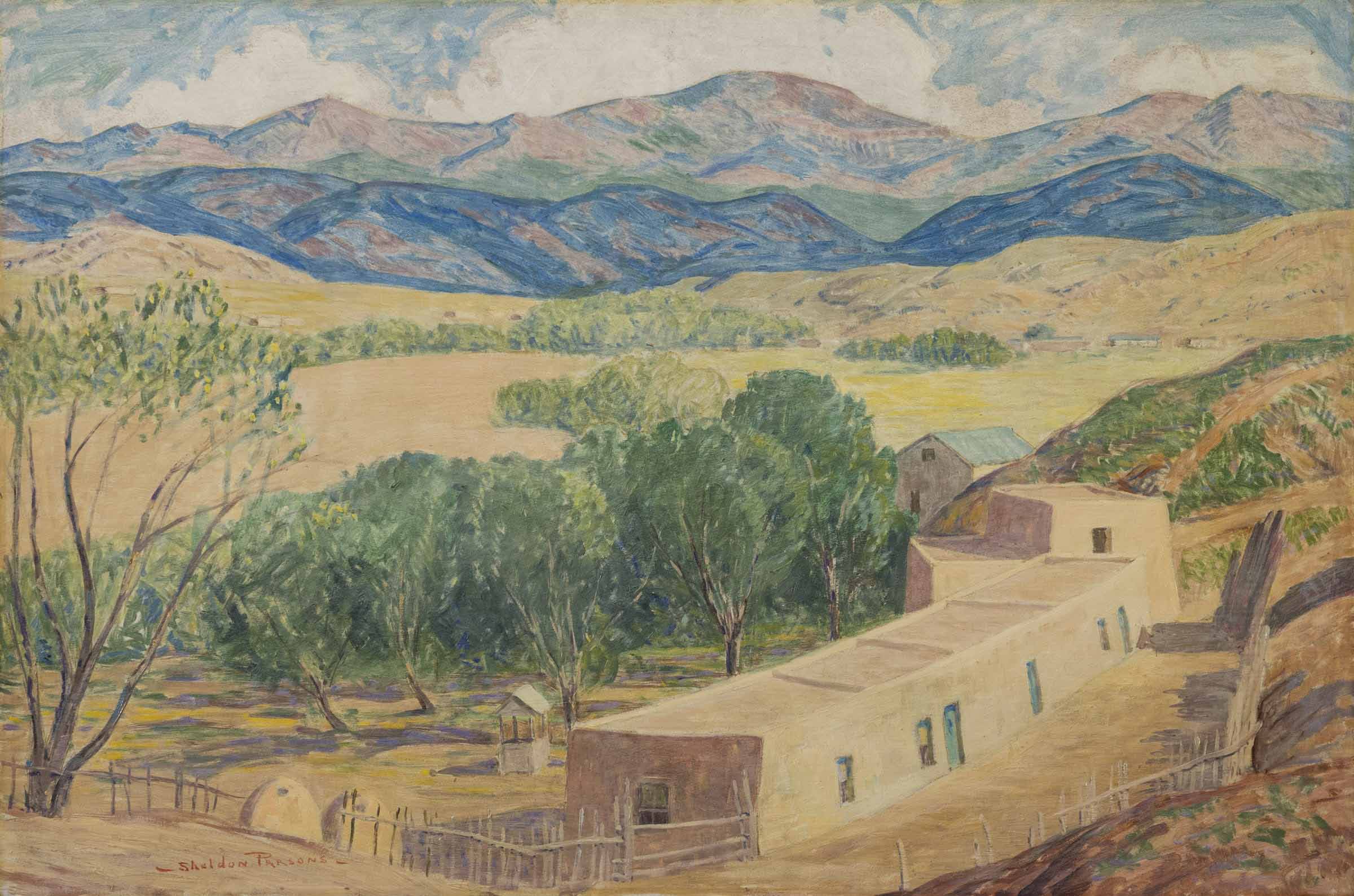
Sheldon Parsons’ career spanned the first half of the 20th century, when one avant-garde art movement after another rose to defy convention and challenge the foundations of Western American art. As an artist and curator, Parsons bridged the professional divide between “realism” and “modernism”—he both promoted traditional standards while being open to new approaches. His more “realistic” side is at play in Nambe Valley, Summer. The painting adheres to the major conventions of Western art: it is composed according to a clearly defined foreground, middle ground, and background; it takes a panoramic perspective on the landscape; its color palette is tightly controlled; and its brushwork delivers a high degree of finish.
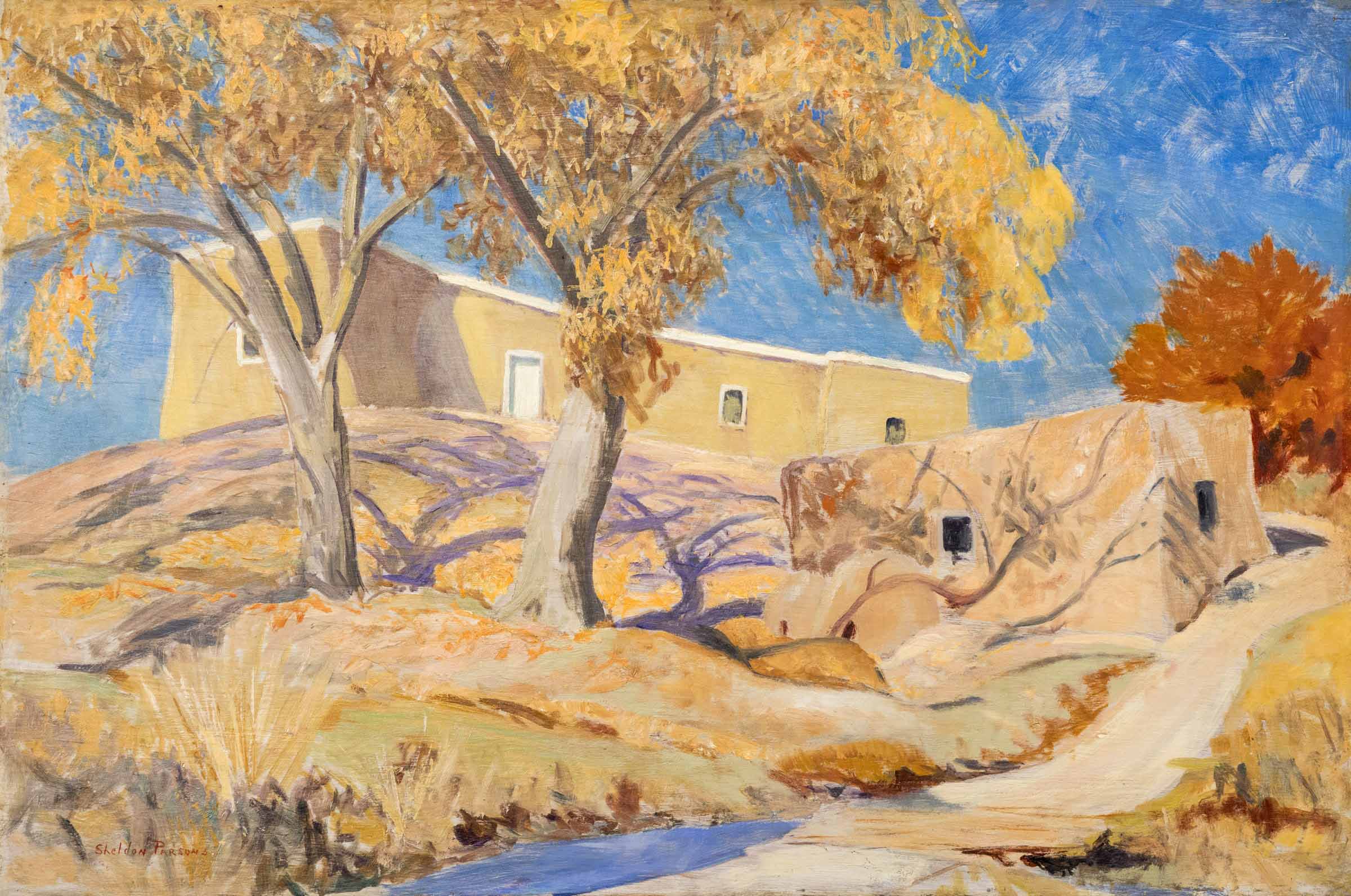
Sheldon Parsons, a leader within the growing Santa Fe artist colony at the beginning of the 20th century, took both sides in the era’s hotly contested artistic debate between “realism” and “modernism” in Western American art, promoting traditional standards without dismissing unconventional ideas. As his career matured, however, Parsons became increasingly experimental in his practice, and bold use of complementary colors became a trademark of the artist’s in his last decade (Parsons died in 1943). In Casa on the Hill, a mix of warm yellow and orange autumn hues stand out against a loosely brushed bright blue sky. Note how the purple shadows cast by towering trees in a latticework pattern on a green-glazed ground make the painting a dance of color.

This Diné (Navajo) sandpainting-style wall painting is the counterpart to one painted on the wall opposite in the rear lobby of the first floor the New Deal McKinley County Courthouse in 1939, reportedly by “a young Navajo painter.”1 (These sandpainting-style wall paintings are two of sixteen total such decorations.) This design is perhaps an iteration of the customary Diné sandpainting symbol representing the sun, while its companion painting likely represents the moon. Unlike its companion, however, it was partially removed when an elevator was installed in the building and an arched doorway created to provide access, and is now missing its left portion.
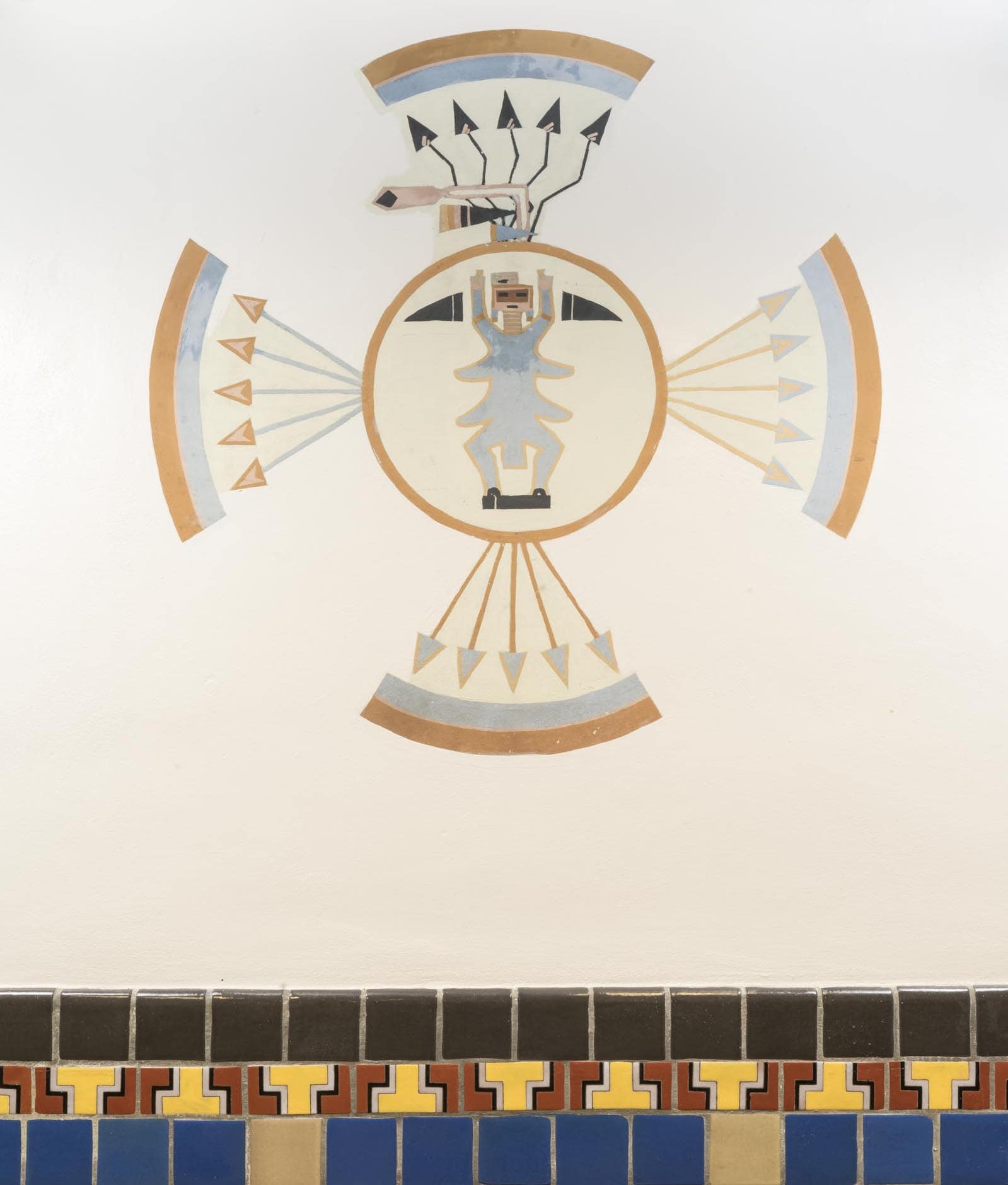
This Diné (Navajo) sandpainting-style wall painting is one of sixteen such murals reportedly painted by “a young Navajo painter”1 in 1939 to decorate the first-floor lobby of the historic McKinley County Courthouse, which was built through the New Deal and opened that same year. It is part of a set of two, as almost all of the courthouse wall paintings are. Its counterpart was painted directly across on the opposite wall. This design is perhaps an iteration of the customary Diné sandpainting symbol representing the moon, while its companion piece likely represents the sun. Unlike its counterpart, however, this painting is still largely intact—look closely to see how efforts have been made to preserve it over time by painting around it (the original wall color appears light green).

