


From 1939 to 1942, the Laboratory of Anthropology in Santa Fe sponsored a New Deal Federal Art Project initiative to create a portfolio of fifteen Navajo weaving designs drawn from its collections, and hired artist Louie Ewing to orchestrate the effort. The silkscreen printing process was a relatively new technology to the United States, so Ewing, with assistance from fellow artist Eliseo Rodriguez, had to essentially invent his own version of it. Two hundred of each print were produced. Prints were distributed to the Bureau of Indian Affairs and federal government “Indian service schools,” as well as universities, libraries, and museums nationwide for instructional and educational purposes.
Color: Pink
Navajo Blanket Portfolio – Plate 9

From 1939–1942, the Laboratory of Anthropology in Santa Fe sponsored a New Deal Federal Art Project initiative to create a portfolio of fifteen Navajo weaving designs drawn from its collections, and hired artist Louie Ewing to orchestrate the effort. The silkscreen printing process was a relatively new technology to the United States, so Ewing, with assistance from fellow artist Eliseo Rodriguez, had to essentially invent his own version of it. Two hundred of each print were produced. Prints were distributed to the Bureau of Indian Affairs and federal government “Indian service schools,” as well as universities, libraries, and museums nationwide for instructional and educational purposes.
Navajo Blanket Portfolio – Plate 3

From 1939–1942, the Laboratory of Anthropology in Santa Fe sponsored a New Deal Federal Art Project initiative to create a portfolio of fifteen Navajo weaving designs drawn from its collections, and hired artist Louie Ewing to orchestrate the effort. The silkscreen printing process was a relatively new technology to the United States, so Ewing, with assistance from fellow artist Eliseo Rodriguez, had to essentially invent his own version of it. Two hundred of each print were produced. Prints were distributed to the Bureau of Indian Affairs and federal government “Indian service schools,” as well as universities, libraries, and museums nationwide for instructional and educational purposes.
Untitled (Navajo Girl with Lamb)
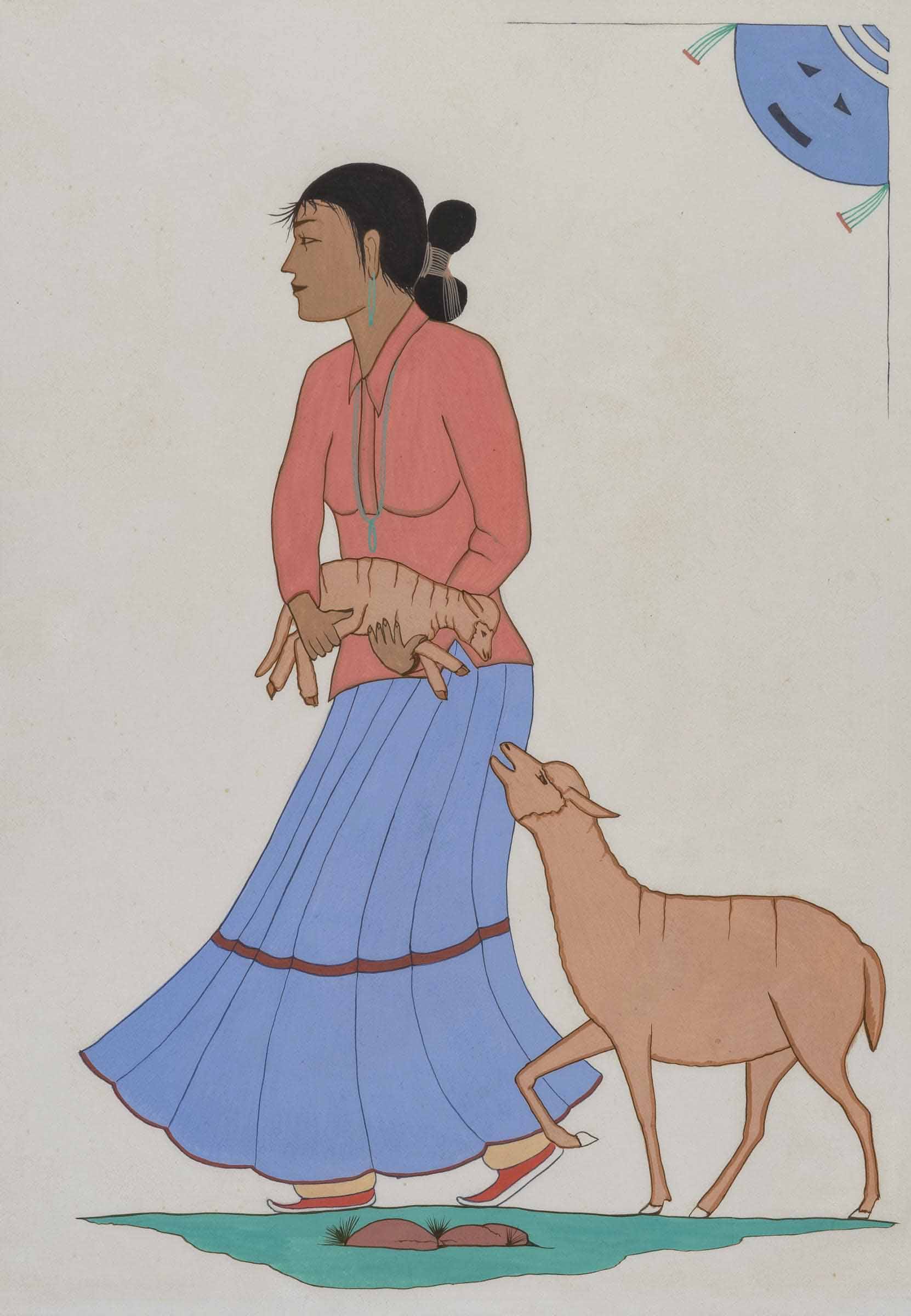
Untitled (Navajo Girl with Lamb) reveals how the flat aesthetic of the 1930s Studio Style, which dictated Native American painting for the first half of the 20th century and beyond, curtailed artists’ ability to communicate meaning. As told in the Studio Style, Timothy Begay’s (Diné/Navajo) story of the sacred and spiritual relationship between his people and their sheep is reduced to a pleasing, decorative scene.
Shiprock

Erik Barger had a short career as a painter in New Mexico in the 1940s during which he depicted several iconic natural landmarks in and around the Gallup area, including Shiprock (Tsé Bitʼaʼí—“winged rock”—in Diné/Navajo), a towering geological formation dramatically interpreted by the artist through bold contours and contrasting colors.