Zuni Pottery Makers

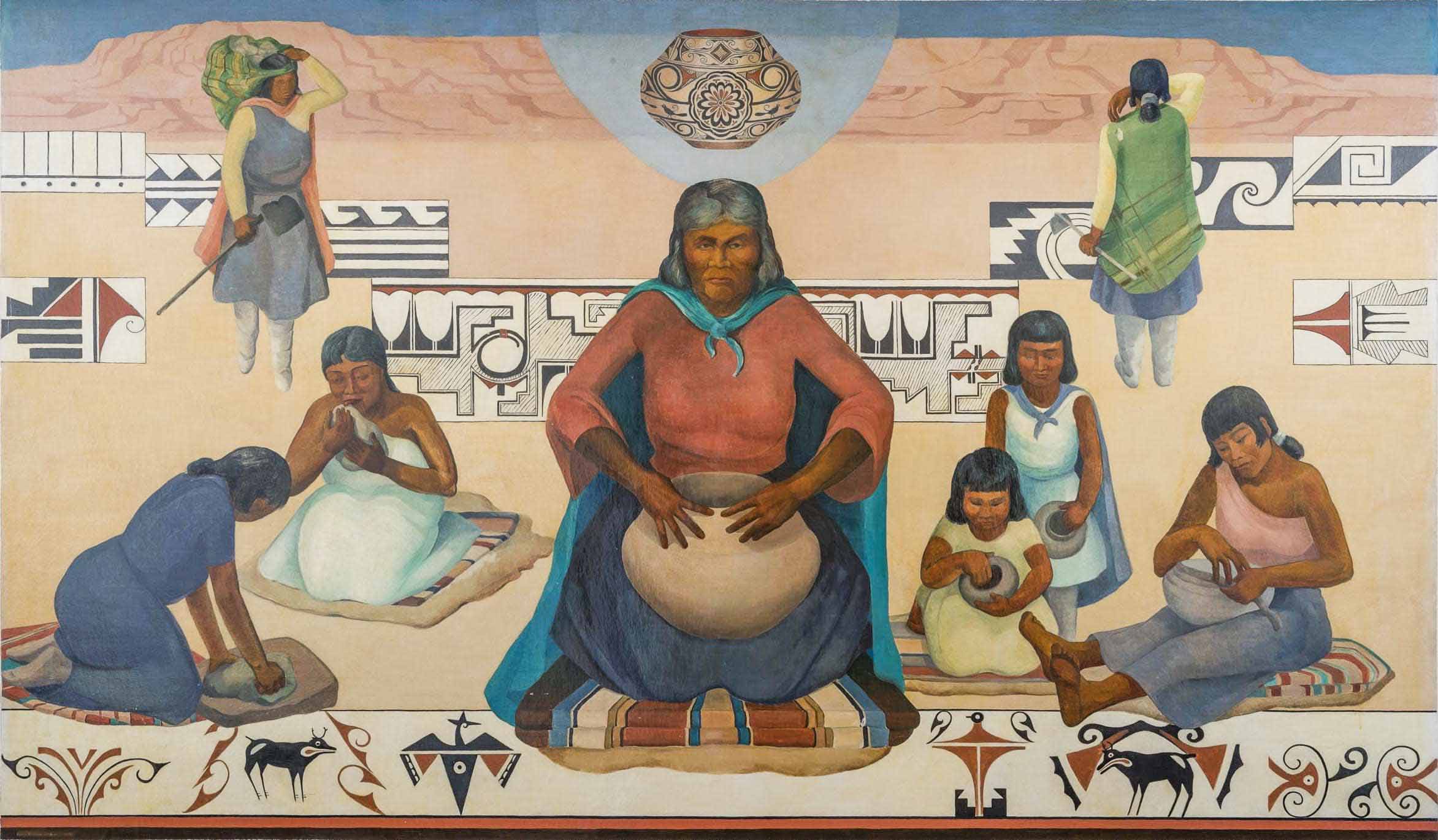
“In this mural the artist has attempted to . . . put on canvas for the observers to see what the Zuni pottery maker has in her conscious and subconscious mind as she makes her pot, the traditions of gathering and working the clay, the religious beliefs and fervor, the history of her people and their traditions which go to make up this her work [sic],” wrote Anna Keener Wilton1 of her painting Zuni Pottery Makers in a 1942 thesis for her master’s degree from the University of New Mexico.2

In her essay, Keener Wilton positions Zuni Pottery Makers as a documentary painting—based on anthropological and ethnographic research, at least one interview with a potter, and, presumably, her own firsthand observations—that illustrates the A:Shiwi (Zuni) pottery-making process step by step. Keener Wilton’s mural is organized around a central master potter (more on her later). As she explains it, the narrative begins with the figure in the top right starting her journey to gather clay from the distant mesas by, “in accordance with the tradition of the pot maker . . . cast[ing] over her shoulder a stone, so that her strength may not fail her.” The same figure is depicted at top left “returning with a load of clay, as much as a hundred and fifty pounds in her blanket, the ends tied and banded across her forehead.” Keener Wilton continues, “in the left foreground we see the next step of the process, the clay being kneaded,” and explains that potters knead the clay to such a fine texture “that the fingers can no longer guide the senses; then it is tested with the tongue as portrayed by the figure above the kneader.” Finally, “to the observer’s right are to be seen the youthful apprentices, forming in the age-old method of their ancestors, the pots of modern Zuni.”3

Zuni Pottery Makers also documents the evolution of A:Shiwi pottery designs. As Keener Wilton writes: “By the use of panels in the composition the artist has attempted to portray the various stages in the development of pottery design from the earliest known period to the present day.” Early designs are replicated in the upper left, later designs in the upper right, and contemporary designs in the middle. “Along the border at the base of the composition are six relatively modern designs . . . of a religious nature.” She also states that she “wishes to point out that every example of design portrayed on the mural has been found in existence in or near Gallup, New Mexico” (though certain designs have been questioned by present-day potters).

In addition to diagramming the process and development of A:Shiwi pottery, Keener Wilton puts forth several major contentions in her essay: a) for a Zuni potter, “her work is born with her”; b) Zuni pottery is the highest form and full expression of Zuni culture; and, c) Zuni potters are great artists. In support of these statements, she places at the center of her mural a potter referred to in her essay as “Mrs. Poncho”4—one of her primary sources for her thesis. Mrs. Poncho is shown demonstrating “how she . . . measures [the pot] by spreading her hands so as to obtain the exact spacing for the design she has visualized,” which is pictured above her head “surrounded by a halo.” In her essay, Keener Wilton quotes Mrs. Poncho as saying, “I always know just how the jar will look before I start to paint it. I just think and think; then I draw what I think.” She goes on to assert her artistic genius as being able to conceive of the pot and design in unison and defends against assumptions of “mere decoration.”

Zuni Pottery Makers was likely installed in the wall of the original County Commission chambers of the historic McKinley County Courthouse soon after it was built. It still hangs in that location, which is now the District Attorney’s office.
Untitled

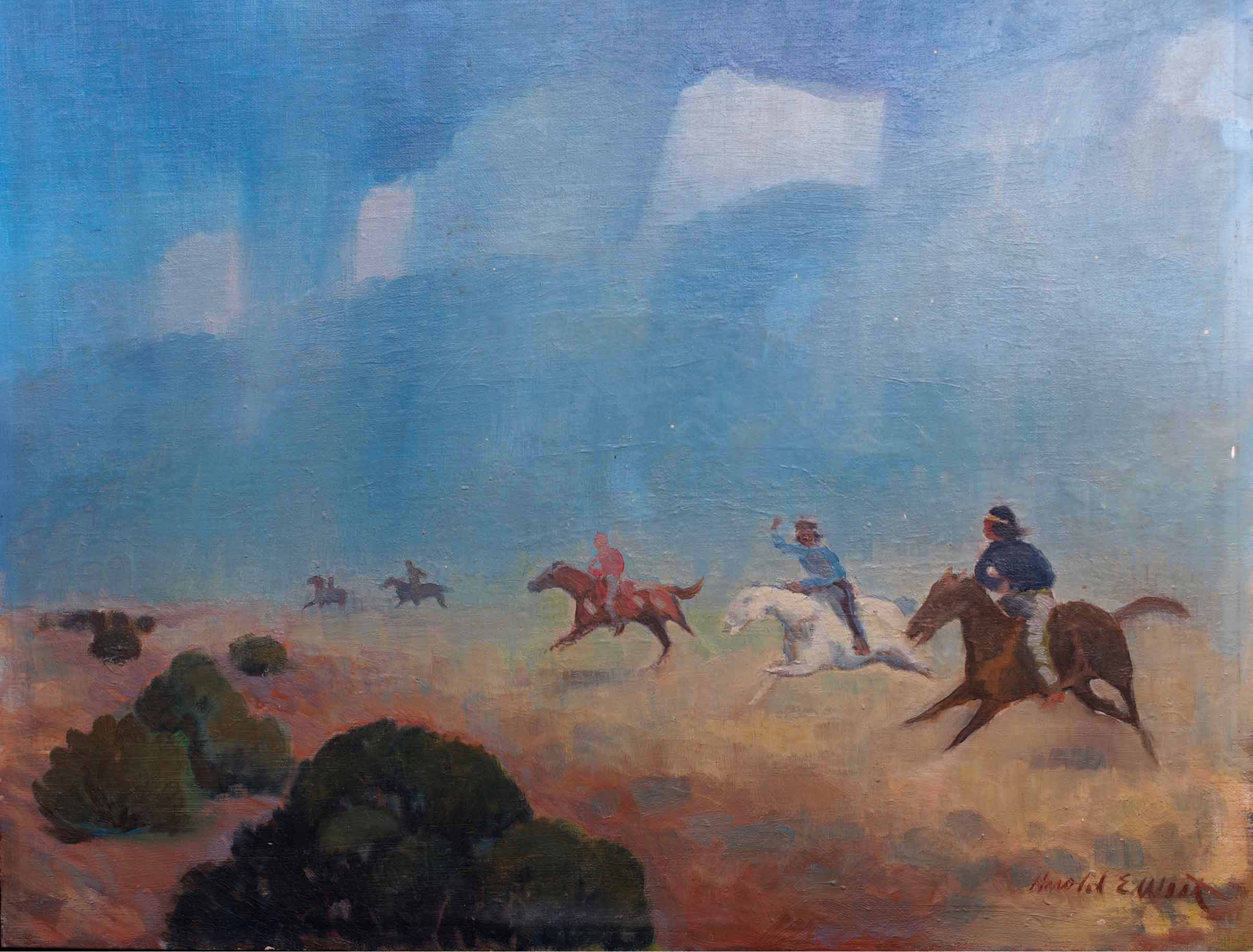
Already established as a commercial printmaker, Harold E. West credits the New Deal for launching his career in painting. Producing work for New Mexico’s Federal Art Project in the late 1930s, he quickly became well known for images of “frontier” life—cowboys, homesteads, ranch animals. In this painting, expert horsemen kick up dust as they race through a range of grass and rabbitbrush. West captures their speed and agility in a blur of brushstrokes and evokes the sensations of a loud stampede of hooves, whooshing air, and an adrenaline-charged shout.

Tilework

The first floor of the 1938 McKinley County Courthouse remains largely in its original condition, including its terrazzo flooring and tile wainscoting. While it is not known where or by whom these tiles were manufactured, it is probable that they are the output of a New Deal era vocational school or workshop. They appear to be designed and made specifically for the courthouse to complement its Southwestern architecture and the many Diné (Navajo) sandpainting-style wall paintings and Nuevomexicano tinwork light fixtures decorating its lobby. The primary pattern within the installation, seen in the arrangement of tan and blue tiles along the wide middle band, is a familiar alternating stepped-triangle design found in Diné weavings and baskets. Additionally, the motif of the second-to-top row of tiles echoes that of Ancestral Puebloan T-shaped doors (which are also used in the architecture of the courthouse in two instances).

(Note: The painted “District Attorney” sign seen in this photograph is a recent addition done in the same lettering style used in 1939 when the courthouse was opened.)

Tinwork Light

As a decorative art, tinwork has been practiced in the area that is now New Mexico for over 300 years. Originally developed by 18th-century Spanish colonists, it is a mestizaje, or hybrid, art form. As seen here, the practice combines Spanish motifs of rosettes and scallops with Indigenous designs of parrots and rainbows to create a distinctly “New Mexican” cultural expression.

Tinwork Light

New Deal art programs were broadly interested in cultivating a unique American artistic identity and in establishing the United States as an arts and cultural center with its own rich legacy and heritage separate from that of Europe. Toward that end, New Mexico’s Federal Art Project (FAP) heavily promoted Spanish Colonial art forms specific to what is now the Southwestern United States. Tinwork was developed by Spanish colonists in what is now New Mexico in the 1700s and became widely practiced after the opening of the Santa Fe Trail in 1821 and the corresponding increase in trade. The New Mexico FAP picked up the mantle of the tradition by directing the state’s workshop programs to train artists in the craft and to produce objects such as this light fixture, frames, and other decorative arts for newly constructed buildings.

Chief Deer (Sioux Indian)

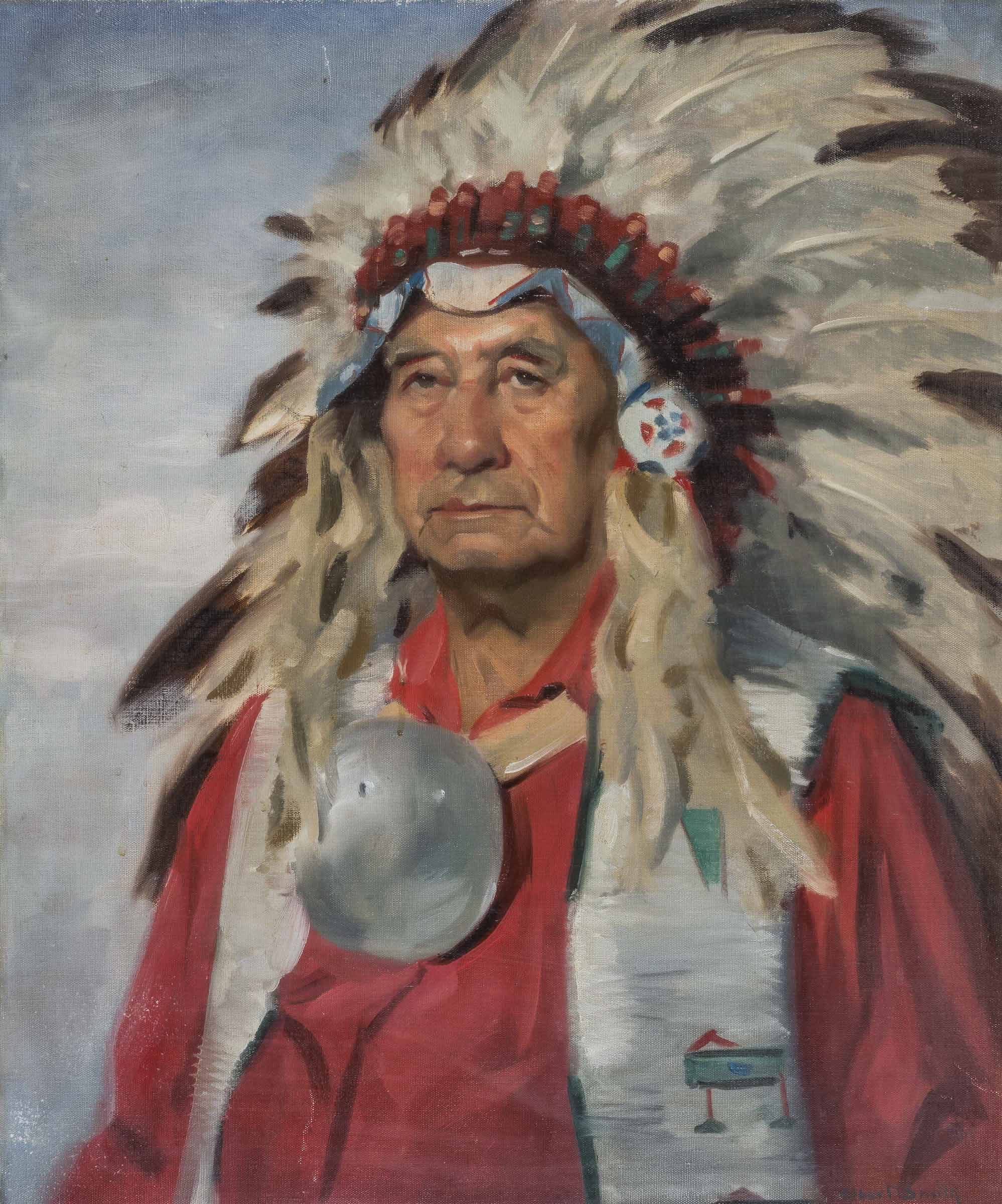
This painting by Albert Delmont Smith, a New York City-based society portraitist, is an enigma. The sitter has not been identified and it is not known for whom or for what reason it was made. It is likely the painting was donated by the artist to the Gallup Art Center, along with The Half-Breed (which may or may not be a companion portrait).

Poster for the Indian Court Federal Building

In 1939, San Francisco hosted the Golden Gate International Exposition to celebrate the opening of the San Francisco—Oakland Bay and Golden Gate Bridges and the theme of “Pacific Unity.” The Exposition included an “Indian Court” exhibit organized by the newly established Indian Arts & Crafts Board (IACB) with art displays, a vendor marketplace, artist demonstrations, and guided tours. These posters, produced by Louis Siegriest for the IACB in partnership with another New Deal program, the Federal Art Project, promote The Indian Court’s conception and representation of “eight great areas of Indian culture,” including the “Fishermen of the Northwest Coast,…Buffalo Hunters of the Plains,…the Cornplanters of the Pueblos, [and] the Navajo Shepherds”—Gallup’s collection includes only four of the eight total posters. The imagery is borrowed from Indigenous artists, who received little or no recognition. Siegriest created the poster designs but “had nothing to do with the actual process,” meaning he didn’t make the screens or pull the prints; “I would see that they got out,” he recalled. “I think they got out 1,500 of each poster.”1

Poster for the Indian Court Federal Building

In 1939, San Francisco hosted the Golden Gate International Exposition to celebrate the opening of the San Francisco—Oakland Bay and Golden Gate Bridges and the theme of “Pacific Unity.” The Exposition included an “Indian Court” exhibit organized by the newly established Indian Arts & Crafts Board (IACB) with art displays, a vendor marketplace, artist demonstrations, and guided tours. These posters, produced by Louis Siegriest for the IACB in partnership with another New Deal program, the Federal Art Project, promote The Indian Court’s conception and representation of “eight great areas of Indian culture,” including the “Fishermen of the Northwest Coast,…Buffalo Hunters of the Plains,…the Cornplanters of the Pueblos, [and] the Navajo Shepherds”—Gallup’s collection includes only four of the eight total posters. The imagery is borrowed from Indigenous artists, who received little or no recognition. Siegriest created the poster designs but “had nothing to do with the actual process,” meaning he didn’t make the screens or pull the prints; “I would see that they got out,” he recalled. “I think they got out 1,500 of each poster.”1

Poster for the Indian Court Federal Building

In 1939, San Francisco hosted the Golden Gate International Exposition to celebrate the opening of the San Francisco—Oakland Bay and Golden Gate Bridges and the theme of “Pacific Unity.” The Exposition included an “Indian Court” exhibit organized by the newly established Indian Arts & Crafts Board (IACB) with art displays, a vendor marketplace, artist demonstrations, and guided tours. These posters, produced by Louis Siegriest for the IACB in partnership with another New Deal program, the Federal Art Project, promote The Indian Court’s conception and representation of “eight great areas of Indian culture,” including the “Fishermen of the Northwest Coast,…Buffalo Hunters of the Plains,…the Cornplanters of the Pueblos, [and] the Navajo Shepherds”—Gallup’s collection includes only four of the eight total posters. The imagery is borrowed from Indigenous artists, who received little or no recognition. Siegriest created the poster designs but “had nothing to do with the actual process,” meaning he didn’t make the screens or pull the prints; “I would see that they got out,” he recalled. “I think they got out 1,500 of each poster.”1

The Engineer

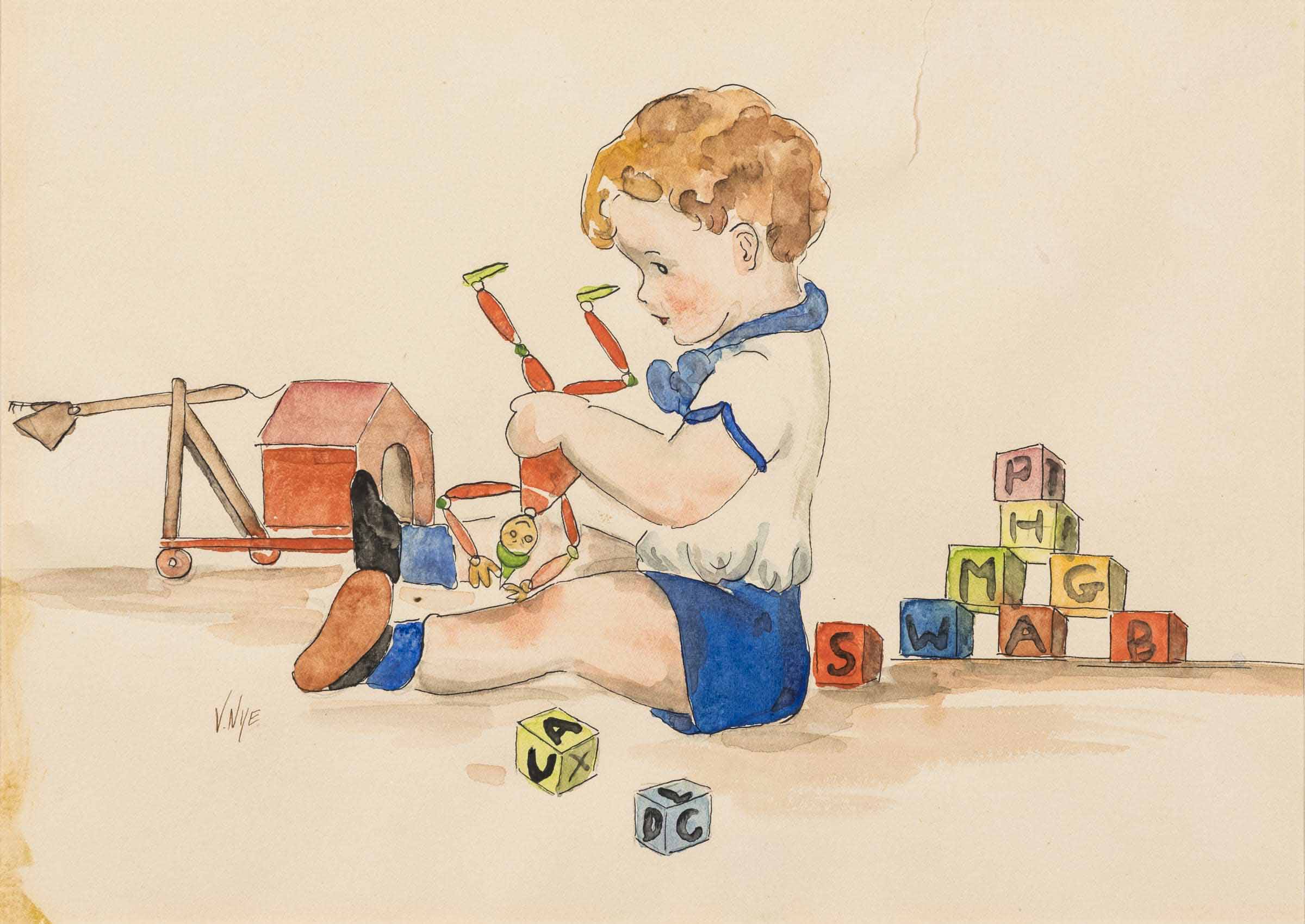
Records indicate Virginia Nye’s art career essentially started and ended with the New Deal. One of her major contributions was hand-coloring printed plates for the Portfolio of Spanish Colonial Design in New Mexico. In The Engineer, we see Nye’s keen eye for illustration, which is especially smart in its use of primary colors to enhance the image of a playful preschooler.

What are you looking for?

Art Collection

Gallup’s New Deal art collection consists of over 120 objects created, purchased, or donated from 1933 to 1942 through New Deal federal art programs administered by President Franklin D. Roosevelt to support artists during the Great Depression.

Main Menu

Image Use Notice: Images of Gallup’s New Deal artworks are available to be used for educational purposes only. Non-collection images are subject to specific restrictions and identified by a © icon. Hover over the icon for copyright info. Read more