


D. Paul Jones’s artistic career, in terms of both production and exhibition, was largely concentrated in and around the Española valley area of New Mexico, countryside studiously represented in Spring Landscape. The artist would have been intimately familiar with the view: a mountain range on the horizon borders a valley blanketed in plowed and planted fields, where squat adobe dwellings nestle among cottonwood trees.
Color: White
Untitled (Apache Crown Dancer)

Trained in the Studio Style by Dorothy Dunn at the Santa Fe Indian School between 1936 and 1937, Allan Houser (Chiricahua Apache) worked in this “flat” style during the New Deal and at the start of his career, on his way to becoming a trailblazing 20th-century artist. Even in this early work, one can see Houser pushing the boundaries of the conventions of the era, painting the dancer’s movements with palpable energy and power.
Under Western Skies—New Mexico

Albert Lorey Groll was heralded in his time as the “greatest of American sky painters.” Over the course of his career, he frequently depicted classic Southwestern vistas of limitless sky, bountiful clouds, and the repetition of increasingly distant mesas and mountains.
Untitled (Red Rocks)

Albert Lorey Groll, a foundational Western American artist, was acclaimed for his ability to capture the sweeping blue expanse and billowing cloud formations of desert skies. In Untitled (Red Rocks), he expertly takes the viewer on a visual journey through seemingly unbounded time and space.
Kit Carson House Taos, N.M.
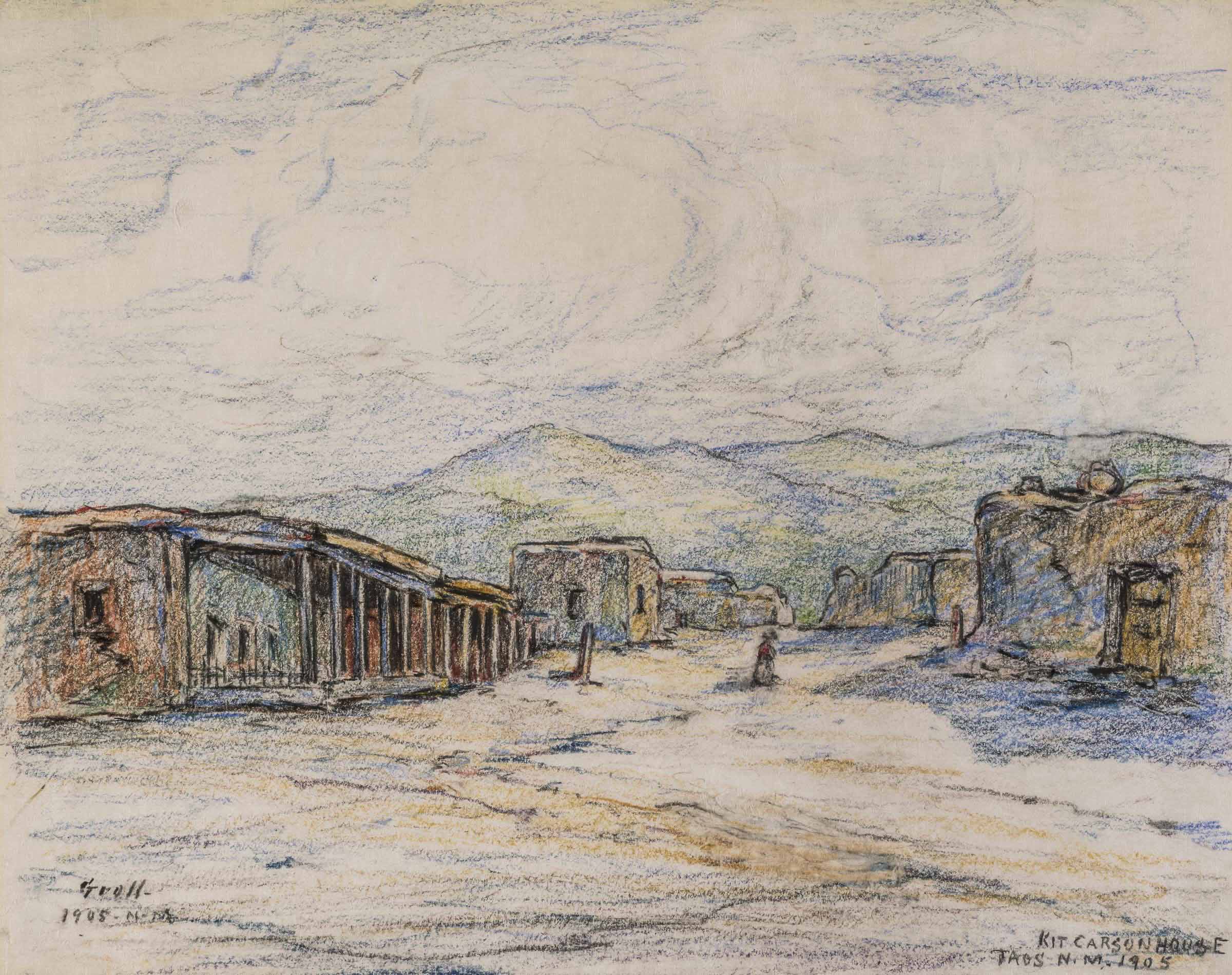
Albert Lorey Groll first visited Arizona and New Mexico in 1904, and he would continue to make frequent trips to the West for the next four decades. Kit Carson House Taos, N.M., made in 1905, takes as its subject the adobe residence of an (in)famous frontiersman, trapper, military commander, and Indian Agent. As such, it encompasses the problematic narratives of the “Wild West”—stereotypes of “Cowboys and Indians,” expansive and rugged landscapes, and remote outposts—in which the Western American art movement was rooted and which it also promoted.
Inscription Rock—N. Mexico
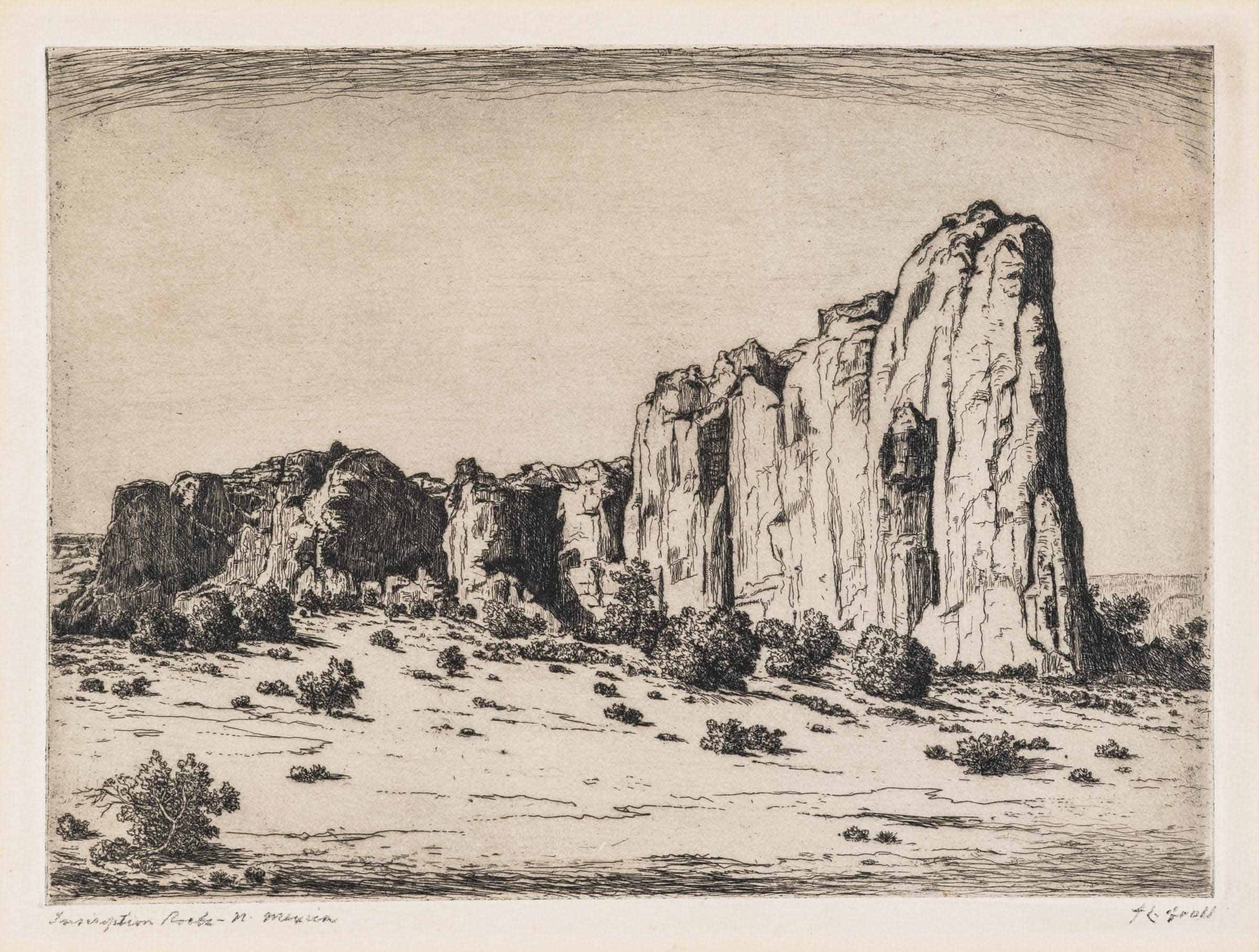
In the early 1900s and for the next four decades, New York–based artist Albert Lorey Groll made numerous trips to the Southwest and produced paintings, etchings, and works on paper that introduced East Coast audiences to novel (for them) landscapes. Some of the places he pictured, though famous now, were only just gaining national recognition at the time of his travels. For example, the Grand Canyon, which Groll repeatedly visited and sketched, was made a National Park in 1919. Likewise, El Morro National Monument, the subject of Inscription Rock—N. Mexico, was designated in 1909.
West Wind
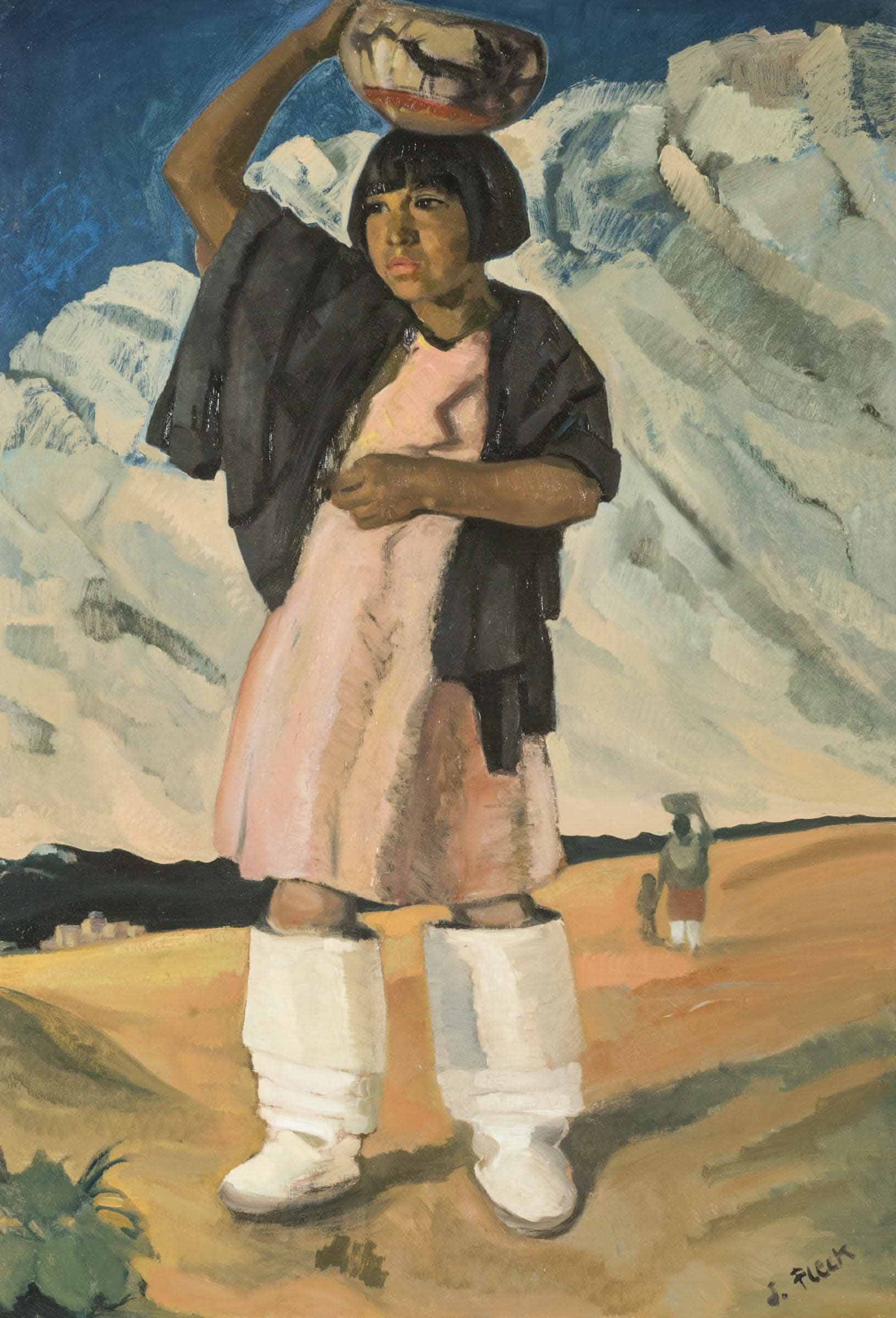
In this full-length portrait, Joseph Fleck monumentalizes the figure of a Pueblo woman: she is as tall as the clouds—the top of her hand cannot even be contained by the canvas—and she is pictured at an oblique angle that exaggerates her proportions. The overall effect is to evoke the perceived mythology of its Native subject—a significant focus of Western American art at the turn of the 20th century and in the following decades. Visual references to Taos Mountain and the ancient Taos Pueblo complex in the distance, as well as to the cultural and generational practice of gathering water (note the woman and child in the background) underscore the painting’s concepts of timelessness and natural harmony.
Navajo Blanket Portfolio – Plate 15

From 1939–1942, the Laboratory of Anthropology in Santa Fe sponsored a New Deal Federal Art Project initiative to create a print portfolio of fifteen Navajo weaving designs drawn from its collections, and hired artist Louie Ewing to orchestrate the effort. The silkscreen printing process was a relatively new technology to the United States, so Ewing, with assistance from fellow artist Eliseo Rodriguez, had to essentially invent his own version of it. Two hundred of each print were produced. Prints were distributed to the Bureau of Indian Affairs and federal government “Indian service schools,” as well as universities, libraries, and museums nationwide for instructional and educational purposes.
Navajo Blanket Portfolio – Plate 14

From 1939–1942, the Laboratory of Anthropology in Santa Fe sponsored a New Deal Federal Art Project initiative to create a portfolio of fifteen Navajo weaving designs drawn from its collections, and hired artist Louie Ewing to orchestrate the effort. The silkscreen printing process was a relatively new technology to the United States, so Ewing, with assistance from fellow artist Eliseo Rodriguez, had to essentially invent his own version of it. Two hundred of each print were produced. Prints were distributed to the Bureau of Indian Affairs and federal government “Indian service schools,” as well as universities, libraries, and museums nationwide for instructional and educational purposes.
Navajo Blanket Portfolio – Plate 12

From 1939–1942, the Laboratory of Anthropology in Santa Fe sponsored a New Deal Federal Art Project initiative to create a portfolio of fifteen Navajo weaving designs drawn from its collections, and hired artist Louie Ewing to orchestrate the effort. The silkscreen printing process was a relatively new technology to the United States, so Ewing, with assistance from fellow artist Eliseo Rodriguez, had to essentially invent his own version of it. Two hundred of each print were produced. Prints were distributed to the Bureau of Indian Affairs and federal government “Indian service schools,” as well as universities, libraries, and museums nationwide for instructional and educational purposes.