


In 1939, San Francisco hosted the Golden Gate International Exposition to celebrate the opening of the San Francisco—Oakland Bay and Golden Gate Bridges and the theme of “Pacific Unity.” The Exposition included an “Indian Court” exhibit organized by the newly established Indian Arts & Crafts Board (IACB) with art displays, a vendor marketplace, artist demonstrations, and guided tours. These posters, produced by Louis Siegriest for the IACB in partnership with another New Deal program, the Federal Art Project, promote The Indian Court’s conception and representation of “eight great areas of Indian culture,” including the “Fishermen of the Northwest Coast,…Buffalo Hunters of the Plains,…the Cornplanters of the Pueblos, [and] the Navajo Shepherds”—Gallup’s collection includes only four of the eight total posters. The imagery is borrowed from Indigenous artists, who received little or no recognition. Siegriest created the poster designs but “had nothing to do with the actual process,” meaning he didn’t make the screens or pull the prints; “I would see that they got out,” he recalled. “I think they got out 1,500 of each poster.”1
New Deal Contribution: Project Artists
Poster for the Indian Court Federal Building

In 1939, San Francisco hosted the Golden Gate International Exposition to celebrate the opening of the San Francisco—Oakland Bay and Golden Gate Bridges and the theme of “Pacific Unity.” The Exposition included an “Indian Court” exhibit organized by the newly established Indian Arts & Crafts Board (IACB) with art displays, a vendor marketplace, artist demonstrations, and guided tours. These posters, produced by Louis Siegriest for the IACB in partnership with another New Deal program, the Federal Art Project, promote The Indian Court’s conception and representation of “eight great areas of Indian culture,” including the “Fishermen of the Northwest Coast,…Buffalo Hunters of the Plains,…the Cornplanters of the Pueblos, [and] the Navajo Shepherds”—Gallup’s collection includes only four of the eight total posters. The imagery is borrowed from Indigenous artists, who received little or no recognition. Siegriest created the poster designs but “had nothing to do with the actual process,” meaning he didn’t make the screens or pull the prints; “I would see that they got out,” he recalled. “I think they got out 1,500 of each poster.”1
Quenching Their Thirst

Eliseo Rodriguez1 is best known for reviving the 18th/19th-century Spanish Colonial art of straw appliqué as a New Deal artist, but he was also a highly accomplished painter, though few of the paintings he made for the Federal Art Project are credited to him. Despite the lack of credit often afforded artists of color by New Deal art programs (and conventional Eurocentric art historical scholarship), Rodriguez was a multitalented modern artist who significantly contributed to the development of the Santa Fe art colony in the first half of the 20th century and beyond. In Quenching Their Thirst, Rodriguez employs confident, bold lines and a primary color palette to show a scene of everyday Hispano life in New Mexico and at the same time refer to the biblical parable of Jesus and the woman at the well. Author Carmella Padilla explains that “Rodriguez’s devout spirituality and personal religious experience infused his paintings with a special soulfulness.”2
The Engineer
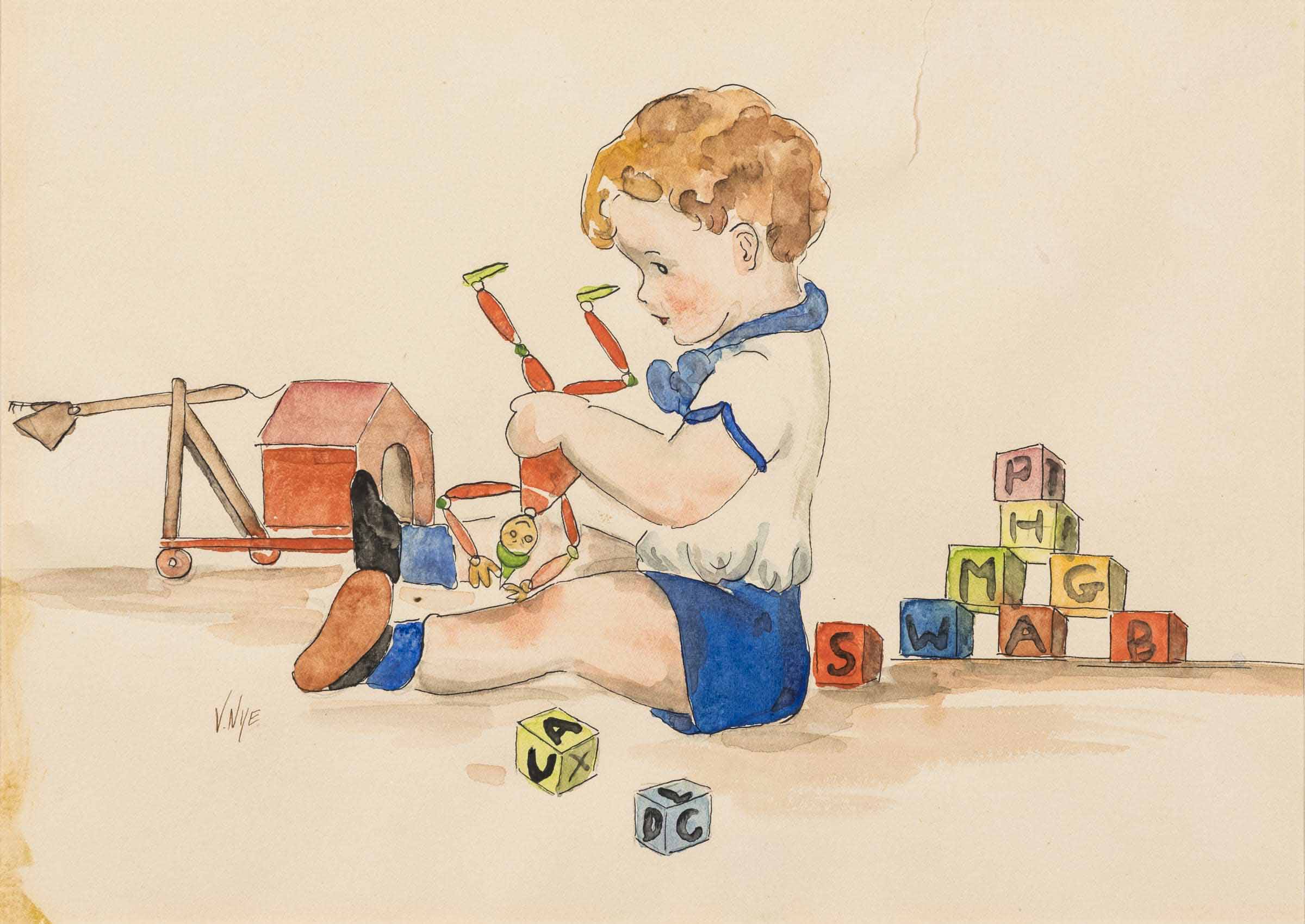
Records indicate Virginia Nye’s art career essentially started and ended with the New Deal. One of her major contributions was hand-coloring printed plates for the Portfolio of Spanish Colonial Design in New Mexico. In The Engineer, we see Nye’s keen eye for illustration, which is especially smart in its use of primary colors to enhance the image of a playful preschooler.
Sandpainting-style Wall Painting (Ripener)

Pictured here is a Diné (Navajo) sandpainting-style wall painting depicting a “ripener” (sometimes referred to as a “cornbeetle”). This and an identical wall painting flank the interior door of the main entrance1 to the historic McKinley County Courthouse. Reportedly painted by “a young Navajo painter”2 in 1939, the same year the New Deal building opened, these murals depict an insect that derives from Diné cosmology and is associated with blessings. All of the sixteen sandpainting-style wall paintings decorating the lobby of the courthouse have similar associations with blessings and guardianship, and they are all arranged in pairs that flank entrances, lobbies, and passageways in order to protect and grace the space.
Sandpainting-style Wall Painting (Buffalo Person)
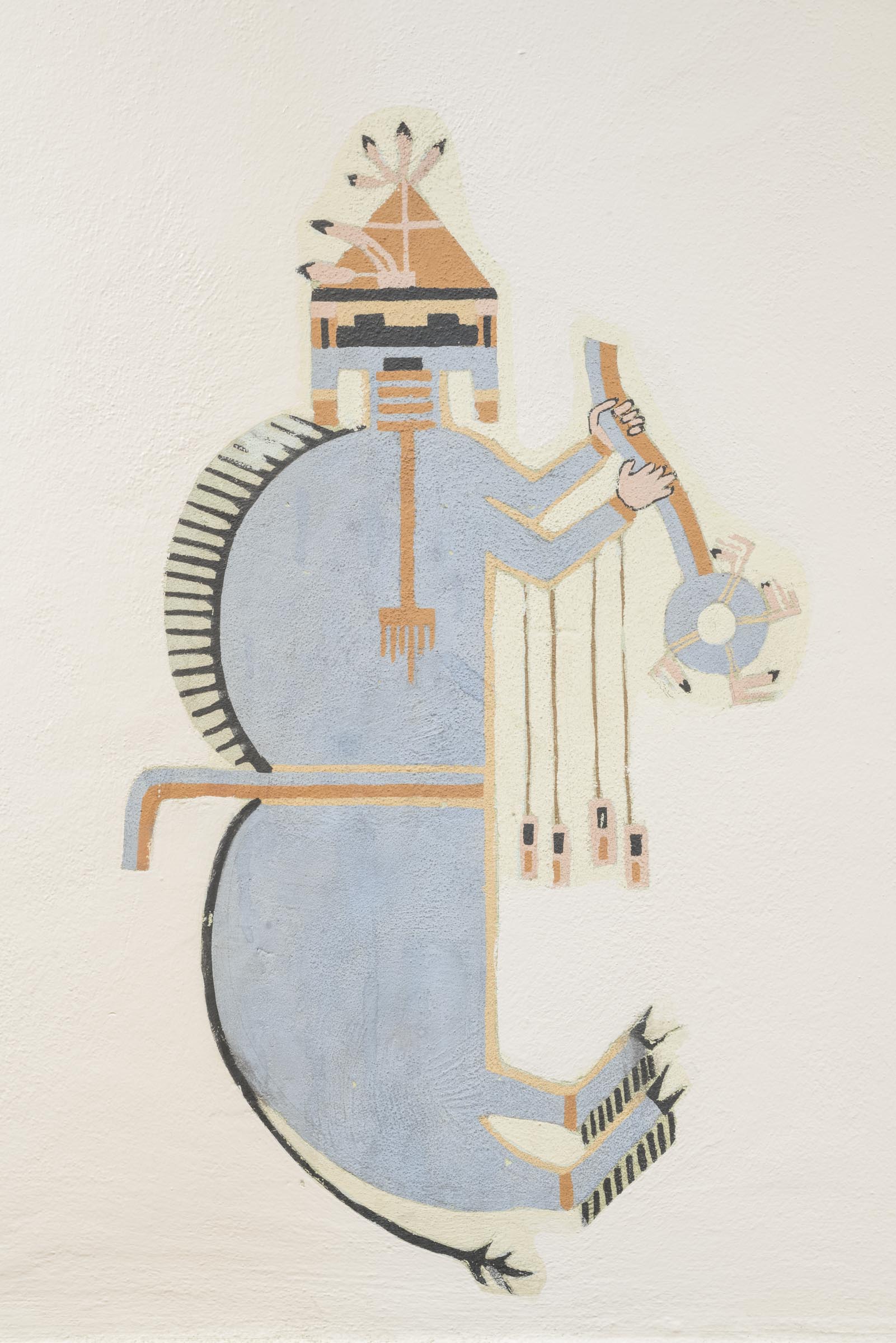
According to a contemporary newspaper report, in July 1939 “state art directors . . . made provision for selection of a young Navajo painter to aid with the murals for the new McKinley county [sic] courthouse”,1 which was a New Deal building that opened that same year. The unidentified artist created a series of sixteen Diné (Navajo) sandpainting-style wall paintings.
This is one of the “buffalo people” paintings—the figure has the body of a buffalo and the head, arms, and hands of a human—that was painted as part of a pair flanking vault doors. Originally, the courthouse’s two vault doors each had a blue figure (as seen here) painted on one side and a yellow figure painted on the other, though one of the blue figures has since been covered over (only three of the four buffalo people paintings remain visible).
Sandpainting-style Wall Painting (Buffalo Person)
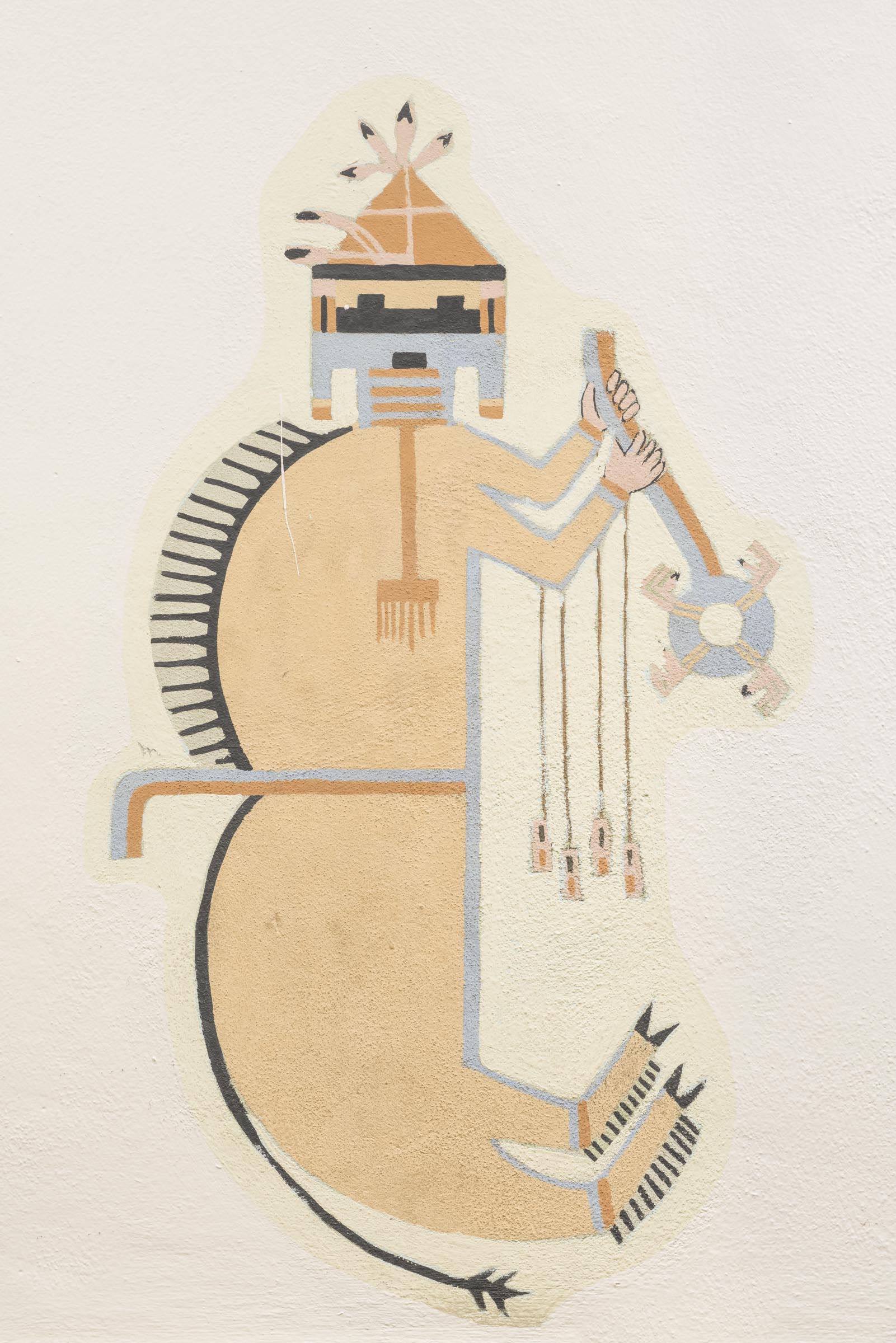
According to a contemporary newspaper report, in July 1939 “state art directors . . . made provision for selection of a young Navajo painter to aid with the murals for the new McKinley county [sic] courthouse”,1 which was a New Deal building that opened that same year. The unidentified artist created a series of sixteen Diné (Navajo) sandpainting-style wall paintings.
This is one of the “buffalo people” paintings—the figure has the body of a buffalo and the head, arms, and hands of a human—that was painted as part of a pair flanking vault doors. Originally, the courthouse’s two vault doors each had a yellow figure (as seen here) painted on one side and a blue figure painted on the other, though one of the blue figures has since been covered over (only three of the four buffalo people paintings remain visible).
Sandpainting-style Wall Painting (Buffalo)
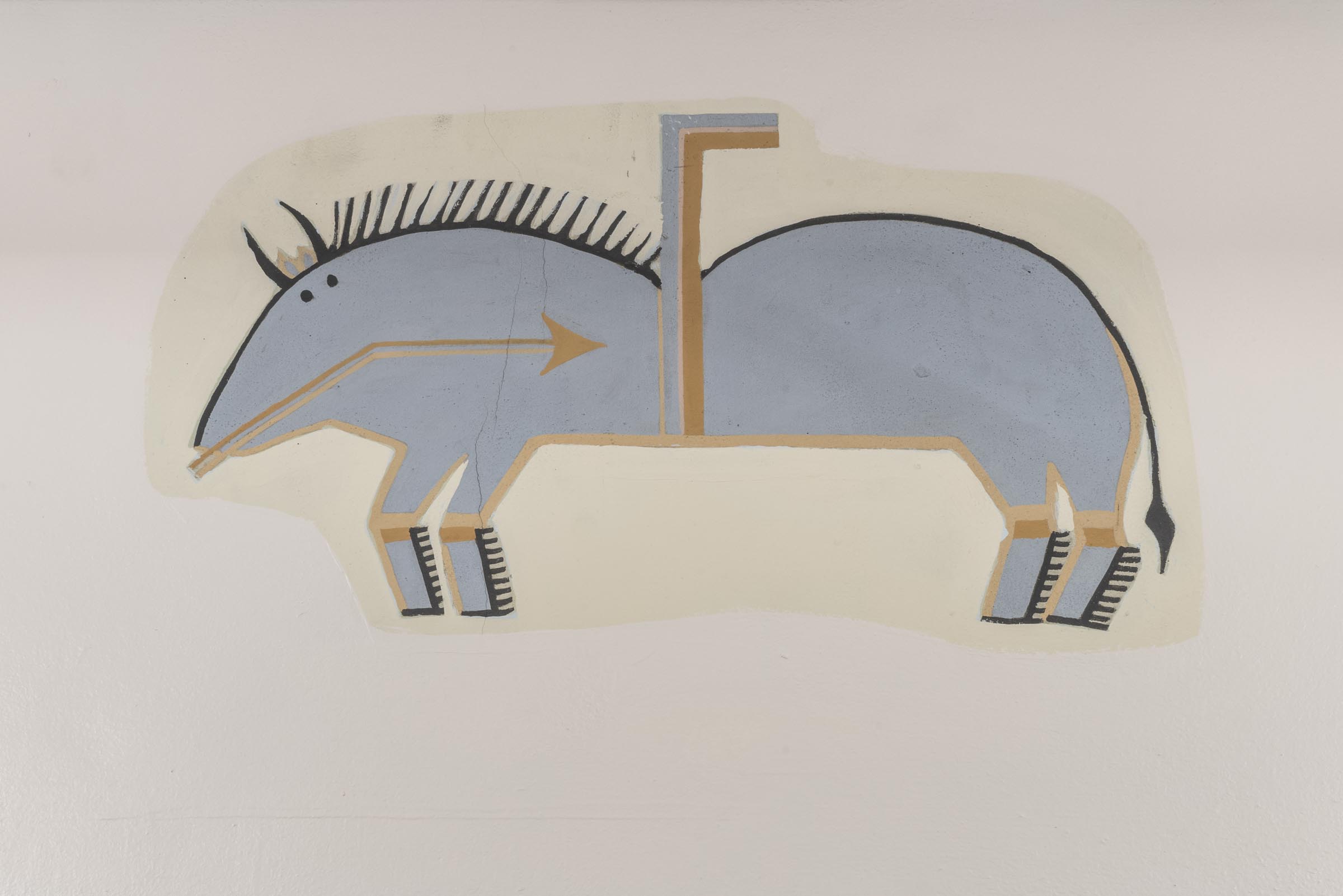
The first-floor lobby of the historic McKinley County Courthouse is decorated “in the round” with sixteen Diné (Navajo) sandpainting-style wall paintings that appear on nearly every wall. The only documentation so far identified for these wall paintings is a July 5, 1939 local newspaper article that states that “state art directors . . . made provision for selection of a young Navajo painter to aid with the murals for the new McKinley county [sic] courthouse” (the courthouse was built through the New Deal and opened in 1939).1
The paintings are organized as pairs and intentionally placed to flank entrances, lobbies, and passageways; most of the designs are traditional symbols of guardianship and blessing. This is an example of one of the buffalo paintings that appears along the lintel of the entrance to the rear staircase. While only three of the four original buffalo paintings have survived, they were originally depicted in sets of two, each with one blue (as seen here) and one yellow buffalo, and painted on either side of the passageway.
Sandpainting-style Wall Painting (Buffalo)

The first-floor lobby of the historic McKinley County Courthouse is decorated “in the round” with sixteen Diné (Navajo) sandpainting-style wall paintings that appear on nearly every wall. The only documentation so far identified for these wall paintings is a July 5, 1939 local newspaper article that states that “state art directors . . . made provision for selection of a young Navajo painter to aid with the murals for the new McKinley county [sic] courthouse” (the courthouse was built through the New Deal and opened in 1939).1
The paintings are organized as pairs and intentionally placed to flank entrances, lobbies, and passageways; most of the designs are traditional symbols of guardianship and blessing. This is an example of one of the buffalo paintings that appears along the lintel of the entrance to the rear staircase. While only three of the four original buffalo paintings have survived, they were originally depicted in sets of two, each with one yellow (as seen here) and one blue buffalo, painted on either side of the passageway.
Sandpainting-style Wall Painting (Sun)

This Diné (Navajo) sandpainting-style wall painting is the counterpart to one painted on the wall opposite in the rear lobby of the first floor the New Deal McKinley County Courthouse in 1939, reportedly by “a young Navajo painter.”1 (These sandpainting-style wall paintings are two of sixteen total such decorations.) This design is perhaps an iteration of the customary Diné sandpainting symbol representing the sun, while its companion painting likely represents the moon. Unlike its companion, however, it was partially removed when an elevator was installed in the building and an arched doorway created to provide access, and is now missing its left portion.