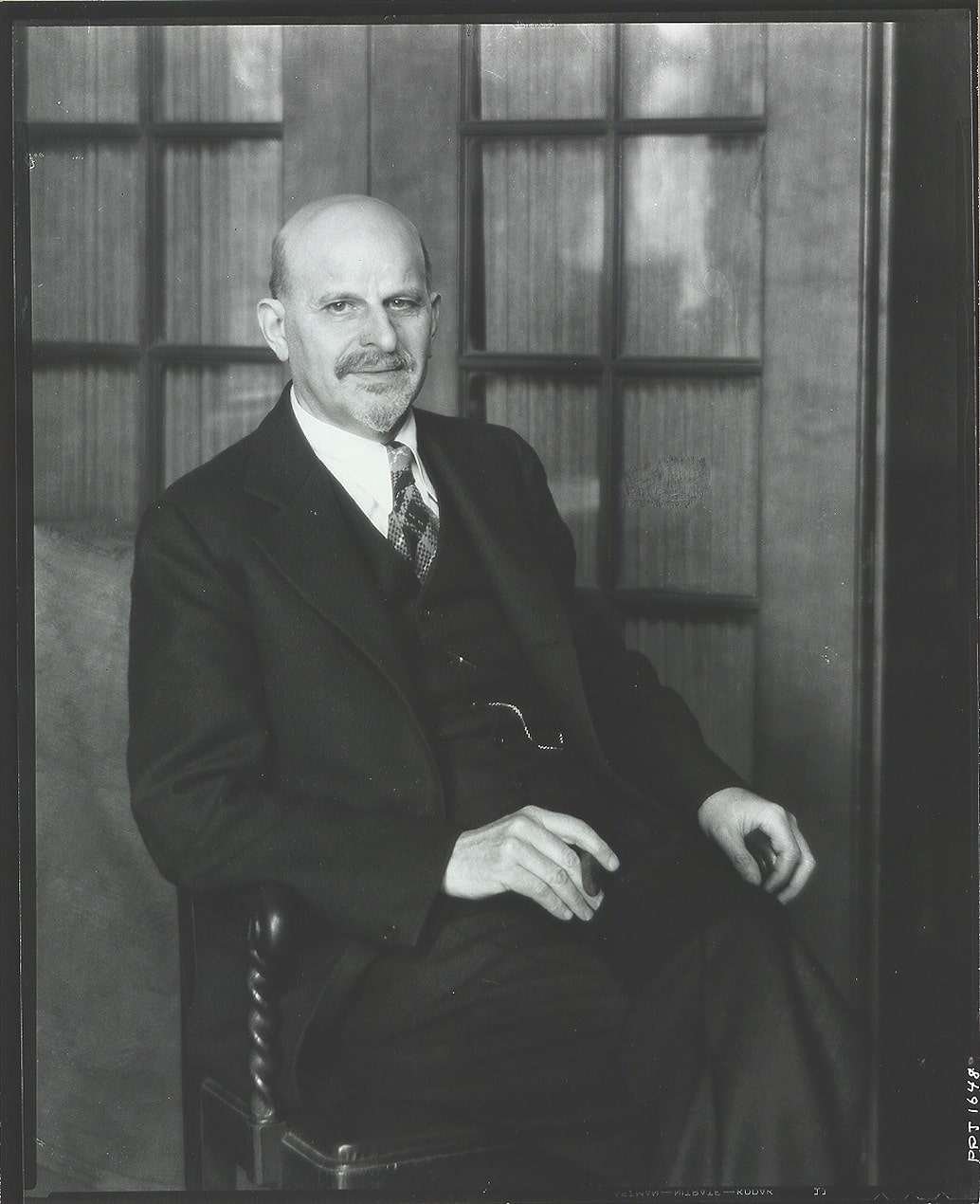
John A. Jellico

John Jellico was an artist, educator, and writer, with a life and career that spanned several states, industries, and genres. 

Born to Austrian immigrants (his gravestone marker notes that his mother was a passenger on the Carpathia when it rescued Titanic shipwreck survivors), Jellico was raised in northern New Mexico and graduated from Raton High School in Raton, NM. He set his sights on the artistic profession from an early age, and worked diligently to achieve his goal. According to an unpublished biography written by his daughter, Nancy Norris Jellico, “his quest for knowledge about art and artists was insatiable and he was never idle. In high school his teachers discovered his art ability and kept him busy with posters, backdrops for plays, and other school artwork. He sketched and painted constantly.”1

Jellico was also aided in his quest during his high school years by Manville Chapman, a noted artist with ties to Taos, NM, originally from Raton. Chapman immediately recognized Jellico’s talent and exchanged art lessons for modeling work. With Chapman’s help, Jellico was able to start selling paintings, adding those earnings to the savings he was putting away for art school from his summer jobs as a ranch hand. 

After graduating high school in 1934, Jellico immediately enrolled in The Art Institute of Pittsburgh. After his first year, he was awarded a scholarship which enabled him to squeeze his next two years into one by taking both day and evening classes. After graduating in 1936, Jellico pursued another year of study at the Phoenix Institute of Art in New York City, where he trained with top illustrators of the period, including Norman Rockwell. Reportedly, Rockwell criticized Jellico’s drawing of horses, to which Jellico retorted that he had no right to do since Rockwell had never lived in the West. Jellico spent the next five years mainly working as a book illustrator and commercial artist, while also showing and selling at Greenwich Village galleries and continuing his education through night classes at the Grand Central School of Art. 

While living in New York City, Jellico maintained his ties to New Mexico, exhibiting in Raton in at least 1938 and 1941. Additionally, according to his daughter’s biography, he spent the summer of 1937 in New Mexico during which he painted a mural for a church in Raton. Perhaps that is also when he became involved in the state’s federal art programs. In an undated, handwritten note to Kathryn Flynn, author of Public Art and Architecture in New Mexico: 1933-1943, Jellico reported that he produced “a large number of easel paintings” for the WPA (Works Progress Administration). He also describes being hired by the WPA to create twenty-seven ceiling decorations with Juanita Lantz for the Raton Public Library (since demolished).2

In 1942, Jellico enlisted and spent the bulk of his military service working under the Chief of Chaplains of the US Air Force and painting murals for sixty-three Air Force chapels.

At the end of WWII, he was offered a job as an instructor at his alma mater, The Art Institute of Pittsburgh, where he would also become the Assistant Director in three years’ time. With the West calling him home, he moved to Denver, CO, in the mid-1950s to help build the Colorado Institute of Art, leading the school until its sale in 1975 (after which it became the Art Institute of Colorado; now closed). 

While fulfilling his role as art educator and administrator, Jellico also authored several instructional books, including How to Draw Horses for Commercial Art (1946) and textbooks for the International Correspondence Schools of Scranton, became a magazine editor and writer, and co-founded a gallery in Santa Fe in 1969, which prompted him to return full-time to painting and exhibiting.

Anna Vaughn Hyatt Huntington

Anna Hyatt Huntington was the foremost female sculptor of her time, producing everything from small medals to monumental works. Though best known for her equestrian monuments, Huntington launched her career with small animal subjects. Hyatt Huntington’s fascination with animals was formed over many visits to the zoo with her father, a professor of paleontology and zoology at the Massachusetts Institute of Technology. Her animal sculptures are noted for their action, energy, verve, subtlety, and realism. As one critic wrote, “Anna Hyatt Huntington displays some of her living animals which are surpassed only by the great Hellenistic masters of animal life. Every beast seems to have waited for this American lady to give it soul.”1 

Like her pouncing, fighting, attacking, howling, and—in the case of the Gallup New Deal Art collection—braying animals, as well as her armor-clad version of Joan of Arc, the artist herself was, by all accounts, a force to be reckoned with. (Indeed, Hyatt Huntington once went as Joan of Arc, in full armor and riding a white horse, to a charity ball event.) By 1912, at the age of thirty-six, she was among the highest-paid professional women in the United States. In 1932, she was among the earliest women artists to be elected to the American Academy of Arts and Letters. Over the course of her career, she received numerous awards and honors. After her 1923 marriage to philanthropist Archer Huntington, the son of railroad magnate Collis Potter Huntington, Hyatt Huntington became a leading patron of American sculpture. With her husband, she established and designed the country’s first public outdoor sculpture garden, Brookgreen Gardens in South Carolina, in 1931. Her sculptures are in the permanent collections of more than 200 museums across the United States as well as overseas.

Allan Houser (Allan Capron Haozous)

Born Allan Capron Haozous, Allan Houser is one of the most influential and renowned Native artists of the 20th century. Best known as a sculptor, Houser also excelled in drawing, painting, and teaching. Through his prodigious artistic output and a generation of students and followers, Houser forged and shaped the field of contemporary Native art. 

Houser was Chiricahua Apache. His parents, Sam and Blossom Haozous, met while imprisoned at Fort Sill, OK. After famed Chiricahua leader Geronimo’s surrender to the US Army in 1886, Sam was one of a group of children and mothers jailed in St. Augustine, FL. Blossom was born in a prison camp at the Mount Vernon Barracks in Alabama. Both were part of 250 Chiricahua later forcibly moved to Fort Sill, where they remained imprisoned until 1913. Allan was their first child born outside of captivity. 

Houser’s artistic career began as a student of Dorothy Dunn’s at The Studio School at the Santa Fe Indian School, where he enrolled in response to an advertisement he saw at the Indian Office in Anadarko, OK. “I was twenty years old when I finally decided that I really wanted to paint,” he said. “I had learned a great deal about my tribal customs from my father and my mother, and the more I learned the more I wanted to put it down on canvas. That’s pretty much how it started.”1 

In a move indicative of the Santa Fe Indian School’s pedagogy, administrators reportedly “suggested” he anglicize his name and change it from Haozous to Houser. Indeed, Houser considered Dunn’s painting instruction equally restrictive. He attended during the 1936-37 school year, overlapping with artists Timothy Begay and Harrison Begay, and earning straight A’s. Houser graduated with a certificate in 1937.2 He would later speak of “not caring” for Dunn’s perception of “Indian-style painting” and the art education he received.3  

Still, Houser’s talent was immediately recognized by the New Deal and beyond. In terms of the New Deal: in addition to exhibiting his work at federal art centers across the country through the Federal Art Project, the Treasury Section of Painting and Sculpture commissioned Houser to paint murals in the Department of Interior building in Washington, DC, between 1939 and 1941. Houser also had a solo exhibition at what is now known as the New Mexico Museum of Art the year he graduated and another in 1939, and his work was also exhibited at the Golden Gate International Exposition and the New York World’s Fair in 1939. 

He achieved even greater success later as he came into his own as an artist. After relocating to Los Angeles in 1942, Houser came into contact with modernist artists and by the end of the decade had established himself as a boundary-pushing, monumental sculptor. Houser broke open narrow expectations of sculpture and Native art, clearing the path to limitless possibilities. 

In 1954, he was awarded the Palmes d’ Academiques, a special commendation from the French government, at the Gallup Inter-Tribal Indian Ceremonial. In 1962, Houser established the sculpture department at the Institute of American Indian Arts (IAIA), the successor to The Studio School. He taught at IAIA for almost two decades. In 1992, he became the first Native artist to be awarded the National Medal of Arts. In 2004, a retrospective of his work served as the inaugural exhibition for the National Museum of the American Indian in Washington, DC.

Albert Lorey Groll

An East Coast-based and European-trained artist, Albert Lorey Groll became a much admired, successful painter of the Southwestern landscape. Groll was part of the first wave of European and European-American artists to venture west and participate in what scholar Joseph Traugott has termed the “culture rush,”1 capturing images of new—to them—places, peoples and cultures.

His career as a Western American artist began in 1904, when he accompanied Brooklyn ethnologist Stewart Culin on an expedition to the territories of Arizona and New Mexico. On that trip he was introduced to Lorenzo Hubbell, owner of the Ganado Trading Post (now known as the Hubbell Trading Post). One of the desert scenes he painted on that trip, titled Arizona, won Groll a gold medal at the Pennsylvania Academy of the Fine Arts in January 1906 and “created a furor when it was exhibited in New York” six months later.2 The artist wrote to Hubbell that his Western paintings “have made a decided hit, both artistically and financially; in fact, my visit to the Southwest has been my lucky stars.” Groll promptly returned to New Mexico that same year to visit Laguna Pueblo, this time taking along his friend and colleague from the Royal Academy in Munich, William Robinson Leigh. Groll is credited with introducing Leigh, who would become another famous Western American artist, to the Southwest. Moreover, as he continued to make frequent trips to and prolifically paint the West, Groll is widely, though not universally, credited for founding the Santa Fe art colony, with the Santa Fe New Mexican reporting in 1923 that “It is said that it was not until Mr. Groll visited Santa Fe that artists came out to New Mexico’s capital to make their residence.”3 

Over the course of four decades, Groll made a name for himself painting vast skies and towering cloud formations on visits to the Grand Canyon, Yellowstone National Park, Hopi Pueblo, Taos, Gallup, and beyond. One reviewer commented in 1922 that “A. L. Groll takes the desert for his subject and paints it under the cloud dotted blue sky which the very mention of his name recalls.”4 And that reputation only grew. By the 1940s, he was being heralded as “the greatest of American sky painters.”5 In addition to achieving broad popularity, his status and legacy as a founding Western American artist was cemented when he was made an affiliate member of the exclusive Taos Society of Artists. Groll’s career developed in lock-step with the Western American art movement, and also represents the origins and formation of that movement. 

In 1941, Groll donated at least three artworks to Gallup’s Federal Art Center for the purposes, as reported in the local newspaper at the time, of forming “a nucleus for a projected permanent museum and art centre [sic] here.” The article goes on to explain that Groll has been “inspired by the gorgeous colors of the skies and also in rock formations near Gallup.”6

Elidio Gonzales

Elidio Gonzales was an esteemed artist, furniture-maker, and businessman. Per his obituary, highlights of his career include being “selected to do the entrance doors for the entrance to the Hispanic Heritage Wing of the Museum of International Folk Art in Santa Fe and [making] furniture and woodwork for famous artists and writers.”1 

Gonzales got his start as a carpenter and artist during the New Deal. Having grown up in Mora and Black Lake, NM, where his family ran a sawmill, he moved to Taos in 1934 to attend the Taos Vocational School. “I learned the Spanish Colonial designs at the school and within three months I was an instructor . . .  I was a participating artist in the WPA [Works Progress Administration] work project in the ’30s,” he told The Taos News in 1985.2 

During World War II, Gonzales served for three years in the US Army as a woodworking instructor for army rehabilitation programs. In 1945, he opened El Artesano de Taos, a hand-crafted furniture business. According to scholar Guadalupe Tafoya, “The red and yellow sign that hung outside of his shop . . . is familiar to anyone who ever walked or drove along La Loma Road [in Taos]. Elidio produced museum-quality pieces for clients all over the Southwest. He had enormous influence on the style of furniture being produced in Taos, favoring the rosette, with designs that were very clean and sharply etched.”3  Gonzales was known as “El Maestro,” or a Master Carver, and mentored many next-generation furniture-makers. 

Despite his widespread recognition and enormous influence, Gonzales’s first print media mention as an artist—according to the available archives—only came in 1961,4  and his first full print media profile appeared in 19665 —more than thirty years into his career (a 1945 newspaper article6  listed him as a member of the “arranging committee” for that year’s Christmas Handicrafts and Art show at the Harwood Museum of Art, but did not identify Gonzales as an artist himself). The art world’s bias against furniture as “fine art” prevailed over the course of his fifty-four years in the business, but Gonzales’s talent and dedication were undeniable and his commitment to education—not only did he teach woodworking, he did many public demonstrations and talks throughout his career—made him an effective advocate for his craft.  

Joseph Amadeus Fleck

Joseph Fleck was born and raised in Austria and trained as an artist at the Academy of Fine Arts in Vienna. After serving on the Italian front in World War I, he emigrated to the United States in 1922, first landing in Kansas City. There, he saw an exhibit of the Taos Society of Artists, which prompted his move to Taos in 1924 or 1925.

Fleck lived and worked in Taos the majority of his life. While he followed and shared the artistic perspective and principles of the exclusive, conservative Taos Society of Artists (active from 1915 to 1927), painting Southwestern subjects—mostly portraits of Native peoples and Taos residents—in a realistic manner, Fleck was denied entry to the Society per its bylaws, which had been amended in 1919 during the Red Scare to restrict membership to American citizens (Fleck became a citizen in 1927). He was, however, a member of the Taos Artists Association.

During the New Deal, Fleck fulfilled commissions through the Public Works of Art Project and painted murals at post offices in Raton, NM, and Hugo, OK. After WWII, he turned his attention from portraiture to landscapes. His style evolved in step with his subjects, gradually loosening from an academic to a quasi-impressionistic approach. From 1942 to 1946, he served as the Dean of Fine Arts and artist-in-residence at the University of Missouri in Kansas City.

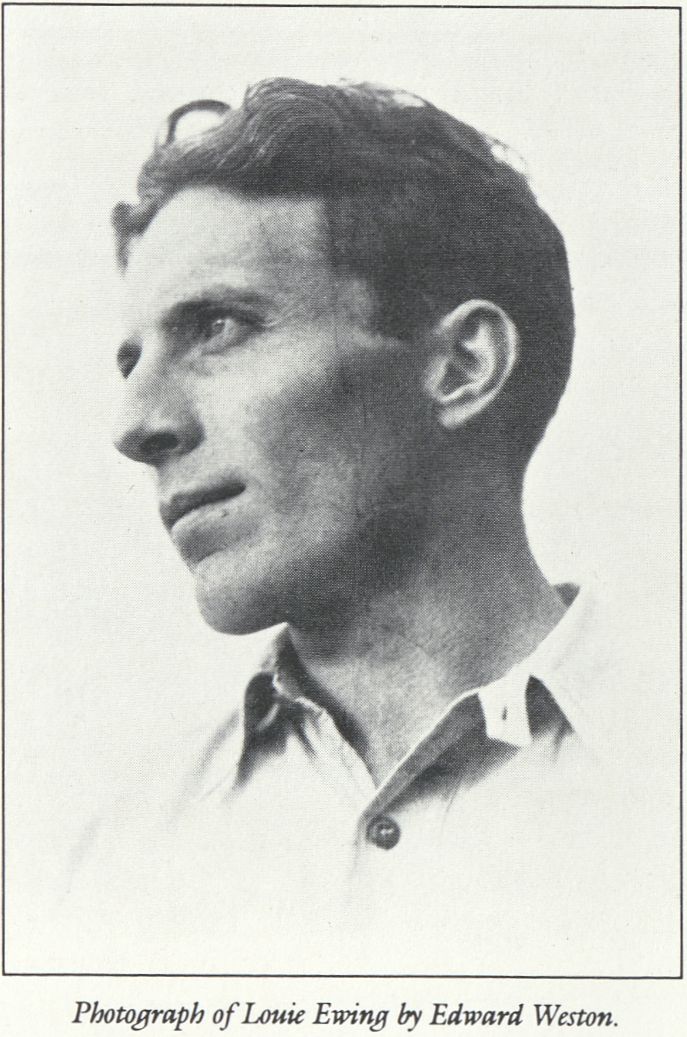
Louie Ewing

Louie Ewing is best known as a pioneer of silkscreen printmaking in the United States, a reputation he earned as a New Deal artist. Ewing moved to California in 1933, where he studied art at a junior college. He followed one of his instructors to Santa Fe, NM, in 1935, and almost immediately started working for the state’s Federal Art Project (FAP). 

Ewing was first hired by the FAP to work as an engraver on the Portfolio of Spanish Colonial Design. He was then classified as an experimental artist1 and, as such, commissioned by the Project’s director, R. Vernon Hunter, to try new ways of working, including mosaic and silkscreen printing. His best-known contribution to the New Deal is  the Navajo Blanket Portfolio, a set of fifteen silkscreen prints of Navajo weavings.

For the Portfolio project, Ewing was hired in 1939 through the FAP by the Laboratory of Anthropology (founded in 1927 by John D. Rockefeller to study the Southwest’s Indigenous cultures; the Laboratory is now part of the Museum of Indian Arts and Culture) to make prints of its Navajo rug collection for distribution to the United States Indian Arts and Crafts Board “in furthering the improvement of Navajo weaving,” to “Indian service schools” for instructional purposes, and to other public educational institutions such as universities, libraries, and museums.  Ewing first made paintings of the rugs and then was assisted by Eliseo Rodriguez in producing 200 prints of each painting. Silkscreen printing was such a novel technique at the time that it took the artists three days to make their first print. “We [first] made our squeegees, to move the paint across the screen, out of an auto tire because there wasn’t a squeegee invented then,” Ewing recalled. “And then we used a window-cleaning thing and that didn’t work because the oil melted the rubber.”2 Finally, they partnered with a local manufacturer to design and produce equipment that worked.3 Only ten of the original fifteen prints have survived in Gallup’s collection, but the National Gallery of Art has a complete set. 

Ewing credits the New Deal with helping to launch his career, saying it offered “a wonderful chance, from getting out of art school to make a transition to professional, and besides making it possible to eat,”4  and adding that “I could break away from the WPA [Works Progress Administration] and have my own business.”5 

Indeed, he continued as a prolific serigrapher for the next four decades, producing silkscreened posters for the Gallup Inter-Tribal Indian Ceremonial from 1939 to at least 19716 and receiving numerous book commissions from major institutions across the country. Additionally, he taught at the Santa Fe Indian School in the 1940s and introduced artist Harrison Begay to silkscreen printing, a technique Begay would later translate into a successful printmaking business called Tewa Enterprises. After the New Deal, Ewing expanded his repertoire to include oil paintings, watercolor, gouache, and acrylic. He had his first solo show in 1946 at the New Mexico Museum of Art.7

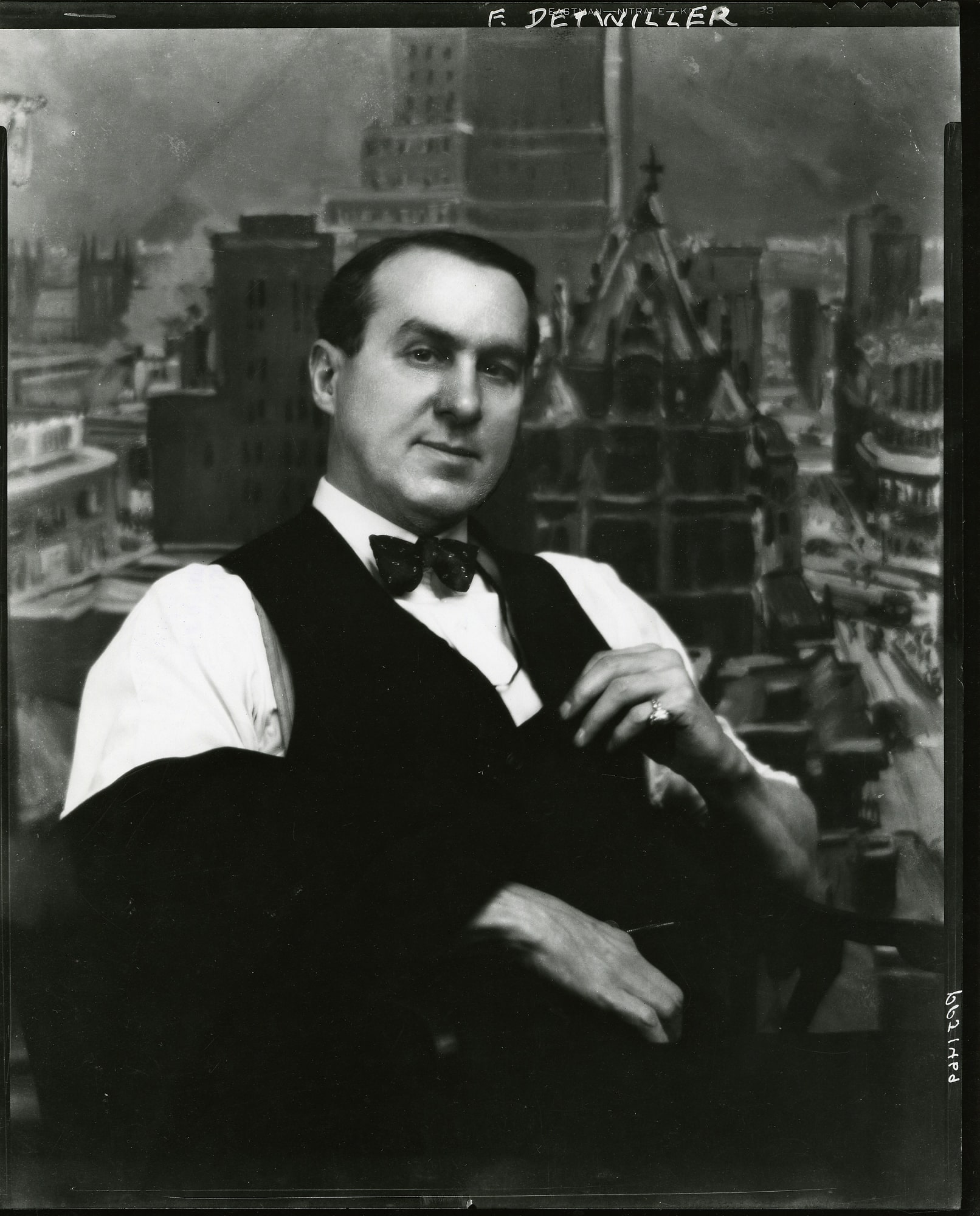
Frederick Detwiller

The son of a doctor and the grandson of Henry Detwiller, one of the first homeopathic physicians in the United States, Frederick Detwiller expressed an early interest in art and won a school drawing contest at the age of eleven. At the urging of his father, however, Detwiller originally pursued a career in law. It wasn’t until 1908, when he was twenty-six,  that he turned his attention professionally to art. He studied architectural design and painting at Columbia University before advancing his education in Europe. At the start of World War I, in 1914, he returned to the United States and established a studio in New York City, where he joined several artists’ associations including the Salmagundi Club, Society of Independent Artists, and The Artists’ Fellowship, Inc., an organization dedicated to aiding artists unable to work, and began exhibiting his work in solo and group shows. Detwiller’s art focuses on architecture (the New York City skyline in particular) as well as scenes from New England fishing villages and seascapes—the artist lived in Noank, CT, from 1917–1921 and made frequent visits to New Harbor, ME.

Detwiller’s connections to Gallup and/or New Mexico are unknown. His archives, located at Skillman Library at Lafayette College, include his writings (speeches, articles, letters) on topics such as the need for increased public support for the arts, opposition to juried exhibitions, wrongful taxation of artists, and advocacy for the preservation for Native American art. Perhaps a combination of his progressive views on arts policy and his interest in Native art prompted him to heed fellow East Coast artist Albert Lorey Groll’s call for support of a potential museum in Gallup during the New Deal.

Elbridge Ayer (E. A.) Burbank

Elbridge Ayer Burbank studied life drawing and portraiture at the Chicago Academy of Design and in Munich, Germany (where he met William Robinson Leigh and, likely, Albert Lorey Groll, two artists who would also go on to become well-known Western American painters). Though he opened a studio in Chicago and his work was critically acclaimed, he followed an unlikely career path, electing to spend time in the southern United States sketching African American subjects rather than trading in society portraits.

His first commission and introduction to the West came by way of Northwest Magazine, which hired Burbank to illustrate the Northern Pacific Railway route from Minnesota to the Puget Sound in Washington for the purposes of encouraging homesteading. His career breakthrough, however, came courtesy of his uncle, Edward E. Ayer, president of the Field Museum of Natural History in Chicago, who commissioned him in 1897 to paint portraits of prominent Native Americans in Oklahoma, Arizona, and New Mexico.

By 1902, Burbank was traveling extensively throughout the West—primarily Oklahoma, the Southwest, and the Dakotas—painting Native American leaders, individuals, groups, and ceremonies. He spent a significant amount of time and established a temporary studio in Ganado, AZ (notably, the US Census shows he was living there in 1910 with his young wife, Nettie). There, he befriended Ganado trading post owner Lorenzo Hubbell and did many drawings of Navajo people in red chalk still on view at the Hubbell Trading Post National Historic Site.

Burbank spent almost two decades on his Field Museum mission, becoming one of the most prolific and prominent portraitists of Native American people of his era. In all, he painted over 1,200 portraits of Native peoples from more than one hundred tribes/nations. Burbank is perhaps best known for having painted the famous, turn-of-the-20th-century Apache leader Geronimo five times. He is said to be the only artist to paint his portrait from life.

Burbank’s work figures deeply in the American consciousness of Native Americans. Several prominent museums, along with one of the country’s first department stores (Wanamaker’s), competed with each other in a bidding war over his Native American portraits at the time he made them, and the Chicago public school system ordered 10,000 color reproductions of a single image. In 1944, the artist published the book Burbank Among the Indians, and his images continue to be widely viewed and distributed.

By the mid-1910s, Burbank had left Ganado to open a studio in Los Angeles, CA. During the Depression, he supported himself by drawing and selling scenes for postcards and greeting cards, pictures of famous Americans, and copies of his Native American studies. He spent the last two decades of his life being treated for bipolar disorder. He died in 1949 in San Francisco after being hit by a cable car.

Timothy Bradley Begay

Little is known about Timothy Bradley Begay. What information that can be pieced together indicates that Begay’s life and career followed much the same trajectory as many of the Native artists of his generation. He trained as a painter first under Dorothy Dunn at The Studio School at the Santa Fe Indian School in 7th and 8th grades (the 1935/36 and 1936/37 school years), and continued his art education at least one more year, in 9th grade, under Dunn’s successor, Gerónima Cruz Montoya, before graduating in 1941.3 Timothy Begay’s classmates at The Studio School included Harrison Begay and Allan Houser.

After graduating high school, Begay was hired by Peter Kilhan (who designed the main light fixtures for the Rainbow Room at Rockefeller Center in New York City) to fabricate decorative ironwork. Kilhan’s firm closed at the start of WWII, and Begay enlisted in 1942, serving through the end of the War. He returned to Santa Fe in 1945, where met his wife, Rosaria, took up welding for work, and continued exhibiting paintings alongside former Studio School classmates and fellow Native artists for a period. The Philbrook Museum of Art has two works by Begay dated 1950, but it would appear that, unlike many of his peers, his art career dwindled in the second half of the 20th century as welding became his full-time and lifelong profession.

What are you looking for?

Art Collection

Gallup’s New Deal art collection consists of over 120 objects created, purchased, or donated from 1933 to 1942 through New Deal federal art programs administered by President Franklin D. Roosevelt to support artists during the Great Depression.

Main Menu

Image Use Notice: Images of Gallup’s New Deal artworks are available to be used for educational purposes only. Non-collection images are subject to specific restrictions and identified by a © icon. Hover over the icon for copyright info. Read more