

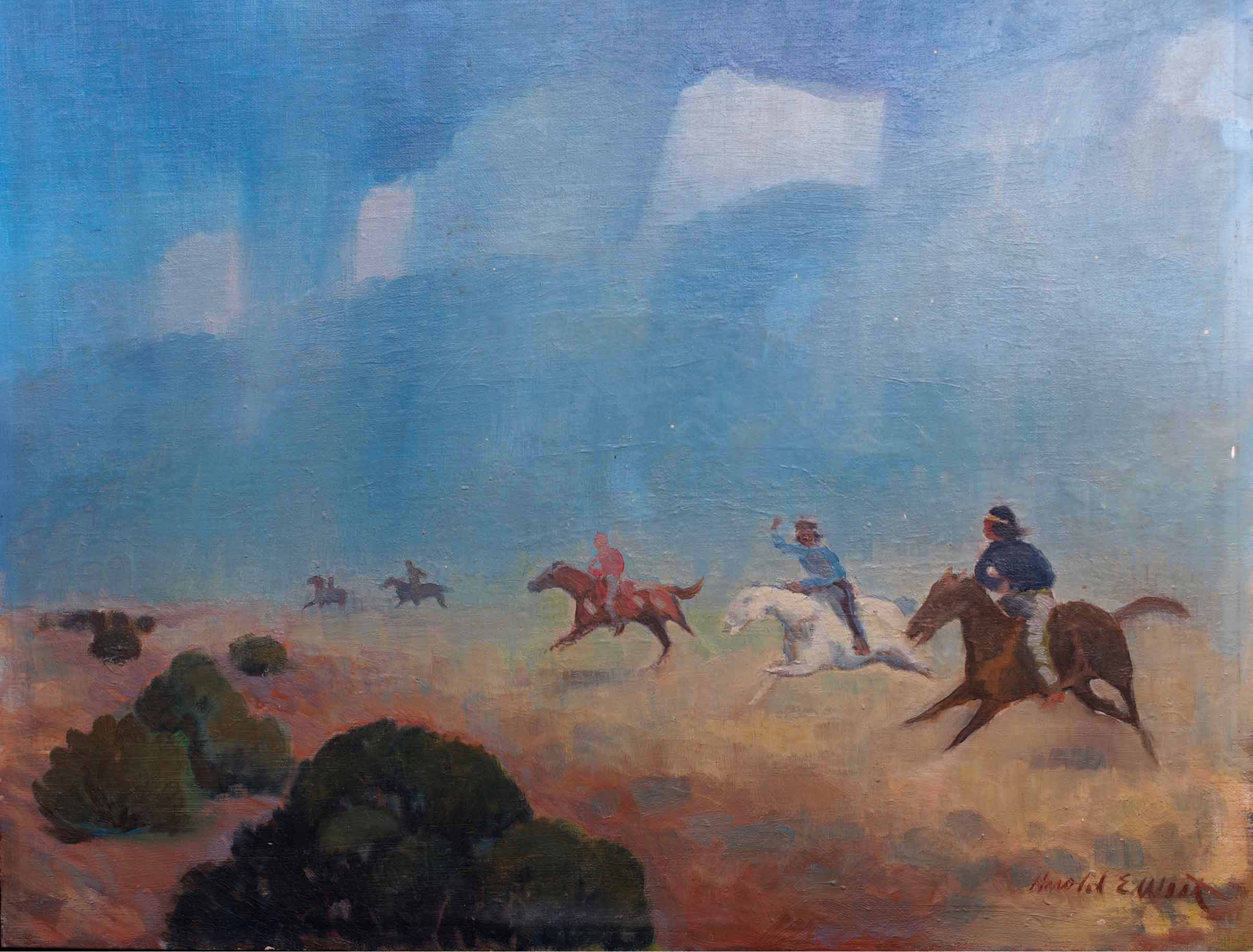
Already established as a commercial printmaker, Harold E. West credits the New Deal for launching his career in painting. Producing work for New Mexico’s Federal Art Project in the late 1930s, he quickly became well known for images of “frontier” life—cowboys, homesteads, ranch animals. In this painting, expert horsemen kick up dust as they race through a range of grass and rabbitbrush. West captures their speed and agility in a blur of brushstrokes and evokes the sensations of a loud stampede of hooves, whooshing air, and an adrenaline-charged shout.
Artist Demographic: European-American
The Mine

The loose, bold brushstrokes of The Mine have the vigor and vitality of a painting made outdoors (a “plein air” painting). While the location in the picture has not been identified, it is both possible and probable that it depicts the Gallup, NM, area. Herbert Tschudy visited Gallup frequently on the annual trips he made to New Mexico during the first three decades of the 1900s. Handwritten notes on the back of the painting detailing its exhibition history indicate it was made in Gallup. A noticeable and plentiful feature of the Gallup landscape are twisted juniper trees, one of which appears prominently in the foreground of The Mine. Despite the title, the sparsely painted smoke stacks in the painting’s background appear incidental to its primary subject: the dramatic natural features and dynamic sunset colors of the high desert landscape. Because the artist has no known involvement in the New Deal, it is likely that he donated this piece to the Gallup Art Center based on his relationship to the community.
Historic McKinley County Courthouse
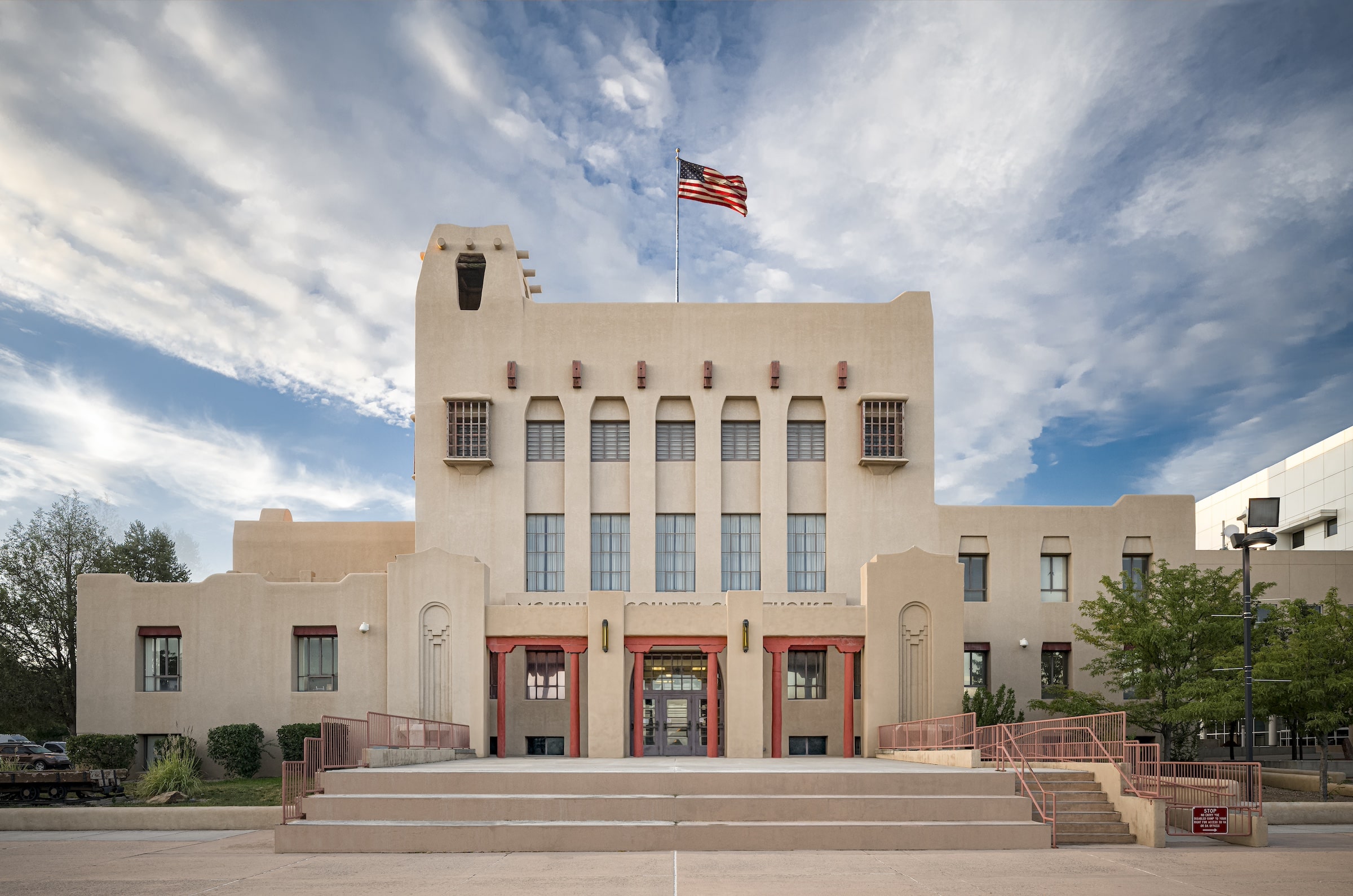
This building was constructed through the Public Works Administration (PWA). The cornerstone was laid in 1938 and the building opened one year later. The PWA funding formula matched local investment 45 percent to 55 percent. McKinley County raised $125,000 through a general obligation bond—passed by voters 427 to 77 on August 9, 1938—and the PWA made a grant of $102,272.
The building was designed by Trost & Trost, an architecture and engineering firm based in El Paso, TX, to house county offices, including the County Commission chambers and County Treasurer, Clerk, and Assessor offices on the first floor, a courtroom on the second floor, and a jail on the third floor. Trost & Trost designed and built hundreds of buildings across the Southwest in the first half of the 1900s. In addition to the courthouse, the firm is responsible for three other Gallup buildings built in the 1920s/1930s, none of which still stand.
In its design for the McKinley County Courthouse, Trost & Trost fully embraced the mythology of “triculturalism,” which has pervaded New Mexico for generations. Triculturalism promotes the exceptionally simplistic view that the state is home to a harmonious melting pot of three main cultures, “Native American,” “Hispanic,” and “Anglo.” Of course, this narrative never has been inclusive of all of the population’s ethnicities or the great variety of ways New Mexicans identify themselves. The historic courthouse conceptualizes triculturalism, as its north, east, and south facades are designed to represent Anglo, Hispanic, and Native American cultures, respectively.
The building’s north face houses its main entrance and includes classic western European features such as a portico and columns along with Art Deco–style elements such as the geometric carved decorations at either end of the portico. Its east side resembles a Spanish mission church, with a high-arched doorway and bell tower. Its southern exterior is an interpretation of an Ancestral Puebloan cliff dwelling with a T-shaped door and flat wall accented by an asymmetrical arrangement of small, square-shaped, unframed windows.
The interior of the courthouse is highly decorated with tilework, wallpaintings and tinwork light fixtures throughout the first-floor lobby, and large mural titled Zuni Pottery Makers on the wall of a first-floor office. A 2,000-square-foot mural covers the walls of the second-floor courtroom, and the building was originally furnished handcrafted pine tables, chairs, benches and cabinets (now in storage).
The Half-Breed
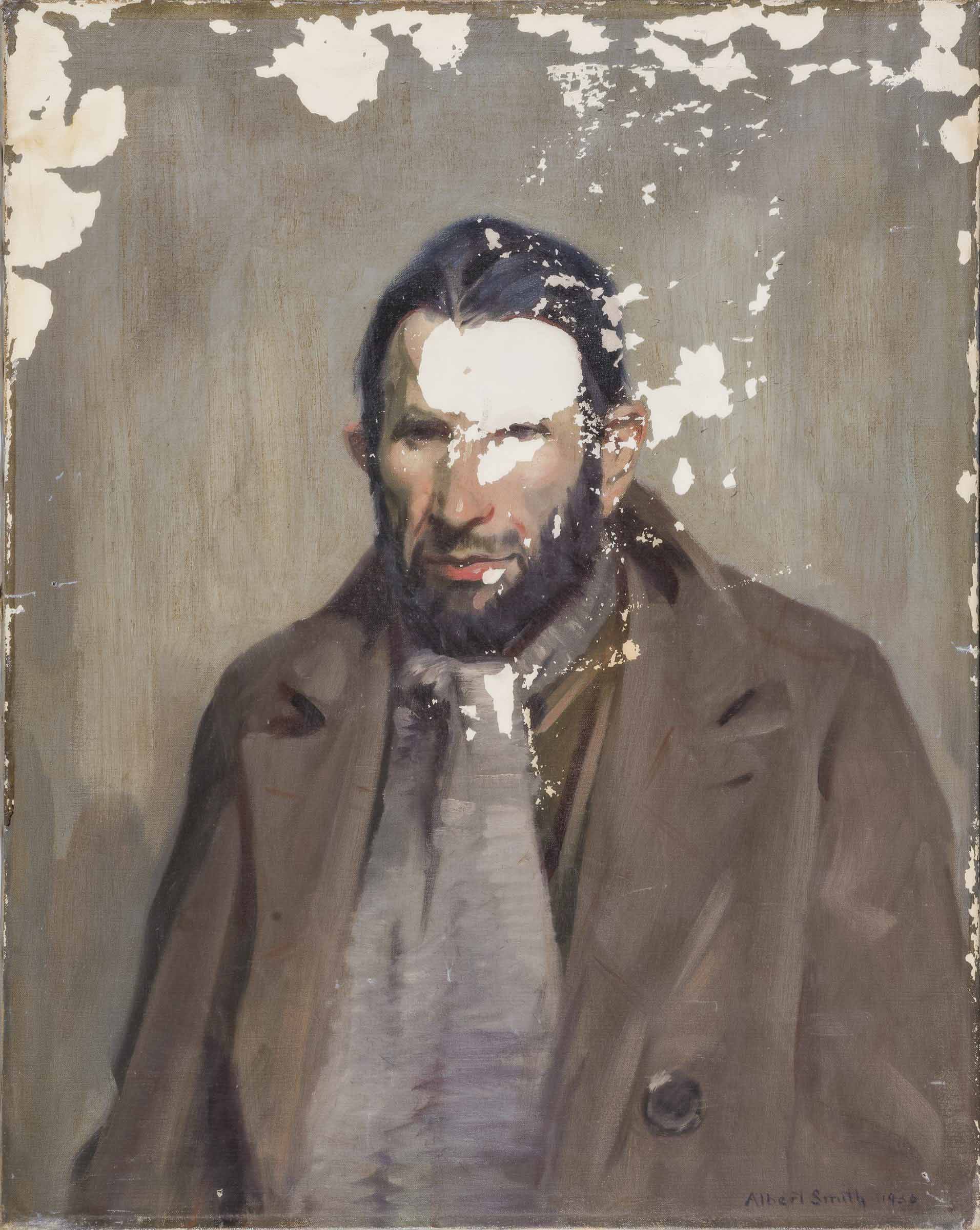
The Half-Breed is a problematic painting, not least because of its title, a derogatory term for a biracial Native American person. The circumstances of its creation are a mystery. Who it pictures and why it was made are not known. The artist likely donated it, along with Chief Deer (Sioux Indian), to the Gallup Art Center. The two paintings are almost identical in size, and the possibility that they are a set raises the question of what Albert Delmont Smith meant to convey by the comparison. The Half-Breed has not been displayed by Gallup’s public library for some time, and suffered damage long ago due to improper storage.
Chief Deer (Sioux Indian)
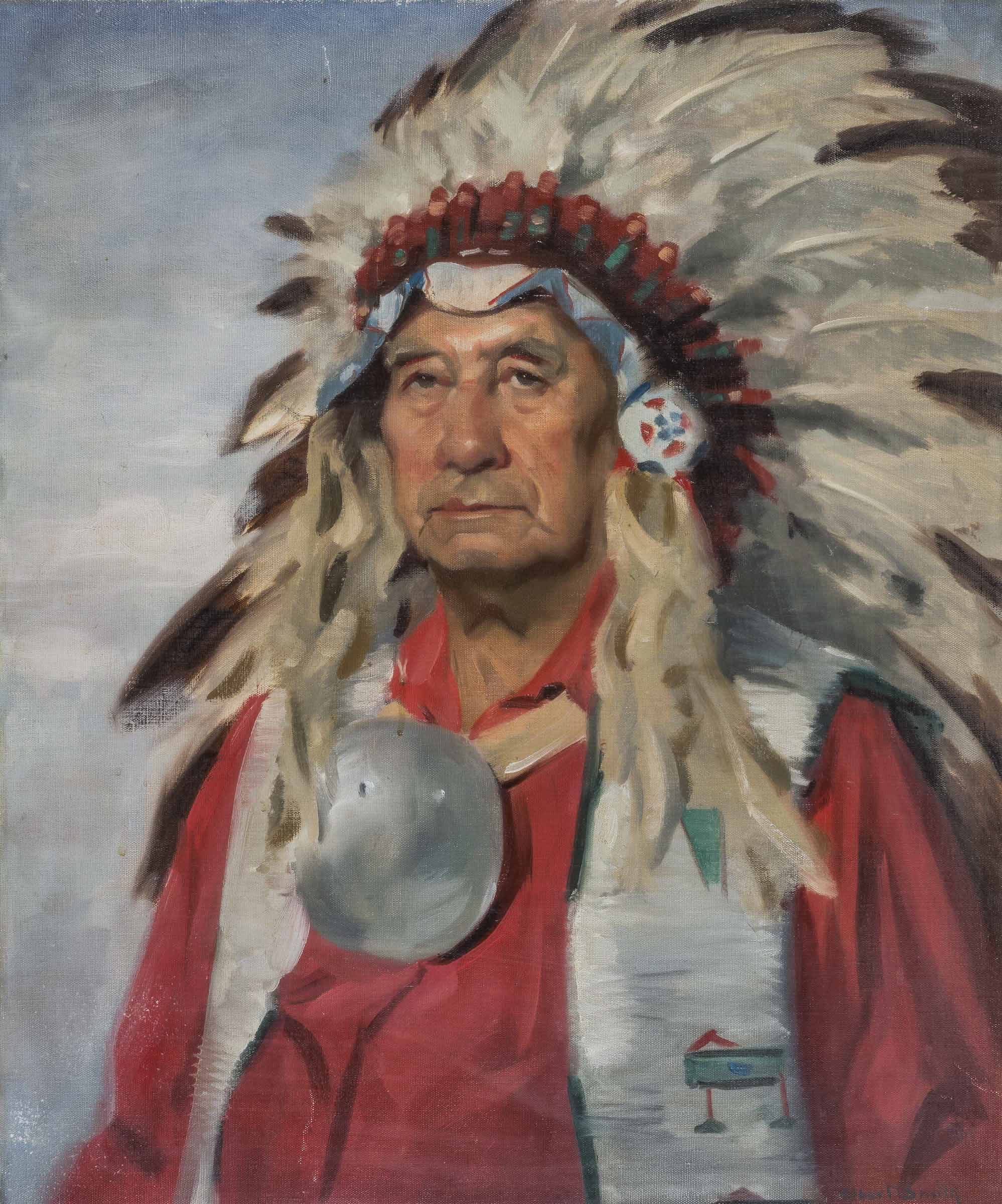
This painting by Albert Delmont Smith, a New York City-based society portraitist, is an enigma. The sitter has not been identified and it is not known for whom or for what reason it was made. It is likely the painting was donated by the artist to the Gallup Art Center, along with The Half-Breed (which may or may not be a companion portrait).
Poster for the Indian Court Federal Building

In 1939, San Francisco hosted the Golden Gate International Exposition to celebrate the opening of the San Francisco—Oakland Bay and Golden Gate Bridges and the theme of “Pacific Unity.” The Exposition included an “Indian Court” exhibit organized by the newly established Indian Arts & Crafts Board (IACB) with art displays, a vendor marketplace, artist demonstrations, and guided tours. These posters, produced by Louis Siegriest for the IACB in partnership with another New Deal program, the Federal Art Project, promote The Indian Court’s conception and representation of “eight great areas of Indian culture,” including the “Fishermen of the Northwest Coast,…Buffalo Hunters of the Plains,…the Cornplanters of the Pueblos, [and] the Navajo Shepherds”—Gallup’s collection includes only four of the eight total posters. The imagery is borrowed from Indigenous artists, who received little or no recognition. Siegriest created the poster designs but “had nothing to do with the actual process,” meaning he didn’t make the screens or pull the prints; “I would see that they got out,” he recalled. “I think they got out 1,500 of each poster.”1
Poster for the Indian Court Federal Building

In 1939, San Francisco hosted the Golden Gate International Exposition to celebrate the opening of the San Francisco—Oakland Bay and Golden Gate Bridges and the theme of “Pacific Unity.” The Exposition included an “Indian Court” exhibit organized by the newly established Indian Arts & Crafts Board (IACB) with art displays, a vendor marketplace, artist demonstrations, and guided tours. These posters, produced by Louis Siegriest for the IACB in partnership with another New Deal program, the Federal Art Project, promote The Indian Court’s conception and representation of “eight great areas of Indian culture,” including the “Fishermen of the Northwest Coast,…Buffalo Hunters of the Plains,…the Cornplanters of the Pueblos, [and] the Navajo Shepherds”—Gallup’s collection includes only four of the eight total posters. The imagery is borrowed from Indigenous artists, who received little or no recognition. Siegriest created the poster designs but “had nothing to do with the actual process,” meaning he didn’t make the screens or pull the prints; “I would see that they got out,” he recalled. “I think they got out 1,500 of each poster.”1
Poster for the Indian Court Federal Building

In 1939, San Francisco hosted the Golden Gate International Exposition to celebrate the opening of the San Francisco—Oakland Bay and Golden Gate Bridges and the theme of “Pacific Unity.” The Exposition included an “Indian Court” exhibit organized by the newly established Indian Arts & Crafts Board (IACB) with art displays, a vendor marketplace, artist demonstrations, and guided tours. These posters, produced by Louis Siegriest for the IACB in partnership with another New Deal program, the Federal Art Project, promote The Indian Court’s conception and representation of “eight great areas of Indian culture,” including the “Fishermen of the Northwest Coast,…Buffalo Hunters of the Plains,…the Cornplanters of the Pueblos, [and] the Navajo Shepherds”—Gallup’s collection includes only four of the eight total posters. The imagery is borrowed from Indigenous artists, who received little or no recognition. Siegriest created the poster designs but “had nothing to do with the actual process,” meaning he didn’t make the screens or pull the prints; “I would see that they got out,” he recalled. “I think they got out 1,500 of each poster.”1
Poster for the Indian Court Federal Building

In 1939, San Francisco hosted the Golden Gate International Exposition to celebrate the opening of the San Francisco—Oakland Bay and Golden Gate Bridges and the theme of “Pacific Unity.” The Exposition included an “Indian Court” exhibit organized by the newly established Indian Arts & Crafts Board (IACB) with art displays, a vendor marketplace, artist demonstrations, and guided tours. These posters, produced by Louis Siegriest for the IACB in partnership with another New Deal program, the Federal Art Project, promote The Indian Court’s conception and representation of “eight great areas of Indian culture,” including the “Fishermen of the Northwest Coast,…Buffalo Hunters of the Plains,…the Cornplanters of the Pueblos, [and] the Navajo Shepherds”—Gallup’s collection includes only four of the eight total posters. The imagery is borrowed from Indigenous artists, who received little or no recognition. Siegriest created the poster designs but “had nothing to do with the actual process,” meaning he didn’t make the screens or pull the prints; “I would see that they got out,” he recalled. “I think they got out 1,500 of each poster.”1
Untitled (Grand Canyon)
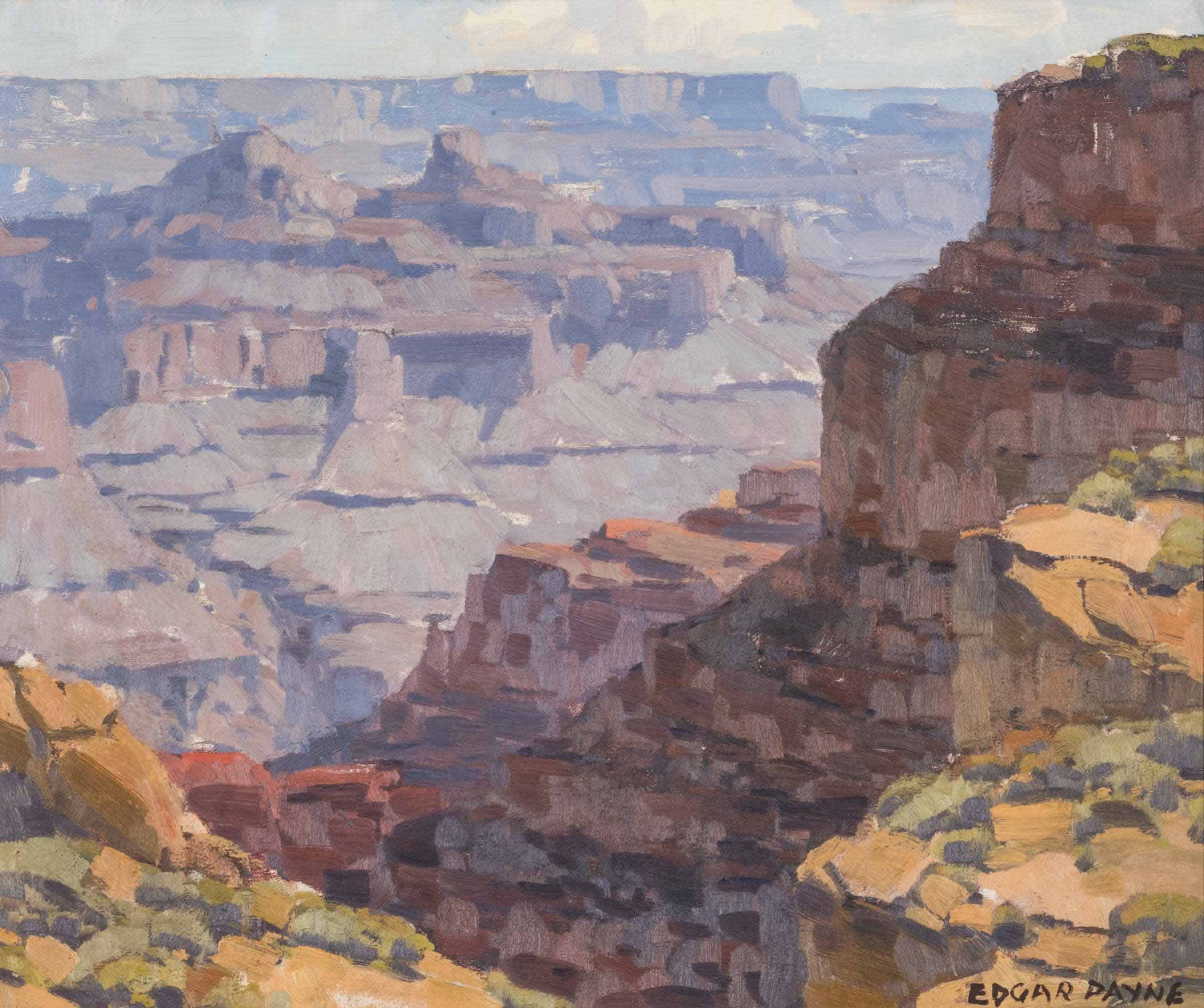
Edgar Alwin Payne’s paintings are often designed not just to show the viewer the landscape, but to help them imagine themselves within it. In Untitled (Grand Canyon), Payne positions the viewer a short distance down a canyon wall trail. This perspective is more intimate than an aerial view or the panorama visible from the canyon’s rim. Immersed within the canyon, the viewer is dwarfed by its hugeness but can also appreciate the architectural features of the canyon walls.