
A priority of New Mexico’s Federal Art Project was the revitalization of “traditional” art forms, with an emphasis on pre-industrial Spanish Colonial craftsmanship. This 1930s chair is a replica of an 18th-century pattern, likely produced by Elidio Gonzales at the Taos Vocational School, which was used as a New Deal decorative arts workshop. Despite the New Deal’s narrative of tradition, it is, in its own way and for its own time, quite modern. While it does not lack detail and decoration, the lines of this chair are clean, straight, and elegant. Take the back and bottom splats, for instance. These appear to be simplified—almost geometric or abstract—versions of typically elaborate and intricate carved floral motifs.
This chair and three identical counterparts were probably made to furnish the historic McKinley County Courthouse, built in 1938 and itself a New Deal building.

The round top of this table is unusual within the universe of Spanish Colonial furniture designs promoted and produced by New Mexico’s New Deal and associated art programs. The state’s Federal Art Project worked in concert with its vocational schools to set up workshops to create the decorative arts needed to furnish numerous newly constructed buildings. The workshops employed artists to manufacture chairs, tables, light fixtures, etc. according to suggested patterns, but this unique table may have been custom-designed and fabricated for the 1938 McKinley County Courthouse by artist Elidio Gonzales. (And perhaps these four chairs were made to match.)

In terms of its decorative arts projects, New Mexico’s New Deal and associated art programs were specifically interested in styles of Spanish Colonial design unique to what is now New Mexico (what were the northern provinces of New Spain in the 18th century). What is referred to as a “Nuevomexicano” aesthetic developed mostly in response to geography. While hardwoods were accessible in what is now Central America, soft pine was what was readily available in what is now the Southwestern United States. That led artists to simplify originally ornate patterns that would not turn out as well in soft wood. Here, for example, the slight S-curve of the table legs is an understated version of a more elaborate style (the technical term for which is “cabriole”). Another simplified element is the basic wavy edge of the table skirt (located under the drawer).

New Deal art programs distinguished between “fine artists” and “craftspeople,” and employed workers differently depending on the category. Fine artists were essentially salaried and given a quota of artworks (typically, paintings or prints) to produce each week or month for inclusion in traveling exhibitions or allocation to public buildings. Fine artists were also granted commissions for projects like murals requested by local governments and communities. In contrast, artists designated as craftspeople were hired to assist with projects and to work in workshops, producing furniture and decorative arts according to design manuals. Ethnic and class biases played a large part in New Deal artist employment practices. While most “fine artists” were formally educated men of European or European-American descent, most “craftspeople” were artists of color, often self-taught.
This trastero (cabinet) was likely produced by Elidio Gonzales at the Taos Vocational School, a New Deal workshop. It is a fine work of art, thoughtfully conceived and very skillfully executed—notice the clarity and uniformity of its hand-carved pattern—yet its maker was not credited at the the time of the New Deal. It was only relatively recently that Gonzales’s identity as a New Deal artist was recovered by scholar Tey Marianna Nunn1 and credit for this piece able to be at least tentatively assigned to him.

From 1939–1942, the Laboratory of Anthropology in Santa Fe sponsored a New Deal Federal Art Project initiative to create a print portfolio of fifteen Navajo weaving designs drawn from its collections, and hired artist Louie Ewing to orchestrate the effort. The silkscreen printing process was a relatively new technology to the United States, so Ewing, with assistance from fellow artist Eliseo Rodriguez, had to essentially invent his own version of it. Two hundred of each print were produced. Prints were distributed to the Bureau of Indian Affairs and federal government “Indian service schools,” as well as universities, libraries, and museums nationwide for instructional and educational purposes.

From 1939–1942, the Laboratory of Anthropology in Santa Fe sponsored a New Deal Federal Art Project initiative to create a portfolio of fifteen Navajo weaving designs drawn from its collections, and hired artist Louie Ewing to orchestrate the effort. The silkscreen printing process was a relatively new technology to the United States, so Ewing, with assistance from fellow artist Eliseo Rodriguez, had to essentially invent his own version of it. Two hundred of each print were produced. Prints were distributed to the Bureau of Indian Affairs and federal government “Indian service schools,” as well as universities, libraries, and museums nationwide for instructional and educational purposes.

From 1939–1942, the Laboratory of Anthropology in Santa Fe sponsored a New Deal Federal Art Project initiative to create a portfolio of fifteen Navajo weaving designs drawn from its collections, and hired artist Louie Ewing to orchestrate the effort. The silkscreen printing process was a relatively new technology to the United States, so Ewing, with assistance from fellow artist Eliseo Rodriguez, had to essentially invent his own version of it. Two hundred of each print were produced. Prints were distributed to the Bureau of Indian Affairs and federal government “Indian service schools,” as well as universities, libraries, and museums nationwide for instructional and educational purposes.

From 1939 to 1942, the Laboratory of Anthropology in Santa Fe sponsored a New Deal Federal Art Project initiative to create a portfolio of fifteen Navajo weaving designs drawn from its collections, and hired artist Louie Ewing to orchestrate the effort. The silkscreen printing process was a relatively new technology to the United States, so Ewing, with assistance from fellow artist Eliseo Rodriguez, had to essentially invent his own version of it. Two hundred of each print were produced. Prints were distributed to the Bureau of Indian Affairs and federal government “Indian service schools,” as well as universities, libraries, and museums nationwide for instructional and educational purposes.

From 1939–1942, the Laboratory of Anthropology in Santa Fe sponsored a New Deal Federal Art Project initiative to create a portfolio of fifteen Navajo weaving designs drawn from its collections, and hired artist Louie Ewing to orchestrate the effort. The silkscreen printing process was a relatively new technology to the United States, so Ewing, with assistance from fellow artist Eliseo Rodriguez, had to essentially invent his own version of it. Two hundred of each print were produced. Prints were distributed to the Bureau of Indian Affairs and federal government “Indian service schools,” as well as universities, libraries, and museums nationwide for instructional and educational purposes.
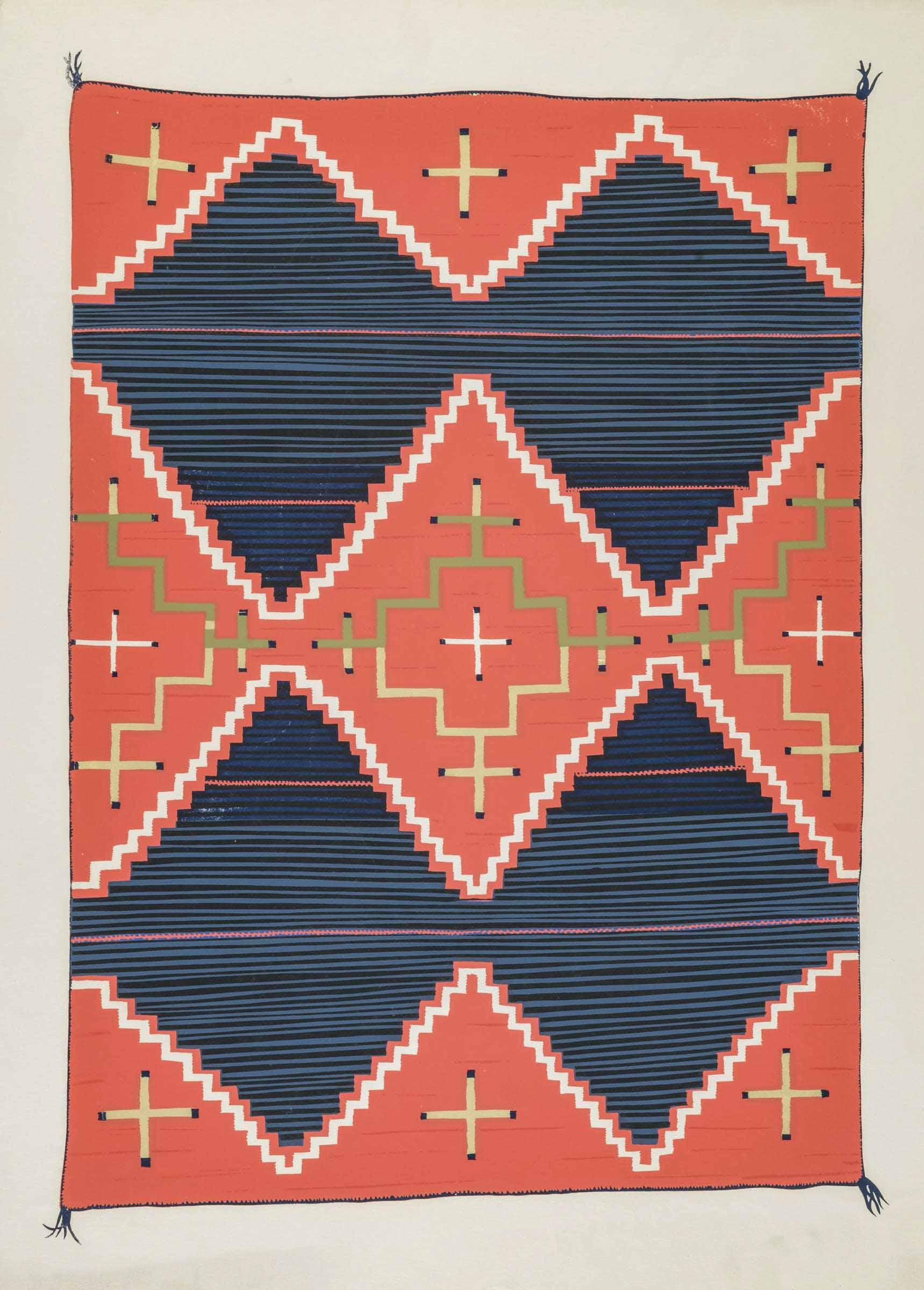
From 1939–1942, the Laboratory of Anthropology in Santa Fe sponsored a New Deal Federal Art Project initiative to create a portfolio of fifteen Navajo weaving designs drawn from its collections, and hired artist Louie Ewing to orchestrate the effort. The silkscreen printing process was a relatively new technology to the United States, so Ewing, with assistance from fellow artist Eliseo Rodriguez, had to essentially invent his own version of it. Two hundred of each print were produced. Prints were distributed to the Bureau of Indian Affairs and federal government “Indian service schools,” as well as universities, libraries, and museums nationwide for instructional and educational purposes.

