

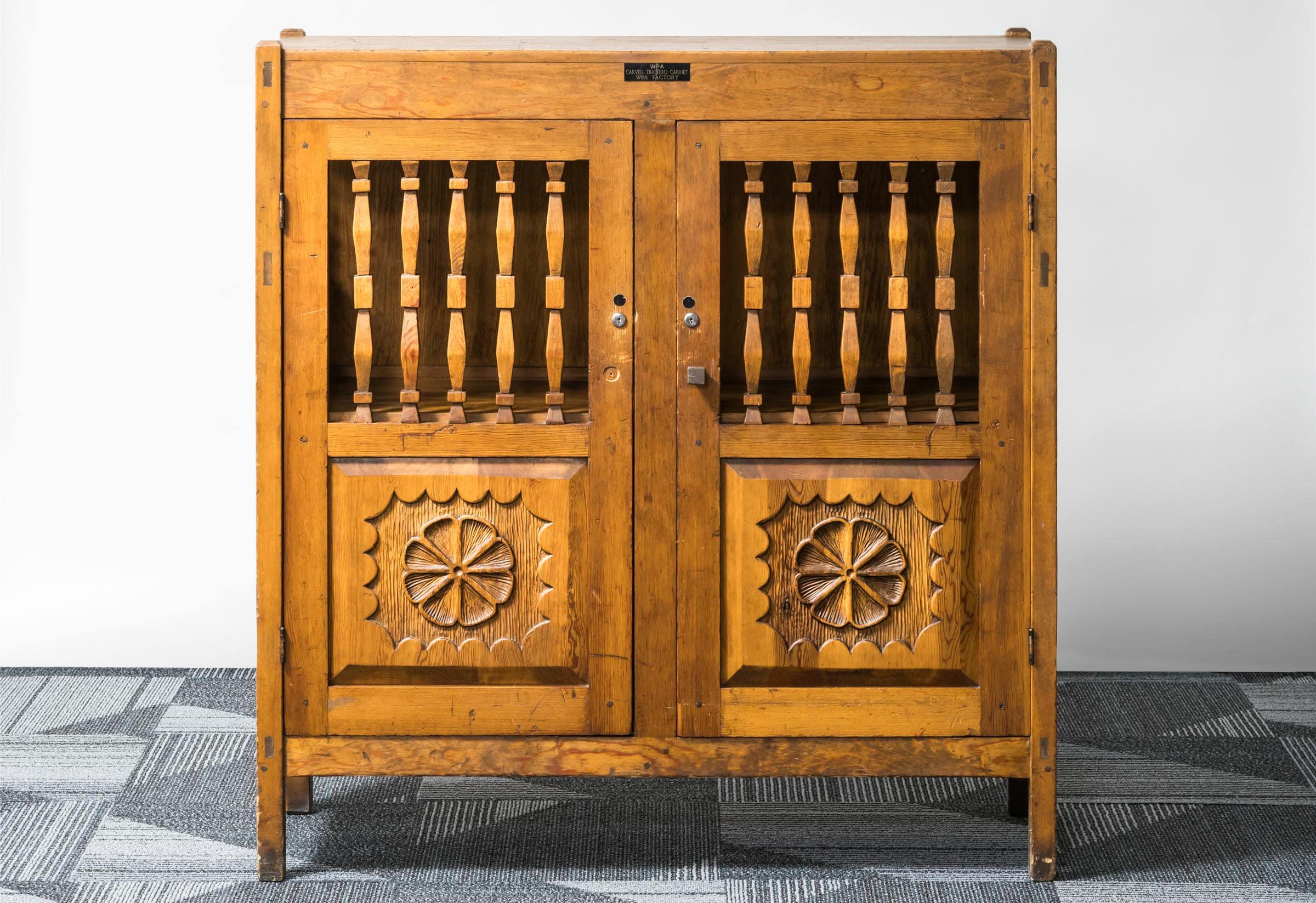
New Mexico’s New Deal programs worked in concert with the State’s vocational schools to produce countless pieces of furniture and decorative arts to fill public buildings. In New Mexico, that program dovetailed with efforts to revive 18th-century Spanish Colonial traditions. The resulting proliferation of Spanish Colonial–style interior décor cemented New Mexico’s visual identity. Take this trastero (cabinet), for example. It was likely produced in a New Deal workshop employing Hispano artists to recreate Spanish Colonial furniture designs, with an emphasis on certain features and motifs such as those seen here: turned spindles, scalloped edges, rosette carvings, and visible joinery. In this way, the New Deal cultivated a visual vocabulary that has since been perceived as looking characteristically “New Mexican.”
Artist Location: Octavia Fellin Public Library
Trastero

This trastero (cabinet) is unique in terms of its design, which draws from the confluence of cultures that is New Mexico. It combines “imported,” traditional Spanish Colonial motifs such as the scalloped border and rosettes carved into the lower part of each front door panel with “local” ideas. By decorating the top half of each panel with images of corn stalks, the artist “Indigenizes” the piece—corn is a crop native to the Americas and it continues to be significant to the Indigenous peoples of what is now the Southwestern United States. Unfortunately, New Deal and associated programs generally categorized woodworkers as “craftspeople” and not artists, and did not credit the maker(s) of this hand-built, original work.
The Mine

The loose, bold brushstrokes of The Mine have the vigor and vitality of a painting made outdoors (a “plein air” painting). While the location in the picture has not been identified, it is both possible and probable that it depicts the Gallup, NM, area. Herbert Tschudy visited Gallup frequently on the annual trips he made to New Mexico during the first three decades of the 1900s. Handwritten notes on the back of the painting detailing its exhibition history indicate it was made in Gallup. A noticeable and plentiful feature of the Gallup landscape are twisted juniper trees, one of which appears prominently in the foreground of The Mine. Despite the title, the sparsely painted smoke stacks in the painting’s background appear incidental to its primary subject: the dramatic natural features and dynamic sunset colors of the high desert landscape. Because the artist has no known involvement in the New Deal, it is likely that he donated this piece to the Gallup Art Center based on his relationship to the community.
The Half-Breed
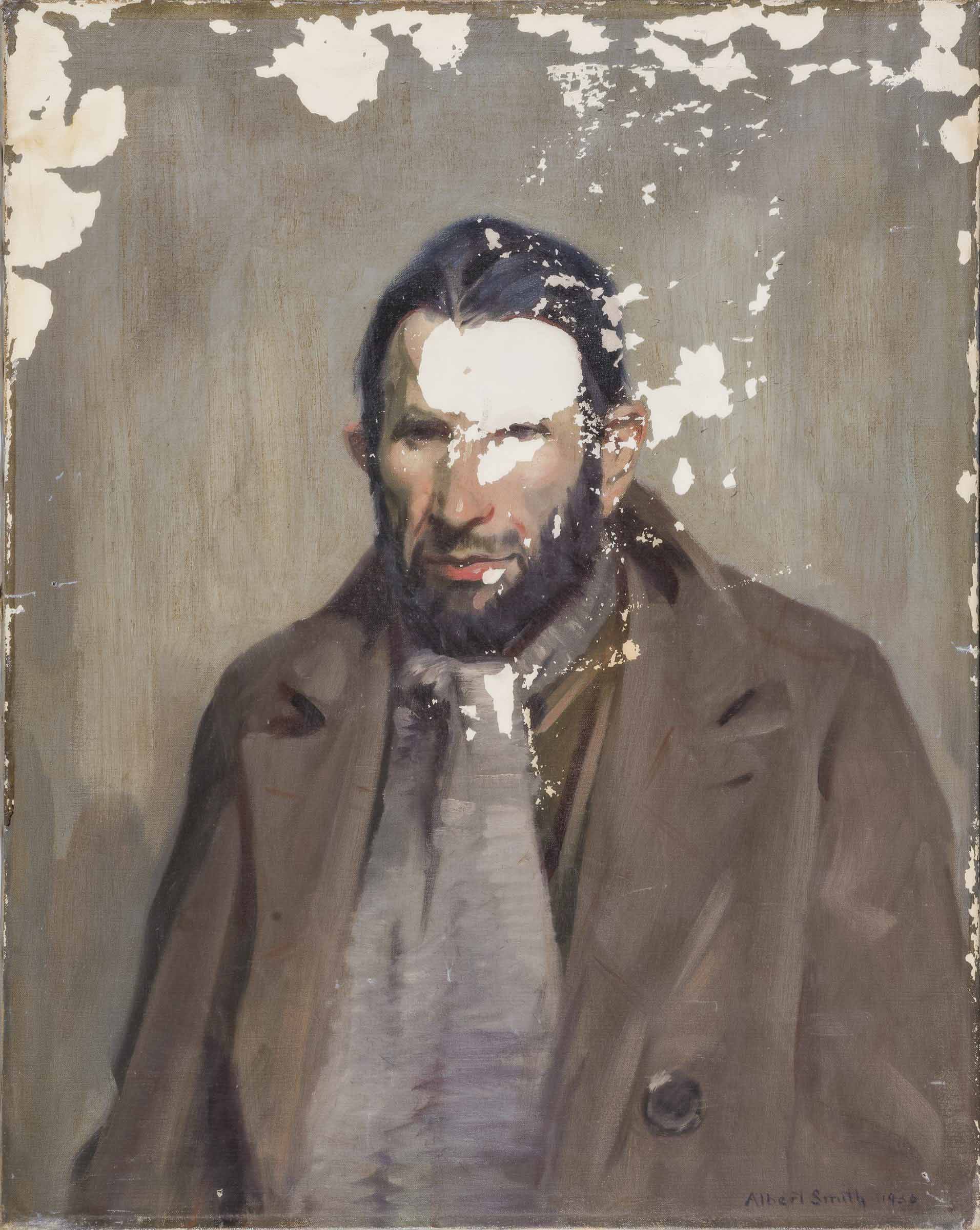
The Half-Breed is a problematic painting, not least because of its title, a derogatory term for a biracial Native American person. The circumstances of its creation are a mystery. Who it pictures and why it was made are not known. The artist likely donated it, along with Chief Deer (Sioux Indian), to the Gallup Art Center. The two paintings are almost identical in size, and the possibility that they are a set raises the question of what Albert Delmont Smith meant to convey by the comparison. The Half-Breed has not been displayed by Gallup’s public library for some time, and suffered damage long ago due to improper storage.
Chief Deer (Sioux Indian)
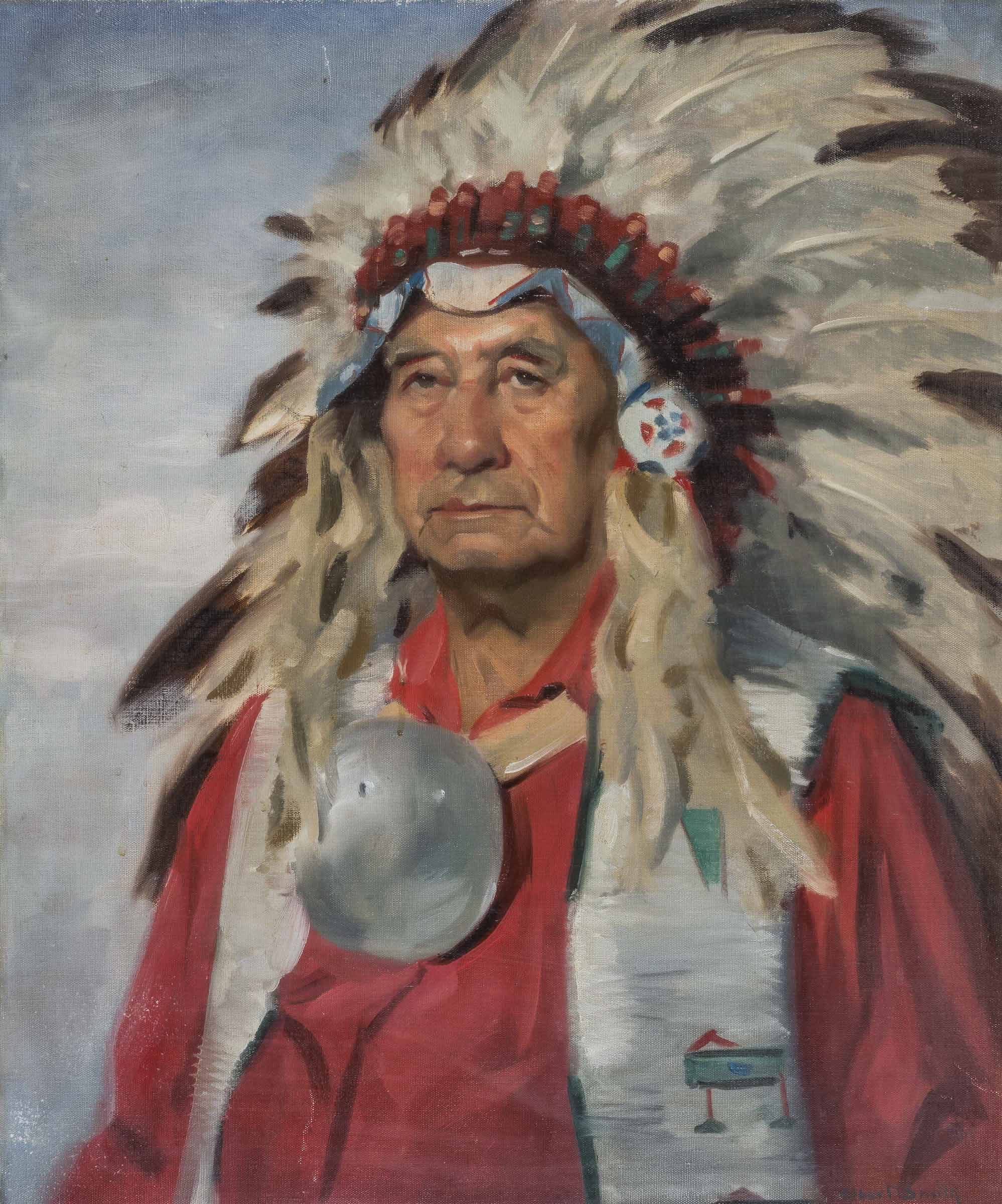
This painting by Albert Delmont Smith, a New York City-based society portraitist, is an enigma. The sitter has not been identified and it is not known for whom or for what reason it was made. It is likely the painting was donated by the artist to the Gallup Art Center, along with The Half-Breed (which may or may not be a companion portrait).
Quenching Their Thirst

Eliseo Rodriguez1 is best known for reviving the 18th/19th-century Spanish Colonial art of straw appliqué as a New Deal artist, but he was also a highly accomplished painter, though few of the paintings he made for the Federal Art Project are credited to him. Despite the lack of credit often afforded artists of color by New Deal art programs (and conventional Eurocentric art historical scholarship), Rodriguez was a multitalented modern artist who significantly contributed to the development of the Santa Fe art colony in the first half of the 20th century and beyond. In Quenching Their Thirst, Rodriguez employs confident, bold lines and a primary color palette to show a scene of everyday Hispano life in New Mexico and at the same time refer to the biblical parable of Jesus and the woman at the well. Author Carmella Padilla explains that “Rodriguez’s devout spirituality and personal religious experience infused his paintings with a special soulfulness.”2
Dead Cottonwood
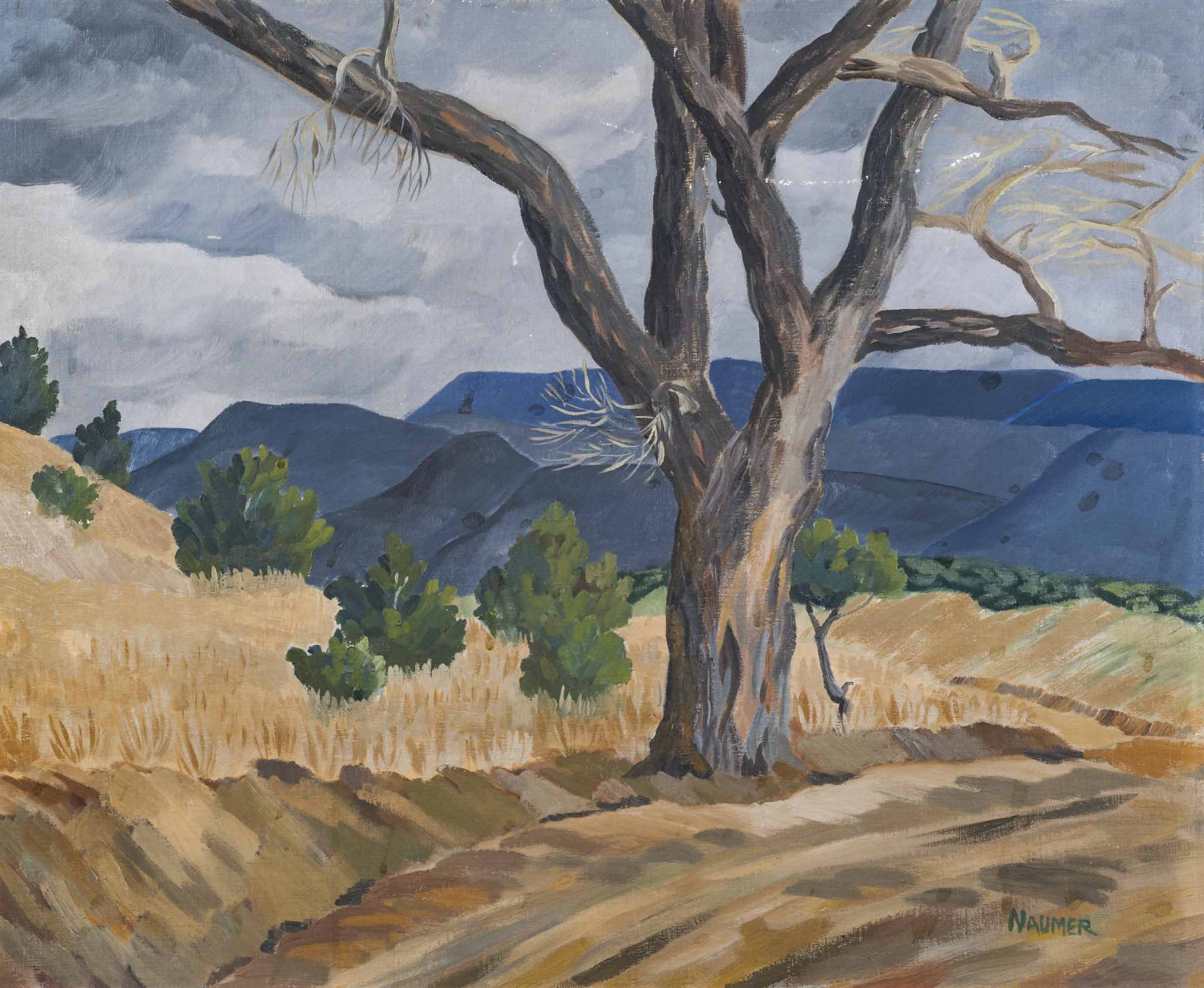
Dead Cottonwood is an unusual painting for Helmuth Naumer, Sr. First, it is in oil, while Naumer mostly worked in and was best known for his pastels. Second, it is relatively drab. One reason Naumer’s pastels were (and are) so popular was that he created them on black paper, which made his vibrant color palette really “pop.” There are inklings of Naumer’s proclivity for complementary colors in Dead Cottonwood: the blues of the mesas in the background complement the yellow hues of the grass in the foreground, and he defines the grain of the cottonwood’s trunk by weaving dabs of terracotta through twists of gray. Yet it is different enough from most of his work to raise questions about what he was thinking. Naumer always said that the Southwest felt instinctively like home, but he was born in Germany. Replying to a question by a journalist in 1938, he expressed concern over Adolf Hitler’s rise to power and predicted the outbreak of a large-scale war.1 Given the time period this work was made—between 1939 and 1943—and the somber subject, title, and colors, perhaps events in Europe weighed heavily on Naumer’s mind when he painted this piece.
Slim Woman and Chewing Tobacco Begay

In keeping with the early 20th-century practice of Native American portraiture in Western American art, Slim Woman and Chewing Tobacco Begay is not so much a portrait of two individuals as it is a stereotyped portrait of a culture. The painting reads like a fashion magazine spread, with the sitters relegated to the role of models, posed so that their jewelry is the center of attention (notice how their hands are unnaturally positioned to show off their rings). In this way, the painting reflects and promotes a superficial understanding of Diné (Navajo) culture.
Rain on the Reservation

In Rain on the Reservation, Lloyd Moylan revels in the light-bending, prismatic effects of a New Mexico monsoon falling in swaths on high mountains and mesas. Moylan’s watercolor technique highlights the geometry of the topography: he lets hard edges of paint form, strengthening the outlines and bulky contours of the shapes. He also paints in layers, so that areas of overlap create a multiplicity of triangles in a kaleidoscopic manner. Moylan loved to experiment with different styles, and in this painting, he plays in the space between realism and abstraction.
Untitled (Pueblo Indians)

Lloyd Moylan tended to depict Diné (Navajo) subjects in a straightforward, almost documentary manner. However, he approached Pueblo subjects differently. Moylan created several paintings of Pueblo women at work, each in a different style. Here, his approach is reminiscent of Pablo Picasso’s 1917–1925 neoclassical period, with statuesque figures, a subdued color palette, white-washed and simplified drapery, and an architectural composition in which the elements are arranged in a triangular formation akin to an ancient Greek temple pediment frieze. In Untitled (Pueblo Indians), Moylan prioritizes form over content, attending more to the artistry of the scene than to the tasks of the people in it.