


Albert Lorey Groll, a foundational Western American artist, was acclaimed for his ability to capture the sweeping blue expanse and billowing cloud formations of desert skies. In Untitled (Red Rocks), he expertly takes the viewer on a visual journey through seemingly unbounded time and space.
Artist Location: Octavia Fellin Public Library
Enchanted Mesa

Several labels are affixed to the back of Enchanted Mesa, including one in elegant script that states “Compliments of Albert Lorey Groll.”1 These confirm that the artist donated this artwork to Gallup’s Federal Art Center in anticipation and support of the formation of a permanent museum for the community. The artist got his start as a Western American artist in the Gallup area and visited frequently from the early 1900s through the early 1940s.
Kit Carson House Taos, N.M.
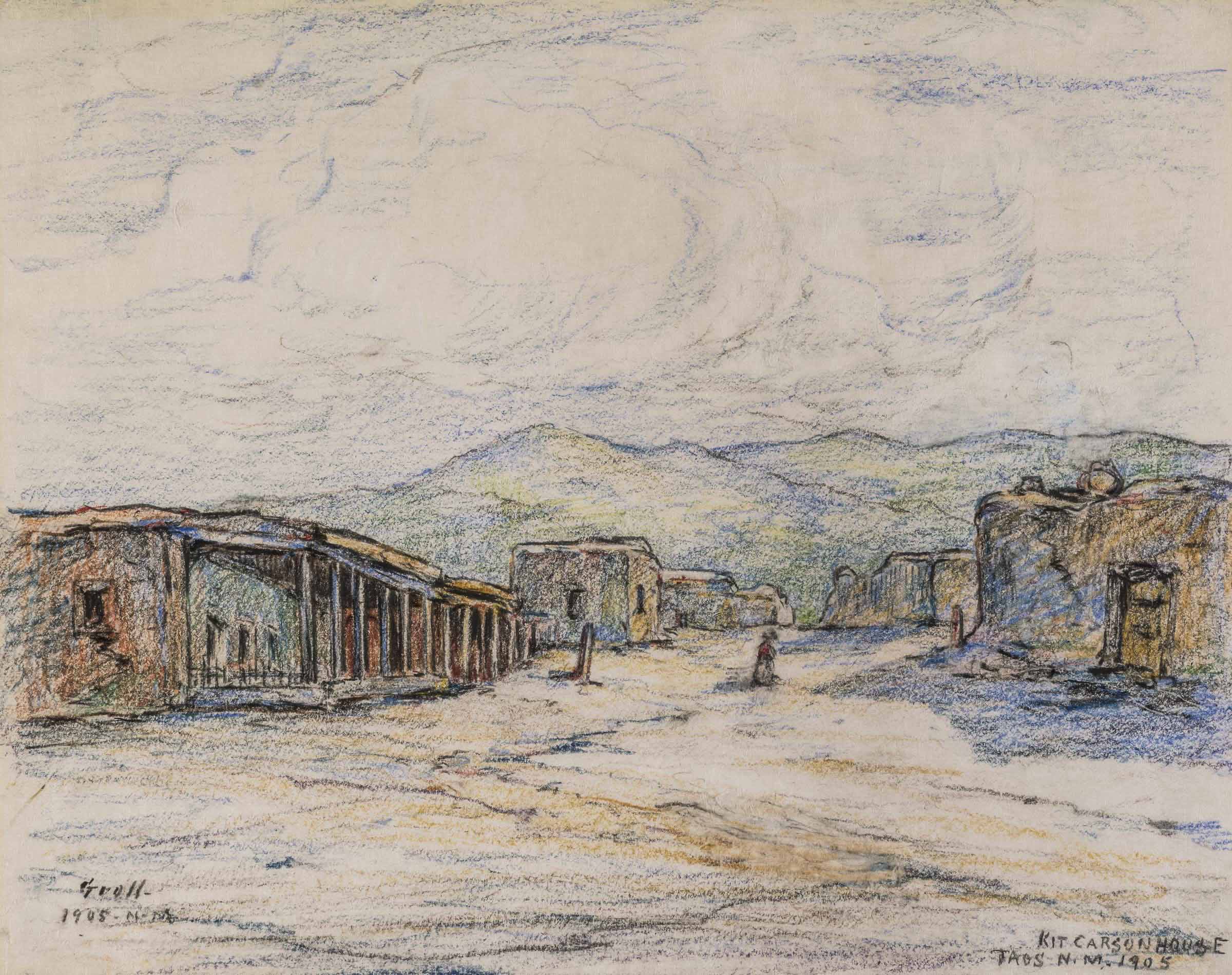
Albert Lorey Groll first visited Arizona and New Mexico in 1904, and he would continue to make frequent trips to the West for the next four decades. Kit Carson House Taos, N.M., made in 1905, takes as its subject the adobe residence of an (in)famous frontiersman, trapper, military commander, and Indian Agent. As such, it encompasses the problematic narratives of the “Wild West”—stereotypes of “Cowboys and Indians,” expansive and rugged landscapes, and remote outposts—in which the Western American art movement was rooted and which it also promoted.
Inscription Rock—N. Mexico
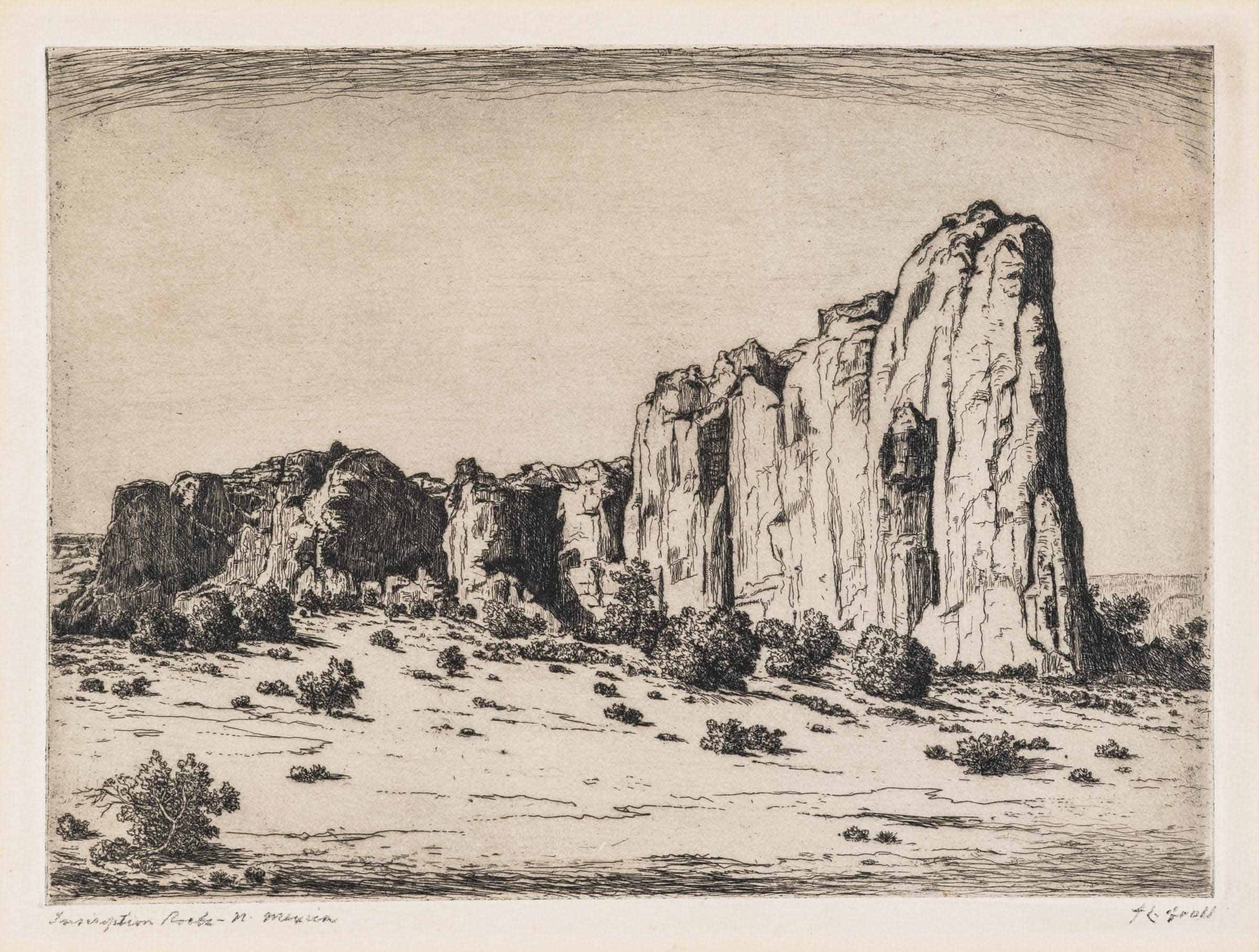
In the early 1900s and for the next four decades, New York–based artist Albert Lorey Groll made numerous trips to the Southwest and produced paintings, etchings, and works on paper that introduced East Coast audiences to novel (for them) landscapes. Some of the places he pictured, though famous now, were only just gaining national recognition at the time of his travels. For example, the Grand Canyon, which Groll repeatedly visited and sketched, was made a National Park in 1919. Likewise, El Morro National Monument, the subject of Inscription Rock—N. Mexico, was designated in 1909.
West Wind
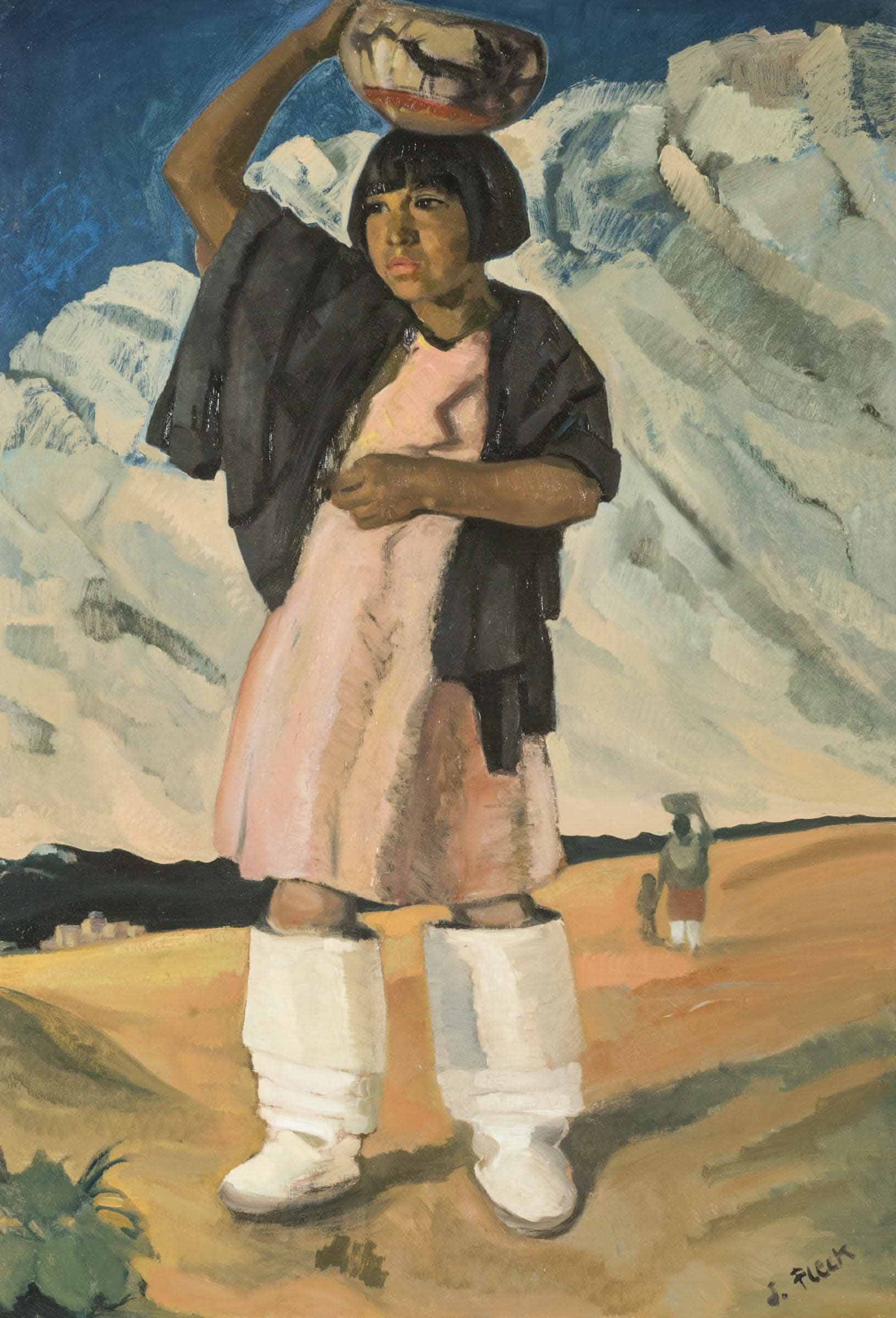
In this full-length portrait, Joseph Fleck monumentalizes the figure of a Pueblo woman: she is as tall as the clouds—the top of her hand cannot even be contained by the canvas—and she is pictured at an oblique angle that exaggerates her proportions. The overall effect is to evoke the perceived mythology of its Native subject—a significant focus of Western American art at the turn of the 20th century and in the following decades. Visual references to Taos Mountain and the ancient Taos Pueblo complex in the distance, as well as to the cultural and generational practice of gathering water (note the woman and child in the background) underscore the painting’s concepts of timelessness and natural harmony.
On the Moorings Maine

An inscription on the back of On the Moorings Maine, probably the artist’s, notes the location of this view as New Harbor, ME, a spot frequently visited by Frederick Detwiller. The artist studied as an architect and is especially attentive here to the design and engineering features of the harbor—the warehouses on stilts and the masts and riggings of sailboats.
No documentation has been found to explain how this piece entered the collection of the Gallup Art Center. A working hypothesis is that Detwiller was an associate of fellow NYC-based artist Albert Lorey Groll, who is known to have reached out to his professional network for artwork contributions in the early 1940s to help establish a permanent art museum in Gallup (which never came to fruition).
Redwood Trees
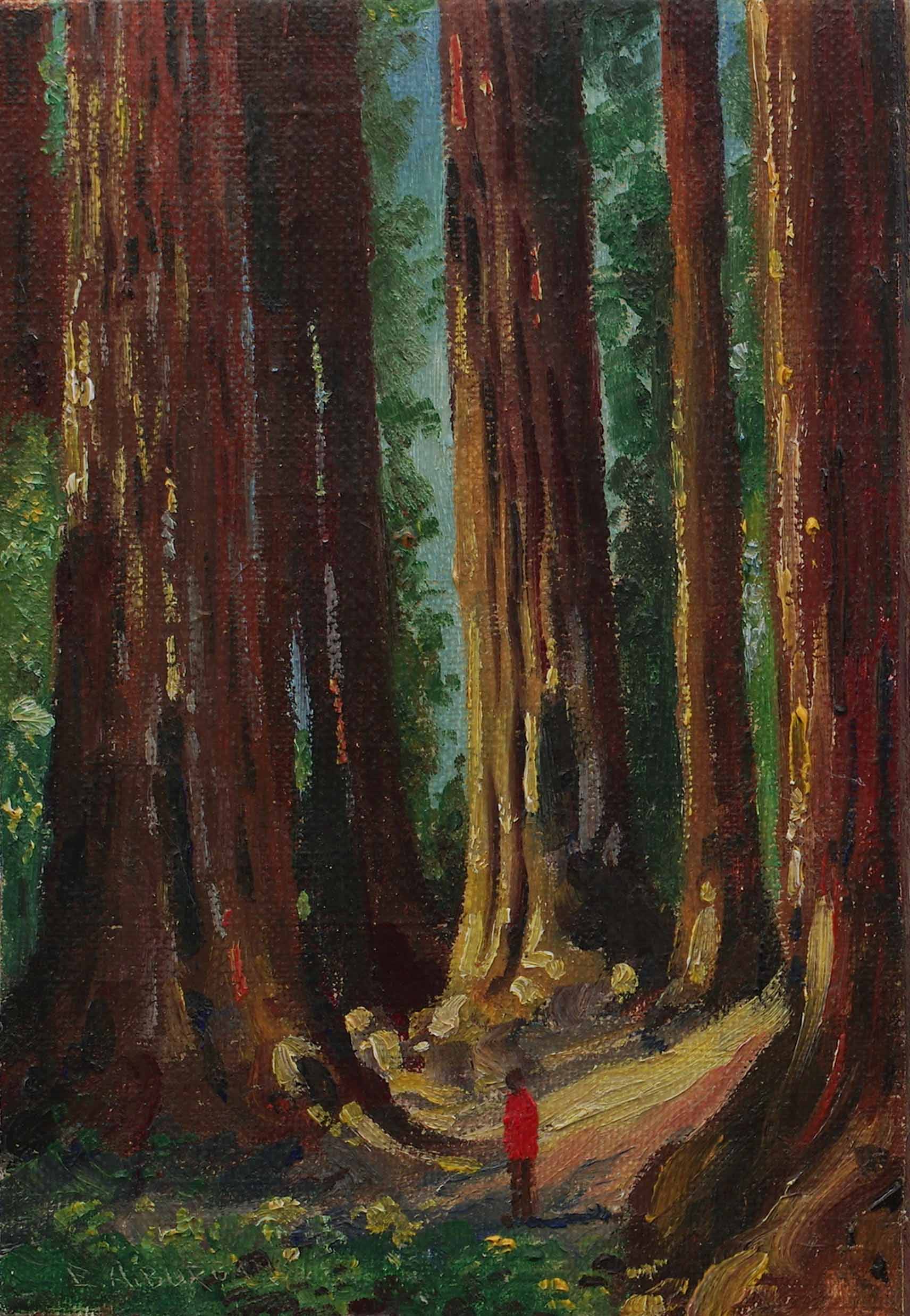
In Redwood Trees, Elbridge Ayer Burbank accomplishes a miniature painting (the size of a postcard) of a monumental subject, achieving a sense of scale and grandeur through a tiny, brightly clad figure and dramatic lighting.
Hopi Indian House

At the turn of the 20th century, Elbridge Ayer Burbank spent two decades traveling the western United States to document Native peoples and cultures for the Field Museum in Chicago. In an inscription on the back of this painting, the artist notes the location of the image as “Polacca, Arizona 80 miles from Holbrook, Arizona where the Santa Fe Railroad is.” The settlement of Polacca was established in the late 19th century with a day school and trading post to accommodate population growth, yet Burbank’s close-up architectural view presents it as a historic, timeless Hopi village.
Untitled (Abraham Lincoln’s Post Office)
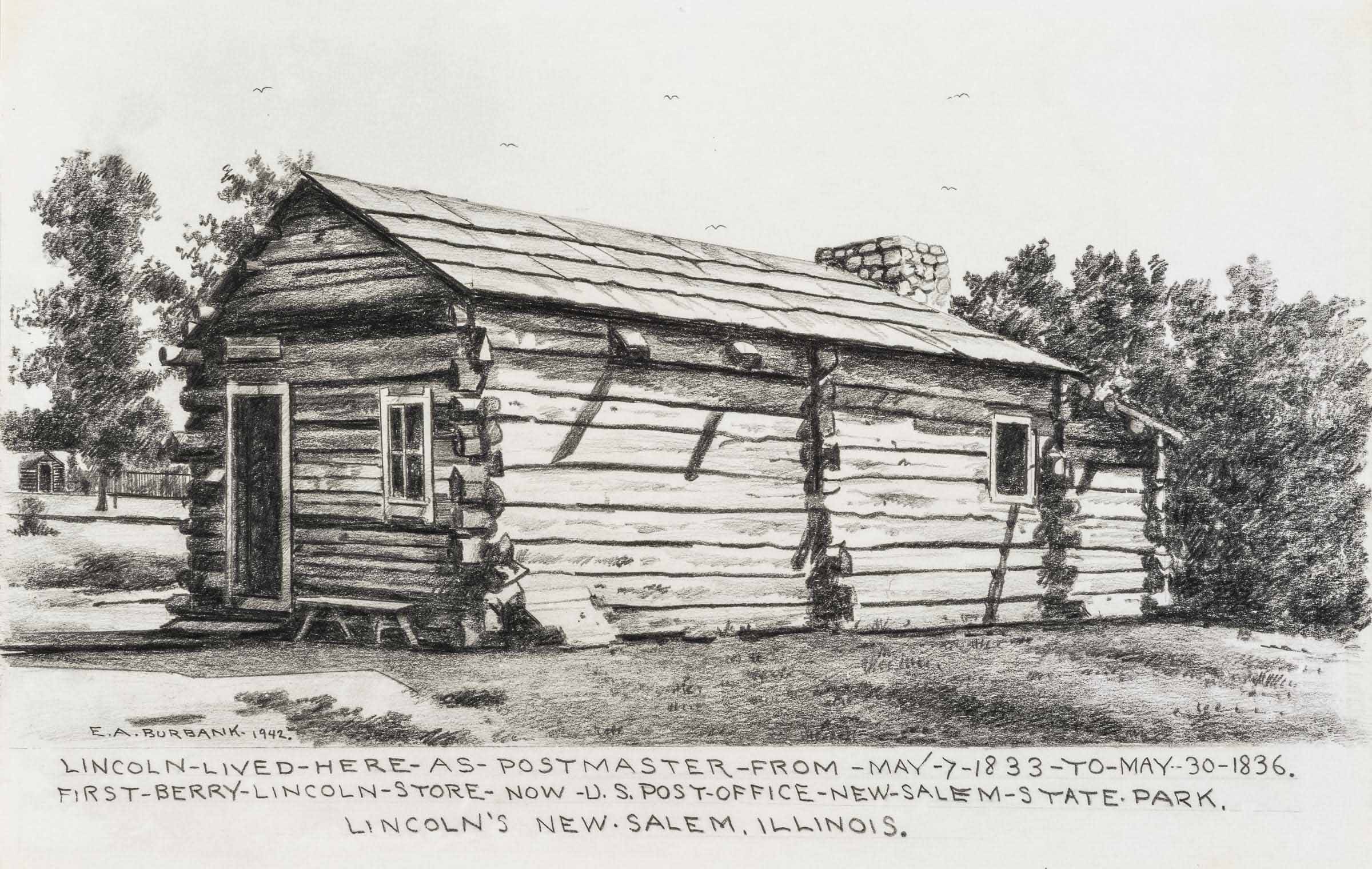
While Elbridge Ayer Burbank is best known for his portraits of Native Americans, his artistic career focused broadly on documenting people, places, and events that define American history and society. In this context—and given the fact that Burbank was born and raised in Abraham Lincoln’s home state of Illinois—his interest in picturing the post office where Lincoln served as postmaster in the 1830s (and where the future president began his legal career and was first elected to public office) makes sense.
Burbank had close ties to the Gallup area. He spent a significant amount of time at what is now known as the Hubbell Trading Post in Ganado, AZ (about one hour’s drive west of Gallup) in the early 1900s in his quest to paint “every single Indian tribe in America.” It is likely that he donated Untitled (Abraham Lincoln’s Post Office) to the Gallup Art Center as efforts to establish a permanent art museum in Gallup gained traction—yet why this piece/subject in particular is undetermined.
Untitled (Navajo Girl with Lamb)
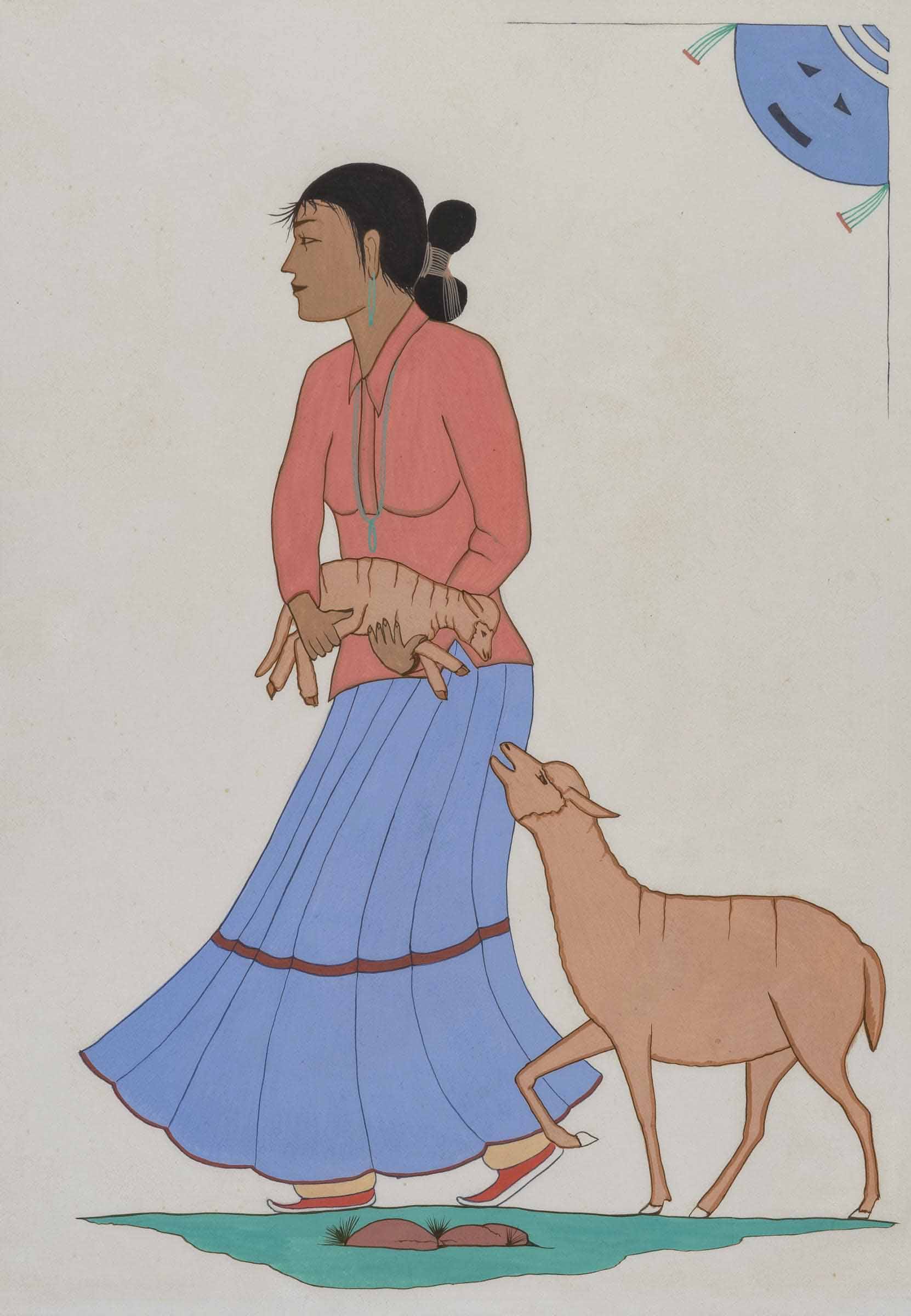
Untitled (Navajo Girl with Lamb) reveals how the flat aesthetic of the 1930s Studio Style, which dictated Native American painting for the first half of the 20th century and beyond, curtailed artists’ ability to communicate meaning. As told in the Studio Style, Timothy Begay’s (Diné/Navajo) story of the sacred and spiritual relationship between his people and their sheep is reduced to a pleasing, decorative scene.