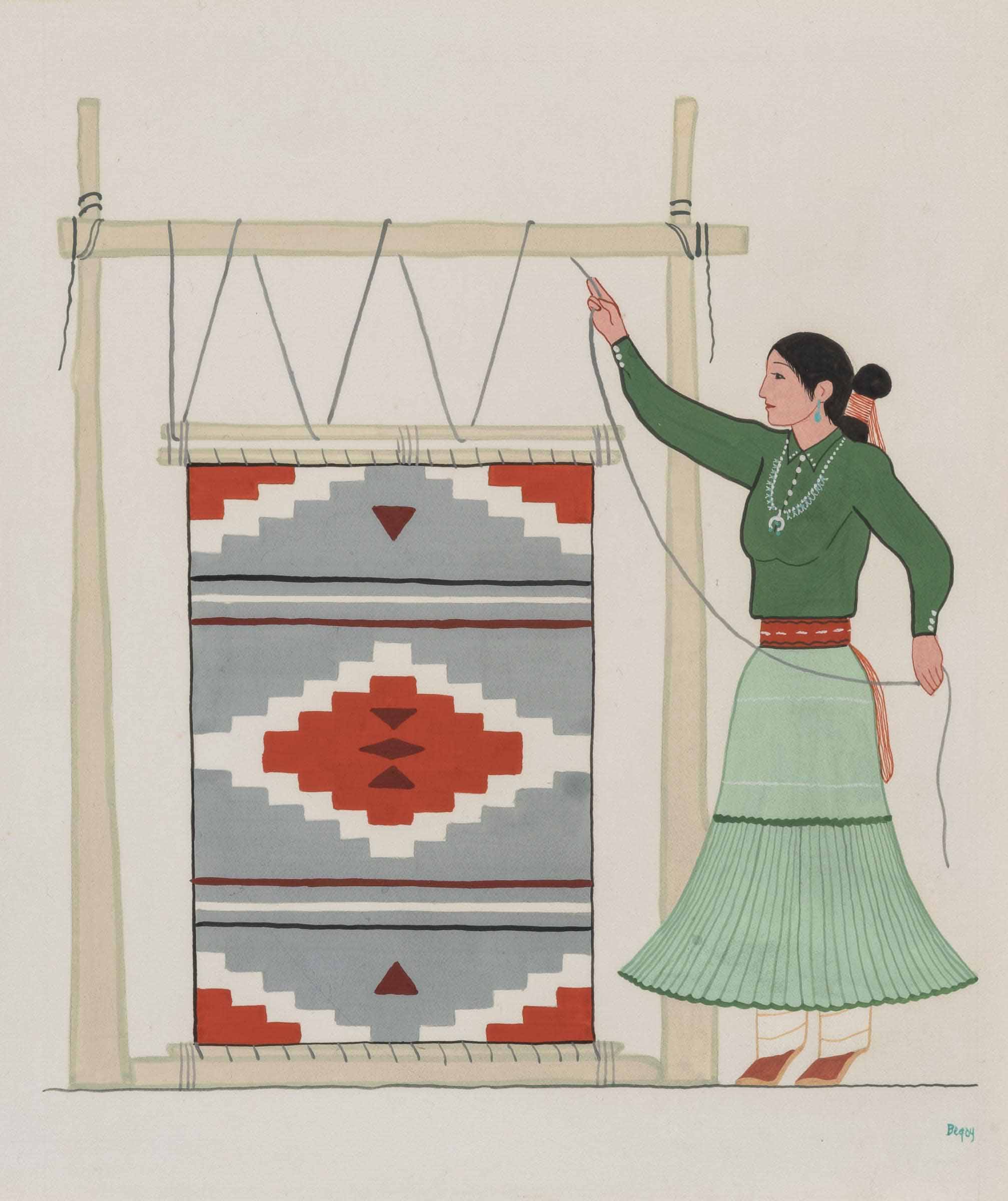
A painting of a woman in a green pleated skirt, red belt and long-sleeved green standing next to a wooden loom which is taller than she is and from which hangs a geometric-patterned red, white and gray textile. The weaving is suspended by a gray string, which wraps around the frame. The woman grips the string in a raised hand and holds the loose end behind her with her other hand, as if lowering the weaving in the manner of window blinds.

Harrison Begay

Untitled (Taking Down a Finished Rug)

About mid-1930s

Casein/tempera on paper

8” W x 9” H

About this artwork

Untitled (Taking Down a Finished Rug) is an excellent example of the problematic Studio Style of Native American painting taught by non-Native art teacher Dorothy Dunn at the Santa Fe Indian School in the 1930s. Harrison Begay (Diné/Navajo) was one of many Native artists initially trained there as a painter. The Studio Style defined Native painting for a generation and its influence is still felt today. It is characterized by formal and conceptual flatness: blank backgrounds, outlined forms, lack of perspective and shading, and an emphasis on “traditional” themes.

Audio description for individuals with low vision. Audio descriptions produced by Art Beyond Sight.

Audio description

Untitled (Taking Down a Finished Rug) is a painting by artist Harrison Begay. It’s nine inches tall and eight inches wide, painted on paper with casein paint and tempera.

The Studio Style of this Native American painting is visually conveyed in its blank background, distinct outlines of the characters, and lack of perspective and shading. For more about this painting style and the history of this painting, read the “About this Artwork” section above.

Most of the painting is taken up by a tall weaving loom that holds a finished rug. The loom is made from horizontal and vertical pieces of beige, unpainted wood.  A woman stands to the right of the frame, reaching up with her right hand and holding a rope while the rope’s loose end is in her left hand. She is in the process of releasing the rope and taking the rug off the loom. The loom looks like an open picture frame, and the rug hangs inside the frame, mounted to flat strips of wood called tension bars at its top and bottom edges. The tension bars are suspended from the loom by thin gray pieces of yarn, which wrap around the frame. First we’ll describe the woman, and then the rug.

The woman wears a dark green, long-sleeved shirt tucked into a light green skirt. Her shirt is collared and has five small buttons closing the top, and a silver necklace with blueish green stones hangs from her neck. Her skirt is tight at her waist and flares out to a pleated bell shape at its bottom near her ankles. Around her waist she wears a dark orange wrapped woven belt decorated with white horizontal stitches. Beneath her skirt she wears traditional knee-high moccasins, white on her leg and at her feet made of dark orange leather wrappings. She also wears bright blue earrings and has dark brown or black hair pulled back into a traditional Diné bun known as a tsiiyéél. The bun is vertical and has two round sections, one on top and one on bottom, separated and held in place by a wrapping of light red yarn.

The rug is longer than it is wide. It has a gray background with three sections of white and red geometric designs common to Navajo rugs. A center section is separated from the top and bottom sections by three lines of dark blue, white and red which run horizontally across the weaving. In between these lines is a large light red diamond shape with a white border. The diamond is wider than it is tall, and the edges of the diamond are staggered as if to resemble stairs. This pattern is commonly called a stair-stepped diamond. In the middle of the light red diamond is a small dark red diamond with a downward pointing triangle above it and an upward pointing triangle below it. The design in the top third and bottom third sections of the rug are identical but mirrored, containing a red triangle pointing down toward the center like an arrow pointing, and a red and white border in each corner which ascends or descends in a similar stair-like style to the center design.

See this artwork in a different light

More artworks by this artist

We are always open to learning more about our collections and updating this website. Does this entry contain inaccurate information or language that you feel we could improve or change? Click here to let us know.

Copyright © 2026 gallupARTS

What are you looking for?

Art Collection

Gallup’s New Deal art collection consists of over 120 objects created, purchased, or donated from 1933 to 1942 through New Deal federal art programs administered by President Franklin D. Roosevelt to support artists during the Great Depression.

Main Menu

Image Use Notice: Images of Gallup’s New Deal artworks are available to be used for educational purposes only. Non-collection images are subject to specific restrictions and identified by a © icon. Hover over the icon for copyright info. Read more