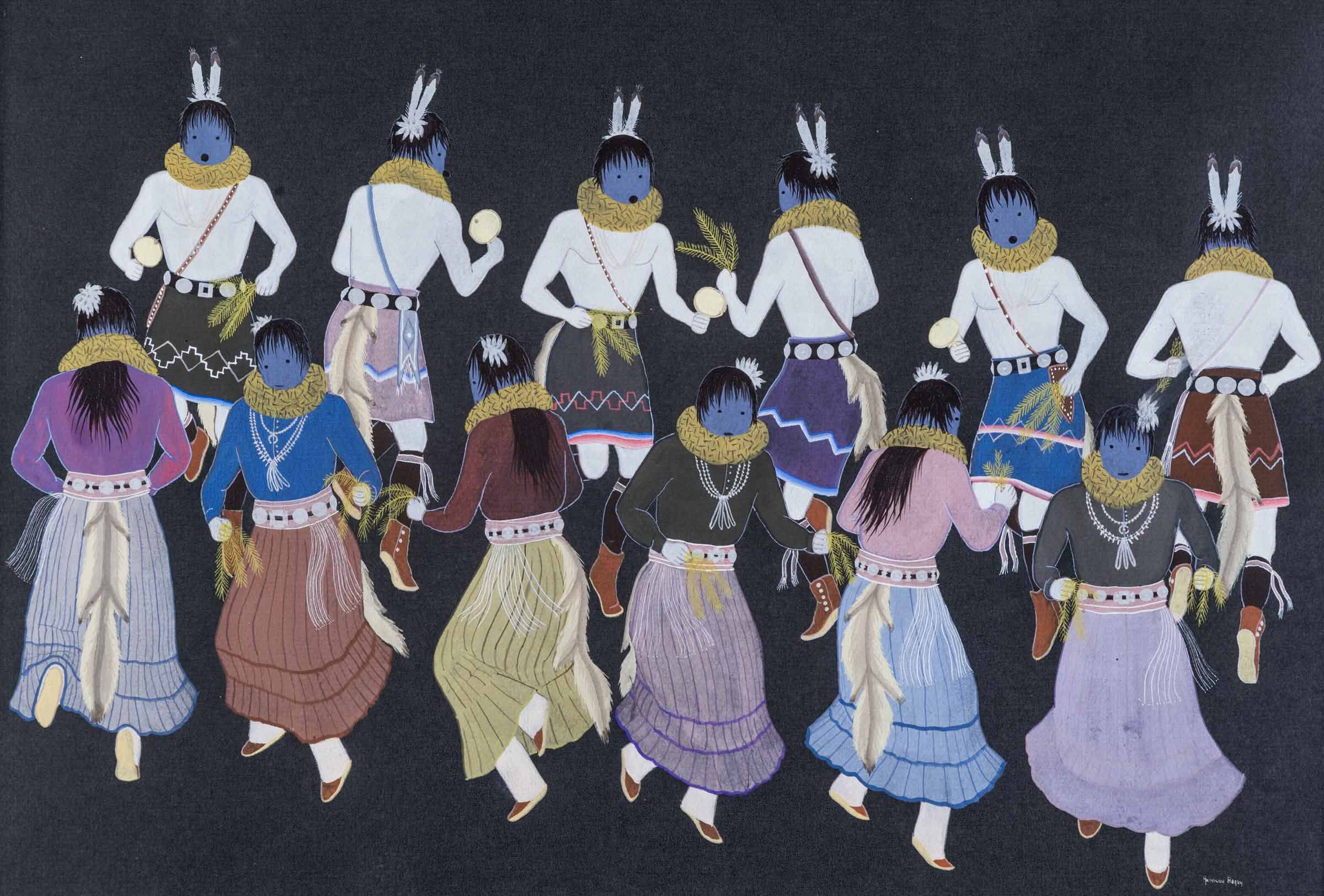
This is an untitled painting by artist Harrison Begay, depicting a Yei Bi Chei ceremony. The work is one and a half feet wide and about a foot high, painted on paper with casein paint and tempera.
In Untitled (Yei Bi Chei), Harrison Begay transcends the restrictive conventions of the “flat” Studio Style in which he — along with most Native painters of his generation — was trained in the 1930s. Through his work, Begay introduces a sense of movement, rhythm, and energy. For more about this painting style and the history of this painting, read the “About this Artwork” section above.
The painting depicts twelve dancers: a horizontal row of six women, with a row of six men behind them, set against a solid black background. All the dancers have black hair. The women wear their hair in short bangs in the front, with long hair reaching down their backs. Their hair is adorned with fluffy white feathers worn on the sides of their heads. The men have similar bangs, but their hair is shorter in the back, reaching their collars, and they wear two feathers upright at the back of their heads.
The faces of all dancers are colored blue. They wear traditional regalia, including bushy light brown collars which we know are made of evergreen tree twigs or branches, and brown and white fur which we know to be fox pelts hang from their waists trailing down the center of their backside like tails.
The men and women are dressed differently. The women wear long-sleeved shirts in solid colors of red, blue, pink, and gray, with multiple strands of necklaces hanging across their chests. Their ankle-length skirts are each a different color: blue, gray, red, beige, and purple. They wear light red woven sash belts with fringe on left and right, each belt encircled by round silver-gray medallions that appear small in our view but are about half the size of the figure’s closed fist. In each hand, they hold several sprigs of pine needles, which have faded to beige due to slight light damage over time. The women wear knee-high white deerskin moccasins.
The men in the back row are shirtless, their bare torsos and arms painted white. They wear knee-length skirts in gray, brown, blue, or red. Around their waists are black woven sash belts with similar circular medallions and fringe on left and right. In one hand, they hold gourd rattles, and in the other, they carry several sprigs of pine needles. On their feet are ankle-height brown leather moccasins worn over black knee-high socks with white tassels at the knee.
All the dancers are in motion, with only one foot on the ground and the other raised in step. We see the sprigs in their hands and the fox pelts at their waists swaying with the rhythm of each dancer’s movement. The dancers turn in place, and though they face different directions, they appear highly synchronized—almost like a repeating pattern of figures, attire, and movements. The artist captures them at various stages of this process, with some having turned fully to face the opposite row of dancers, while others are mid-turn, facing away from the dance group.