Zuni Pottery Makers

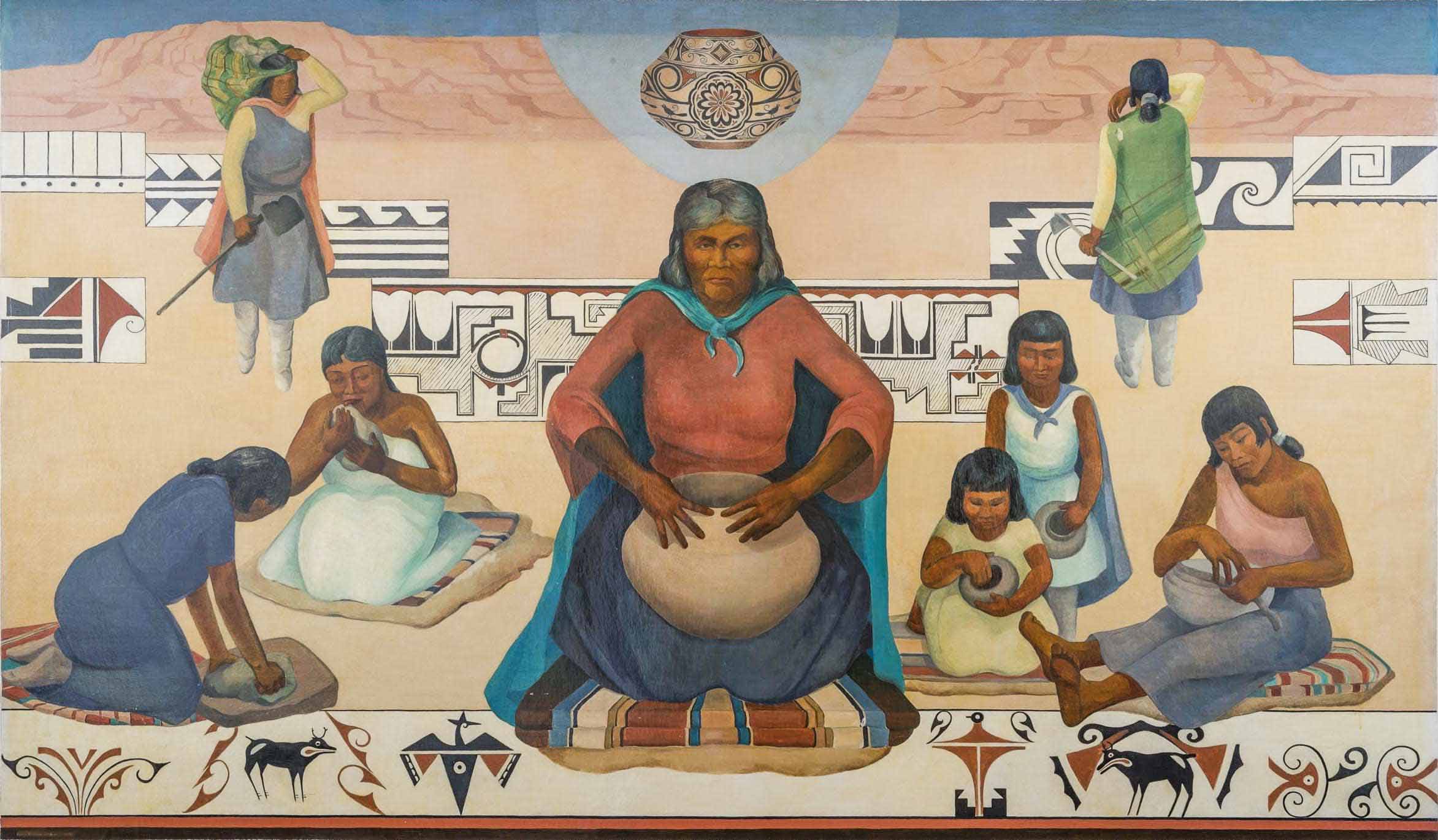
“In this mural the artist has attempted to . . . put on canvas for the observers to see what the Zuni pottery maker has in her conscious and subconscious mind as she makes her pot, the traditions of gathering and working the clay, the religious beliefs and fervor, the history of her people and their traditions which go to make up this her work [sic],” wrote Anna Keener Wilton1 of her painting Zuni Pottery Makers in a 1942 thesis for her master’s degree from the University of New Mexico.2

In her essay, Keener Wilton positions Zuni Pottery Makers as a documentary painting—based on anthropological and ethnographic research, at least one interview with a potter, and, presumably, her own firsthand observations—that illustrates the A:Shiwi (Zuni) pottery-making process step by step. Keener Wilton’s mural is organized around a central master potter (more on her later). As she explains it, the narrative begins with the figure in the top right starting her journey to gather clay from the distant mesas by, “in accordance with the tradition of the pot maker . . . cast[ing] over her shoulder a stone, so that her strength may not fail her.” The same figure is depicted at top left “returning with a load of clay, as much as a hundred and fifty pounds in her blanket, the ends tied and banded across her forehead.” Keener Wilton continues, “in the left foreground we see the next step of the process, the clay being kneaded,” and explains that potters knead the clay to such a fine texture “that the fingers can no longer guide the senses; then it is tested with the tongue as portrayed by the figure above the kneader.” Finally, “to the observer’s right are to be seen the youthful apprentices, forming in the age-old method of their ancestors, the pots of modern Zuni.”3

Zuni Pottery Makers also documents the evolution of A:Shiwi pottery designs. As Keener Wilton writes: “By the use of panels in the composition the artist has attempted to portray the various stages in the development of pottery design from the earliest known period to the present day.” Early designs are replicated in the upper left, later designs in the upper right, and contemporary designs in the middle. “Along the border at the base of the composition are six relatively modern designs . . . of a religious nature.” She also states that she “wishes to point out that every example of design portrayed on the mural has been found in existence in or near Gallup, New Mexico” (though certain designs have been questioned by present-day potters).

In addition to diagramming the process and development of A:Shiwi pottery, Keener Wilton puts forth several major contentions in her essay: a) for a Zuni potter, “her work is born with her”; b) Zuni pottery is the highest form and full expression of Zuni culture; and, c) Zuni potters are great artists. In support of these statements, she places at the center of her mural a potter referred to in her essay as “Mrs. Poncho”4—one of her primary sources for her thesis. Mrs. Poncho is shown demonstrating “how she . . . measures [the pot] by spreading her hands so as to obtain the exact spacing for the design she has visualized,” which is pictured above her head “surrounded by a halo.” In her essay, Keener Wilton quotes Mrs. Poncho as saying, “I always know just how the jar will look before I start to paint it. I just think and think; then I draw what I think.” She goes on to assert her artistic genius as being able to conceive of the pot and design in unison and defends against assumptions of “mere decoration.”

Zuni Pottery Makers was likely installed in the wall of the original County Commission chambers of the historic McKinley County Courthouse soon after it was built. It still hangs in that location, which is now the District Attorney’s office.

Shalako

Shalako, which depicts an annual A:shiwi (Zuni) winter festival, is an action-packed, tremendously detailed painting. In it, Jose Rey Toledo captures everything from the central dancers’ movements and regalia to the backdrop with supreme precision. Notice the fine lines delineating each individual bead on the dancers’ necklaces, how headdress feathers have been colored one by one, and how the artist renders the fringe of the woven sashes worn by the two dancers on the left with pinpoint-size brushstrokes. Behind them, more than two dozen onlookers are individually represented, each with distinct facial features, clothing, and postures. Toledo’s meticulousness even extends to the background, where each element is finely articulated, including the perched owl’s feathers.

Poster for the Indian Court Federal Building

In 1939, San Francisco hosted the Golden Gate International Exposition to celebrate the opening of the San Francisco—Oakland Bay and Golden Gate Bridges and the theme of “Pacific Unity.” The Exposition included an “Indian Court” exhibit organized by the newly established Indian Arts & Crafts Board (IACB) with art displays, a vendor marketplace, artist demonstrations, and guided tours. These posters, produced by Louis Siegriest for the IACB in partnership with another New Deal program, the Federal Art Project, promote The Indian Court’s conception and representation of “eight great areas of Indian culture,” including the “Fishermen of the Northwest Coast,…Buffalo Hunters of the Plains,…the Cornplanters of the Pueblos, [and] the Navajo Shepherds”—Gallup’s collection includes only four of the eight total posters. The imagery is borrowed from Indigenous artists, who received little or no recognition. Siegriest created the poster designs but “had nothing to do with the actual process,” meaning he didn’t make the screens or pull the prints; “I would see that they got out,” he recalled. “I think they got out 1,500 of each poster.”1

Poster for the Indian Court Federal Building

In 1939, San Francisco hosted the Golden Gate International Exposition to celebrate the opening of the San Francisco—Oakland Bay and Golden Gate Bridges and the theme of “Pacific Unity.” The Exposition included an “Indian Court” exhibit organized by the newly established Indian Arts & Crafts Board (IACB) with art displays, a vendor marketplace, artist demonstrations, and guided tours. These posters, produced by Louis Siegriest for the IACB in partnership with another New Deal program, the Federal Art Project, promote The Indian Court’s conception and representation of “eight great areas of Indian culture,” including the “Fishermen of the Northwest Coast,…Buffalo Hunters of the Plains,…the Cornplanters of the Pueblos, [and] the Navajo Shepherds”—Gallup’s collection includes only four of the eight total posters. The imagery is borrowed from Indigenous artists, who received little or no recognition. Siegriest created the poster designs but “had nothing to do with the actual process,” meaning he didn’t make the screens or pull the prints; “I would see that they got out,” he recalled. “I think they got out 1,500 of each poster.”1

Poster for the Indian Court Federal Building

In 1939, San Francisco hosted the Golden Gate International Exposition to celebrate the opening of the San Francisco—Oakland Bay and Golden Gate Bridges and the theme of “Pacific Unity.” The Exposition included an “Indian Court” exhibit organized by the newly established Indian Arts & Crafts Board (IACB) with art displays, a vendor marketplace, artist demonstrations, and guided tours. These posters, produced by Louis Siegriest for the IACB in partnership with another New Deal program, the Federal Art Project, promote The Indian Court’s conception and representation of “eight great areas of Indian culture,” including the “Fishermen of the Northwest Coast,…Buffalo Hunters of the Plains,…the Cornplanters of the Pueblos, [and] the Navajo Shepherds”—Gallup’s collection includes only four of the eight total posters. The imagery is borrowed from Indigenous artists, who received little or no recognition. Siegriest created the poster designs but “had nothing to do with the actual process,” meaning he didn’t make the screens or pull the prints; “I would see that they got out,” he recalled. “I think they got out 1,500 of each poster.”1

Sandpainting-style Wall Painting (Sun)

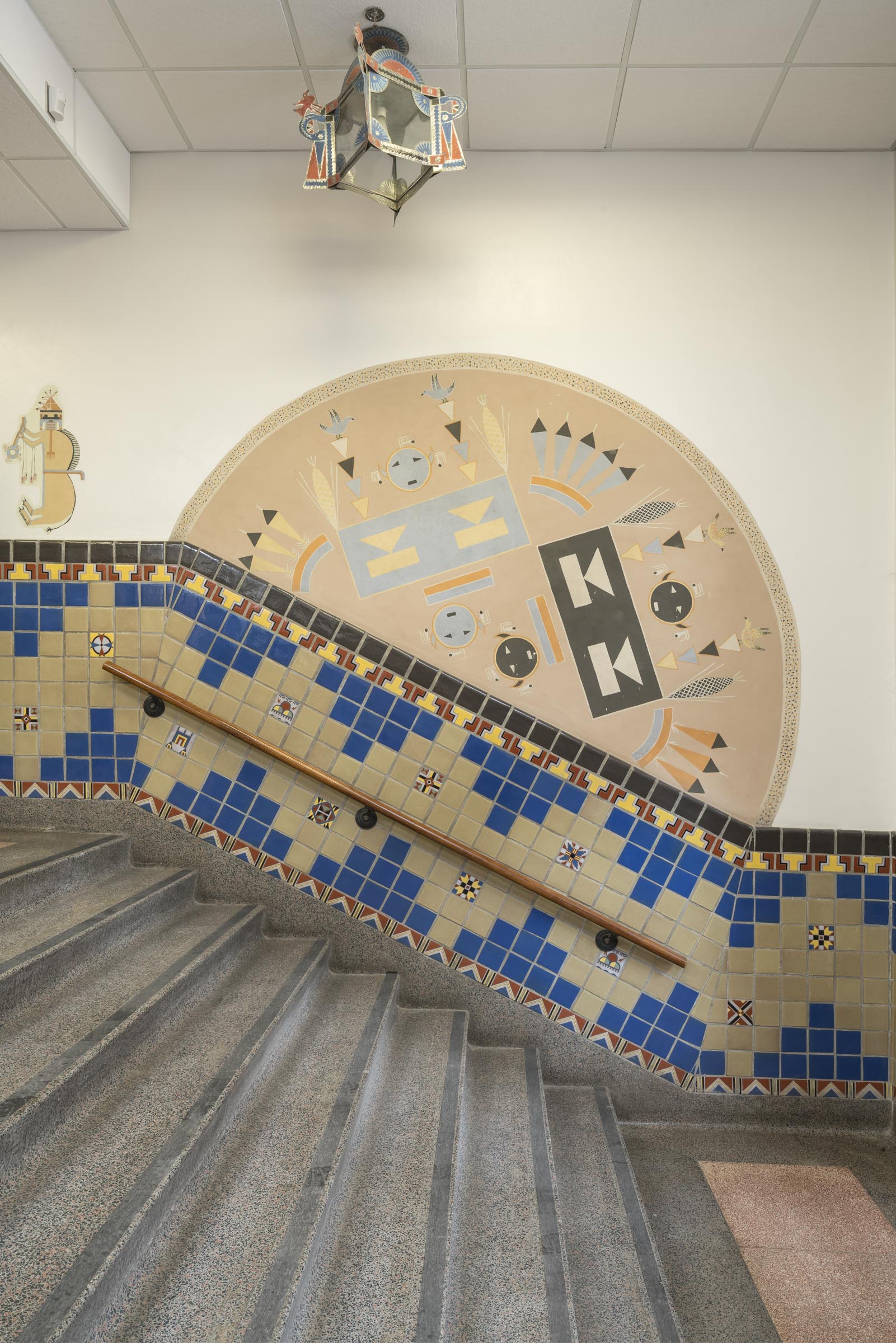
This Diné (Navajo) sandpainting-style wall painting is the counterpart to one painted on the wall opposite in the rear lobby of the first floor the New Deal McKinley County Courthouse in 1939, reportedly by “a young Navajo painter.”1 (These sandpainting-style wall paintings are two of sixteen total such decorations.) This design is perhaps an iteration of the customary Diné sandpainting symbol representing the sun, while its companion painting likely represents the moon. Unlike its companion, however, it was partially removed when an elevator was installed in the building and an arched doorway created to provide access, and is now missing its left portion.

Sandpainting-style Wall Painting (Half Circle)

This Diné (Navajo) sandpainting-style wall painting is one of sixteen such murals decorating the first-floor lobby of the historic McKinley County Courthouse. It was reportedly painted by “a young Navajo painter”1 in 1939, the year the New Deal building opened. It is the companion piece to a semicircular mural painted on the wall opposite it (the murals are painted on either side of the building’s entryway staircase). Together, the two murals form a circular composition that references the four cardinal directions, represented by the circles and rectangles colored blue and black (seen here) and yellow and white (seen in the companion piece), which are sacred to the Diné people because the Diné homeland is delineated by northern, southern, eastern, and western mountains (as seen in the Navajo Nation flag).

It is not only this mural and its counterpart that are painted in pairs. Throughout the entire first floor of the courthouse, sandpainting-style wall paintings are composed in sets. Moreover, the artist intentionally placed sandpainting designs and figures so that they flank entrances, lobbies, and passageways, with most symbolically communicating messages of guardianship and blessing. Here, the semicircular mural includes four songbirds, perhaps bluebirds and orioles, which traditionally symbolize good fortune (generally speaking). In this manner, the artist wrapped the entire space in a protective embrace.

Sandpainting-style Wall Painting

The first recorded instance of reproductions of Diné (Navajo) sandpainting designs being used for interior decoration was in the El Navajo Inn in Gallup, NM. The El Navajo was a Harvey House hotel—one of dozens owned and operated by the Fred Harvey Company at major stops along the Santa Fe Railroad. It opened in 1923 and featured first-of-its-kind artwork in the lobby and common areas: twelve sandpainting-style wall paintings copied by Fred Greer, a white artist, from drawings by Sam Day Jr., a Diné artist. This use of sandpainting designs was highly controversial as sandpainting was traditionally a deeply sacred, private, and protected ceremonial practice. To quell the outcry from the Diné community, the Harvey Company arranged for the hotel’s opening to include a ceremony performed by a reported twenty-nine “medicine men.”1

Less than two decades later, the sandpainting-style wall painting concept was repeated in Gallup’s 1938 New Deal McKinley County Courthouse, when, according to a contemporary report, “state art directors . . . made provision for the selection of a young Navajo artist to aid with the murals for the new McKinley county [sic] courthouse.”2 The artist painted a total of sixteen sandpainting-style wall paintings throughout the building’s first floor, and, in fact, the one seen here is a nearly exact replica of one installed at the El Navajo Inn3 (which was demolished in 1957). Perhaps because these murals are seen as “decorative” or “reproductions” of traditional/cultural designs, the artist was never credited by name (the story of the three sets of painted-over initials seen along the bottom of the painting has been lost; they are presumed to be additions made and then “erased” long after the fact and their relevance and meaning is, at this point, undetermined).

Squaw Dance

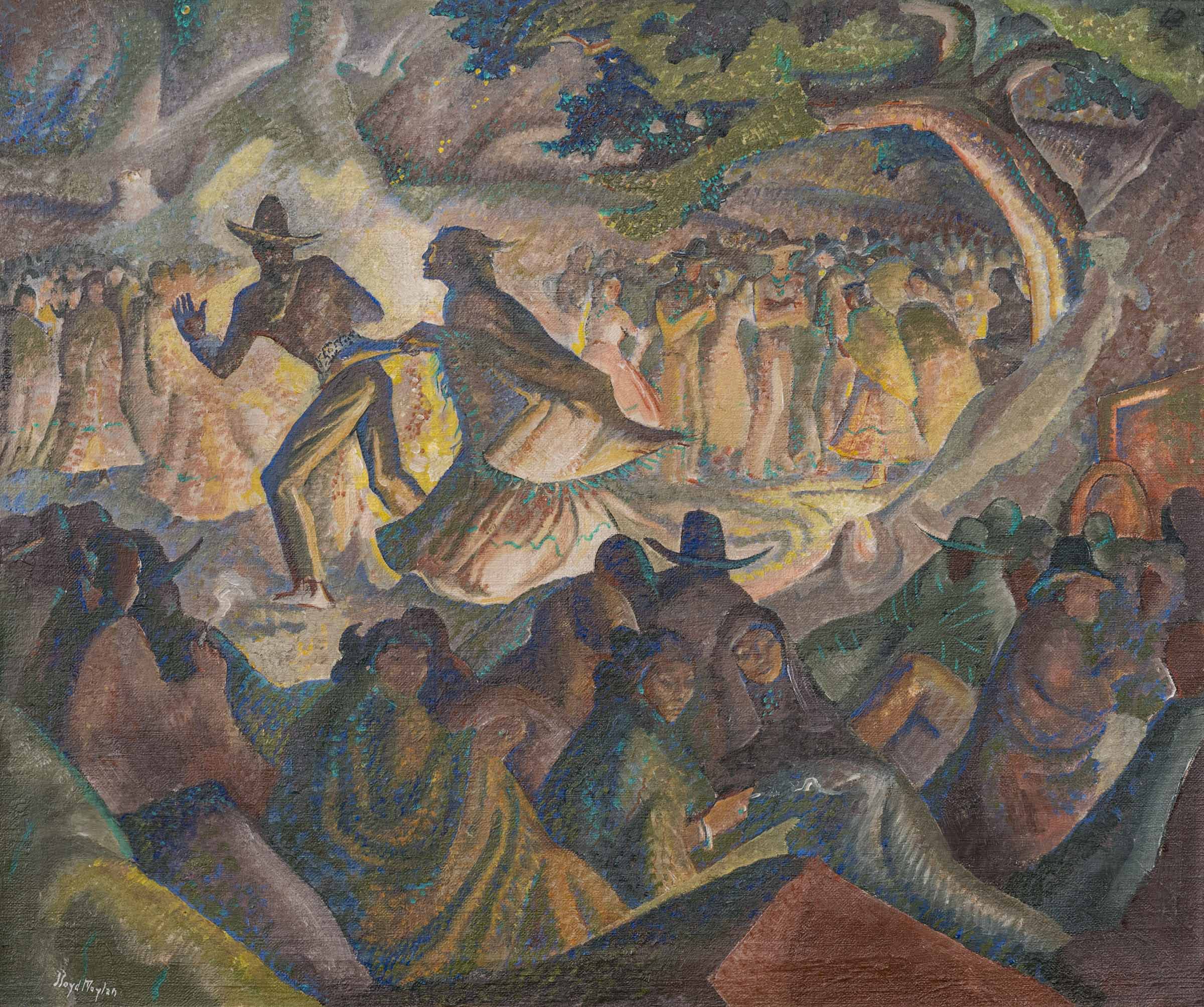
Lloyd Moylan was known by his contemporaries as a “specialist in Navajo subject matter.”1 It is believed that, in the spirit of the Western American self-styled artist-explorers who preceded him, he spent a significant amount of time visiting the Navajo Nation. Indeed, his paintings, presumably of people he met and events he attended, communicate first-hand experience. In Squaw Dance,2 Moylan takes a documentary approach both in the way he positions the viewer as an onlooker removed from the action and also in details such as the curls of cigarette smoke. (The lived experience of this piece is highlighted by comparison to Moylan’s Dance at San Felipe.)

Untitled (Rooster Pull)

A “rooster pull” is an exhibition of horsemanship with roots in Spain that has been practiced in the southwest United States for centuries.1 Today the sport is performed as an old-school rodeo event with inanimate objects, but at the time Lloyd Moylan made this painting the event likely involved a live chicken, making it highly controversial by current standards. While in specific contexts the tradition may have carried spiritual significance, its primary purpose has historically been to show off equestrian athleticism and skill as riders are required to bend to reach the ground from their saddles while riding close to each other at fast speeds. Moylan uses dynamic diagonals to emphasize the acrobatics of the frenetic, intense, and dangerous pursuit. Through his limited color palette, fine lines, and clean background, the three competitors become graceful dancers.

What are you looking for?

Art Collection

Gallup’s New Deal art collection consists of over 120 objects created, purchased, or donated from 1933 to 1942 through New Deal federal art programs administered by President Franklin D. Roosevelt to support artists during the Great Depression.

Main Menu

Image Use Notice: Images of Gallup’s New Deal artworks are available to be used for educational purposes only. Non-collection images are subject to specific restrictions and identified by a © icon. Hover over the icon for copyright info. Read more