

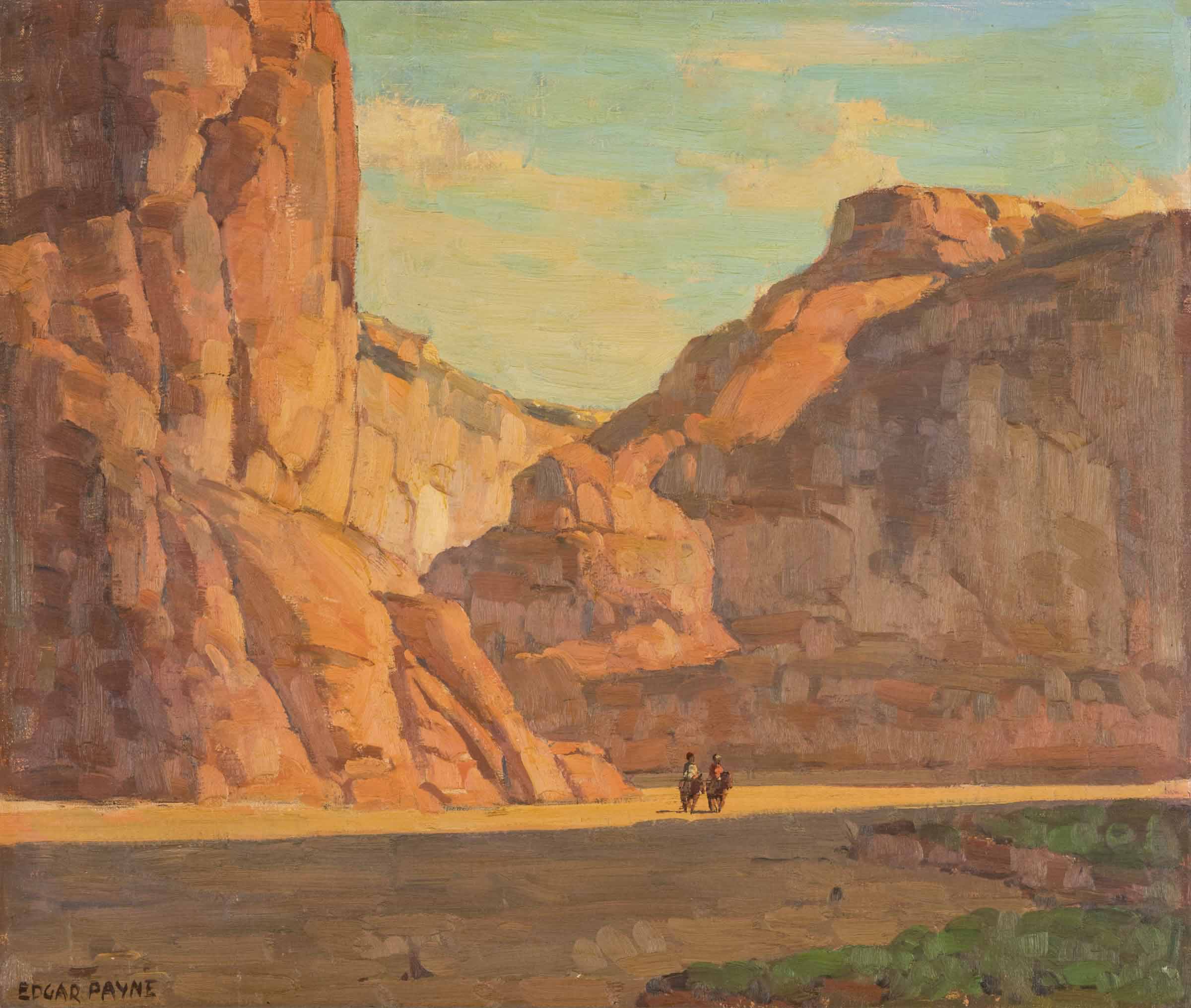
Edgar Alwin Payne first visited and painted Canyon de Chelly—a cluster of several canyons, including Canyon del Muerto, in northeastern Arizona—in 1917.1 Commissioned by the Santa Fe Railroad to record the journey from Albuquerque to California, Payne spent four months exploring the canyons, and the artwork he produced cemented his status as one of the period’s leading Western American artists. In Canyon de Muerto, Payne is largely concerned with capturing the scale of the canyon’s 1,000-foot-tall walls. The painting is composed so that the sandstone rock formations extend beyond the boundaries of the frame, taking up over two-thirds of the canvas and rationing the view of the sky. Two strategically positioned horseback riders provide the viewer a reference point for apprehending such dramatic proportions.
Color: Yellow
Nambe Valley, Summer
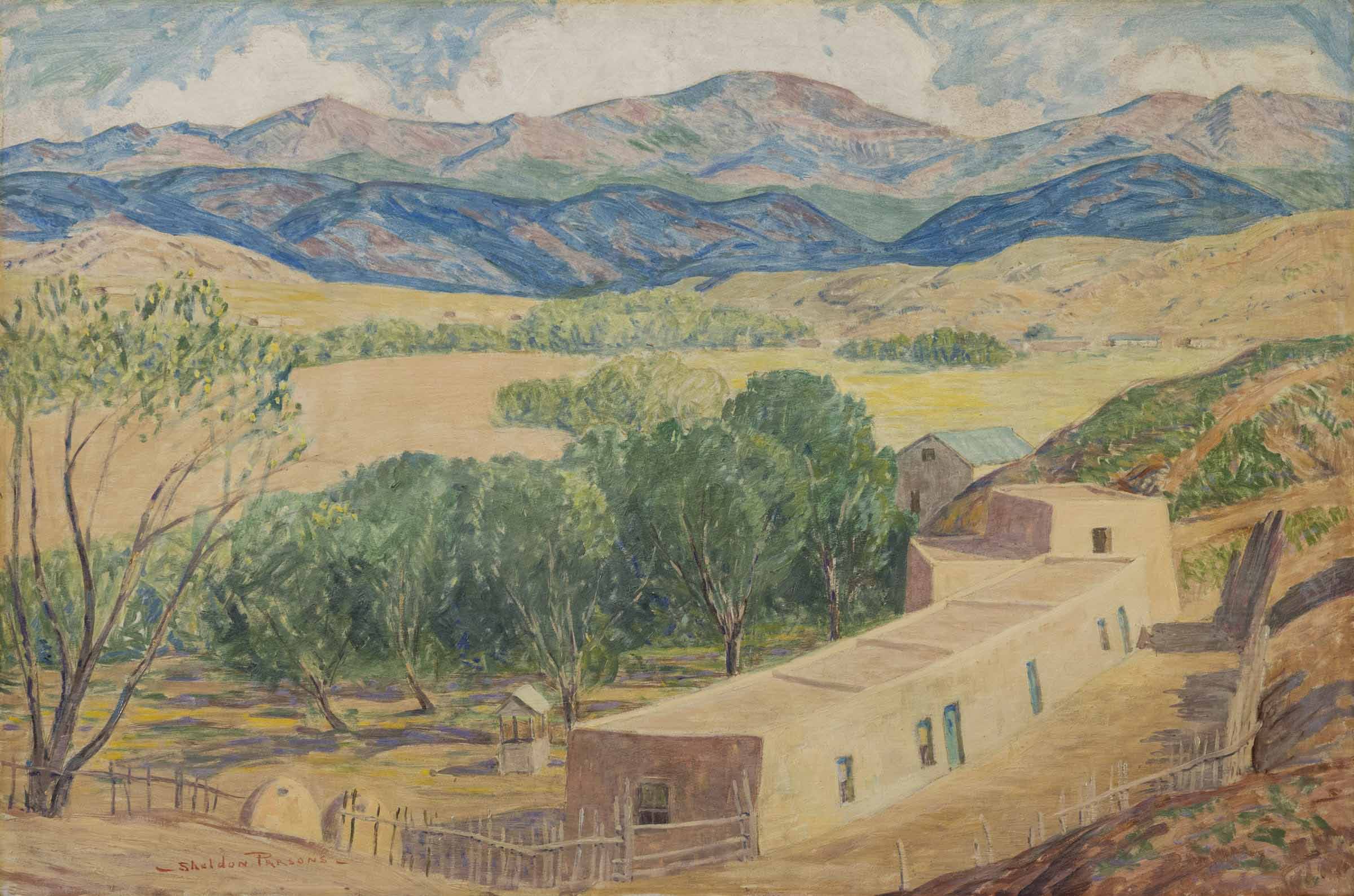
Sheldon Parsons’ career spanned the first half of the 20th century, when one avant-garde art movement after another rose to defy convention and challenge the foundations of Western American art. As an artist and curator, Parsons bridged the professional divide between “realism” and “modernism”—he both promoted traditional standards while being open to new approaches. His more “realistic” side is at play in Nambe Valley, Summer. The painting adheres to the major conventions of Western art: it is composed according to a clearly defined foreground, middle ground, and background; it takes a panoramic perspective on the landscape; its color palette is tightly controlled; and its brushwork delivers a high degree of finish.
Casa on the Hill
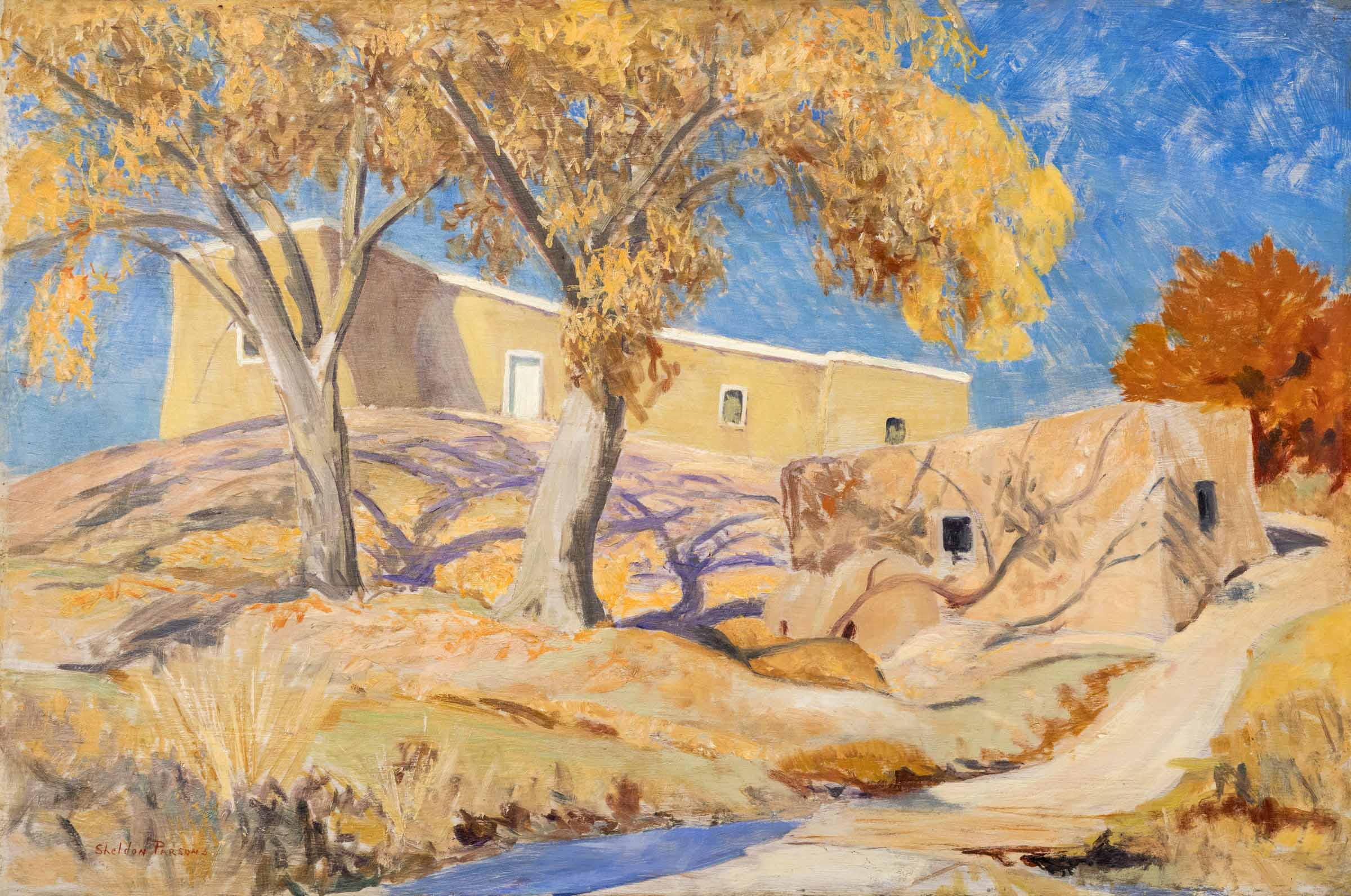
Sheldon Parsons, a leader within the growing Santa Fe artist colony at the beginning of the 20th century, took both sides in the era’s hotly contested artistic debate between “realism” and “modernism” in Western American art, promoting traditional standards without dismissing unconventional ideas. As his career matured, however, Parsons became increasingly experimental in his practice, and bold use of complementary colors became a trademark of the artist’s in his last decade (Parsons died in 1943). In Casa on the Hill, a mix of warm yellow and orange autumn hues stand out against a loosely brushed bright blue sky. Note how the purple shadows cast by towering trees in a latticework pattern on a green-glazed ground make the painting a dance of color.
Sandpainting-style Wall Painting (Ripener)

Pictured here is a Diné (Navajo) sandpainting-style wall painting depicting a “ripener” (sometimes referred to as a “cornbeetle”). This and an identical wall painting flank the interior door of the main entrance1 to the historic McKinley County Courthouse. Reportedly painted by “a young Navajo painter”2 in 1939, the same year the New Deal building opened, these murals depict an insect that derives from Diné cosmology and is associated with blessings. All of the sixteen sandpainting-style wall paintings decorating the lobby of the courthouse have similar associations with blessings and guardianship, and they are all arranged in pairs that flank entrances, lobbies, and passageways in order to protect and grace the space.
Sandpainting-style Wall Painting (Buffalo Person)
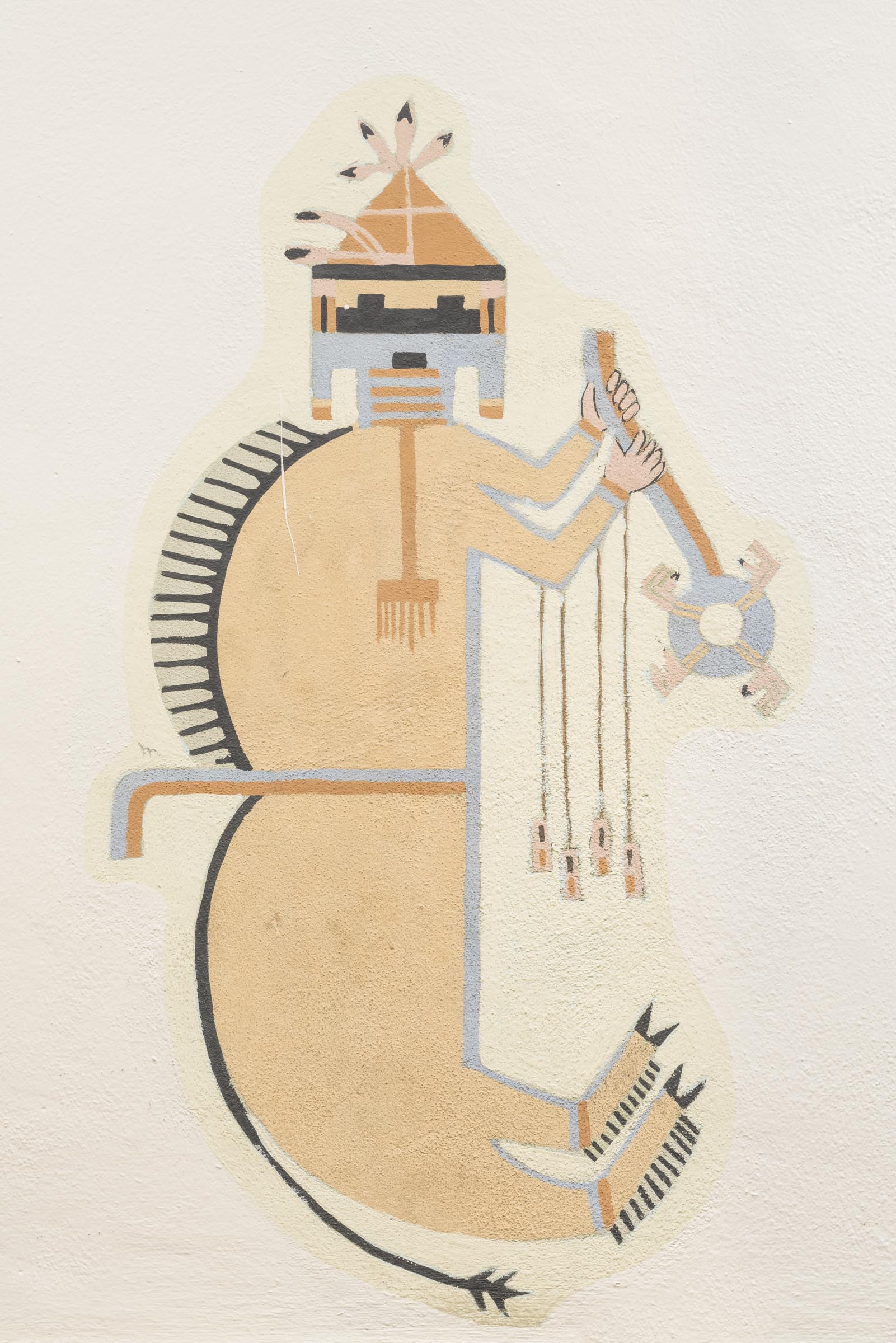
According to a contemporary newspaper report, in July 1939 “state art directors . . . made provision for selection of a young Navajo painter to aid with the murals for the new McKinley county [sic] courthouse”,1 which was a New Deal building that opened that same year. The unidentified artist created a series of sixteen Diné (Navajo) sandpainting-style wall paintings.
This is one of the “buffalo people” paintings—the figure has the body of a buffalo and the head, arms, and hands of a human—that was painted as part of a pair flanking vault doors. Originally, the courthouse’s two vault doors each had a yellow figure (as seen here) painted on one side and a blue figure painted on the other, though one of the blue figures has since been covered over (only three of the four buffalo people paintings remain visible).
Sandpainting-style Wall Painting (Buffalo)

The first-floor lobby of the historic McKinley County Courthouse is decorated “in the round” with sixteen Diné (Navajo) sandpainting-style wall paintings that appear on nearly every wall. The only documentation so far identified for these wall paintings is a July 5, 1939 local newspaper article that states that “state art directors . . . made provision for selection of a young Navajo painter to aid with the murals for the new McKinley county [sic] courthouse” (the courthouse was built through the New Deal and opened in 1939).1
The paintings are organized as pairs and intentionally placed to flank entrances, lobbies, and passageways; most of the designs are traditional symbols of guardianship and blessing. This is an example of one of the buffalo paintings that appears along the lintel of the entrance to the rear staircase. While only three of the four original buffalo paintings have survived, they were originally depicted in sets of two, each with one yellow (as seen here) and one blue buffalo, painted on either side of the passageway.
Sandpainting-style Wall Painting (Thunder Being)
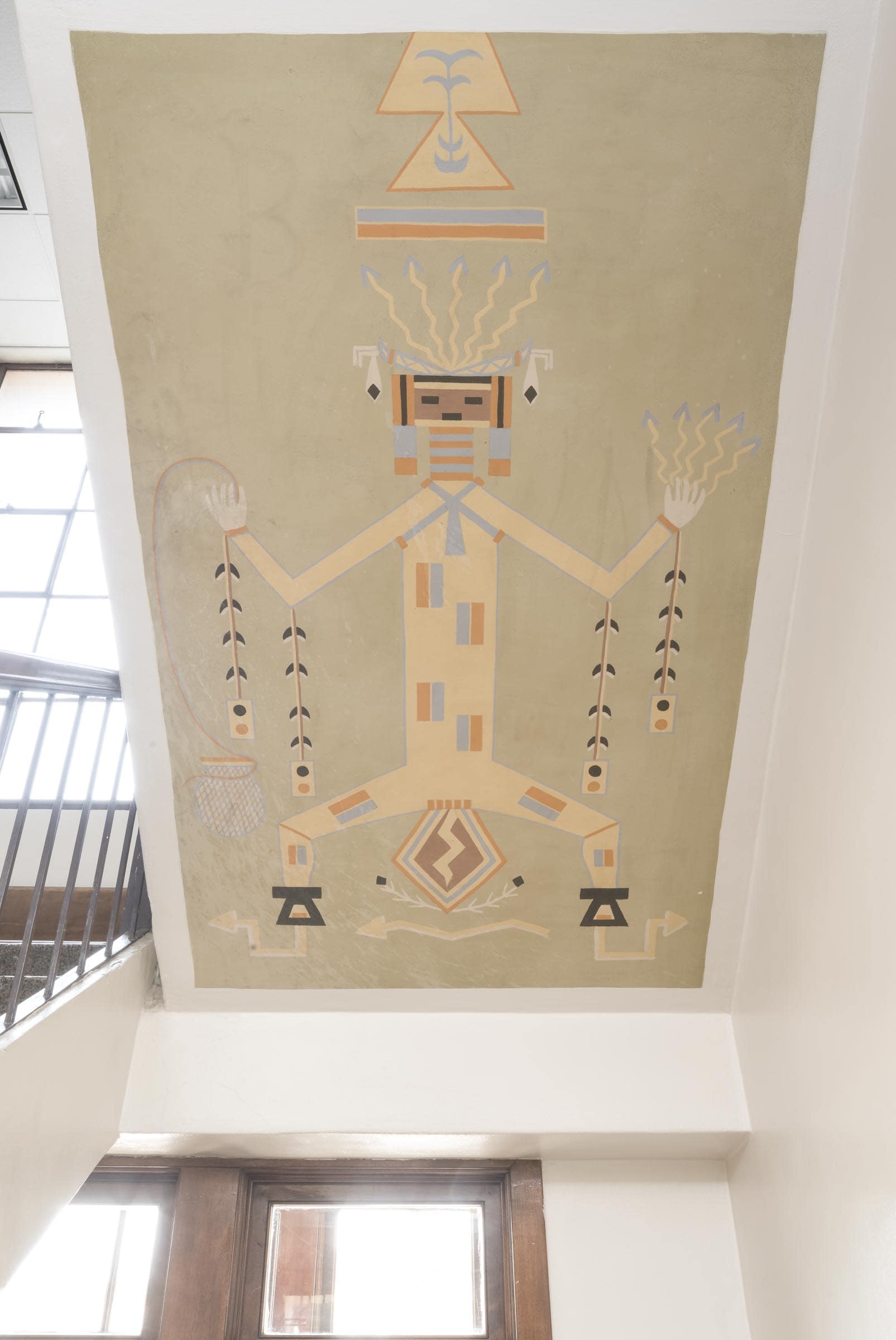
In 1939, according to a newspaper report, “state art directors . . . made provision for selection of a young Navajo painter to aid with the murals for the new McKinley county [sic] courthouse”1 (the now-historic McKinley County Courthouse was built with New Deal funding and opened in 1939). The same article explains that the plan was for “the Navajo painter [to] aid in a sandpainting reproduction on the ceiling of the entrance hall.” The wall painting seen here most closely fits that specific description. It is painted on the ceiling under the second-floor staircase in the building’s back entryway. Because the stairway divides into two at the landing, there is an identical painting on the ceiling across the stairwell.2 The artist created sandpainting pairs throughout the entire first floor, paying particular attention to flanking entrances, lobbies, and passageways with matching sandpainting designs in order, it seems, to bestow the space with protection and blessings.
The design seen here is likely an anthropomorphized “thunder being.” It is generally understood that the zigzag arrows emanating from the head and left hand of the figure represent the sound and reverberation of thunder, while its feet represent storm clouds emitting lighting.
Sandpainting-style Wall Painting (Half Circle)

This wall painting is one of sixteen Diné (Navajo) sandpainting-style murals decorating the first-floor lobby of the historic McKinley County Courthouse. It was reportedly painted by “a young Navajo painter”1in 1939, the year the New Deal building opened. It is the companion piece to a semicircular mural painted on the wall opposite it (the murals are painted on either side of the building’s entryway staircase). Together, the two murals form a circular composition that references the four cardinal directions, represented by the circles and rectangles colored white and yellow (seen here) and blue and black (seen in the companion piece). The four directions are sacred to the Diné (Navajo) people because the Diné homeland is delineated by northern, southern, eastern, and western mountains (as seen in the Navajo Nation flag).
It is not only this mural and its counterpart that are painted in pairs. Throughout the entire first floor of the courthouse, sandpainting-style wall paintings are composed in sets. Moreover, the artist intentionally placed sandpainting designs and figures so that they flank entrances, lobbies, and passageways, with most symbolically communicating messages of guardianship and blessing. Here, the semicircular mural includes four songbirds, perhaps bluebirds and orioles, which traditionally symbolize good fortune (generally speaking). In this manner, the artist wrapped the entire space in a protective embrace.
Sandpainting-style Wall Painting

The first recorded instance of reproductions of Diné (Navajo) sandpainting designs being used for interior decoration was in the El Navajo Inn in Gallup, NM. The El Navajo was a Harvey House hotel—one of dozens owned and operated by the Fred Harvey Company at major stops along the Santa Fe Railroad. It opened in 1923 and featured first-of-its-kind artwork in the lobby and common areas: twelve sandpainting-style wall paintings copied by Fred Greer, a white artist, from drawings by Sam Day Jr., a Diné artist. This use of sandpainting designs was highly controversial as sandpainting was traditionally a deeply sacred, private, and protected ceremonial practice. To quell the outcry from the Diné community, the Harvey Company arranged for the hotel’s opening to include a ceremony performed by a reported twenty-nine “medicine men.”1
Less than two decades later, the sandpainting-style wall painting concept was repeated in Gallup’s 1938 New Deal McKinley County Courthouse, when, according to a contemporary report, “state art directors . . . made provision for the selection of a young Navajo artist to aid with the murals for the new McKinley county [sic] courthouse.”2 The artist painted a total of sixteen sandpainting-style wall paintings throughout the building’s first floor, and, in fact, the one seen here is a nearly exact replica of one installed at the El Navajo Inn3 (which was demolished in 1957). Perhaps because these murals are seen as “decorative” or “reproductions” of traditional/cultural designs, the artist was never credited by name (the story of the three sets of painted-over initials seen along the bottom of the painting has been lost; they are presumed to be additions made and then “erased” long after the fact and their relevance and meaning is, at this point, undetermined).
Dead Cottonwood
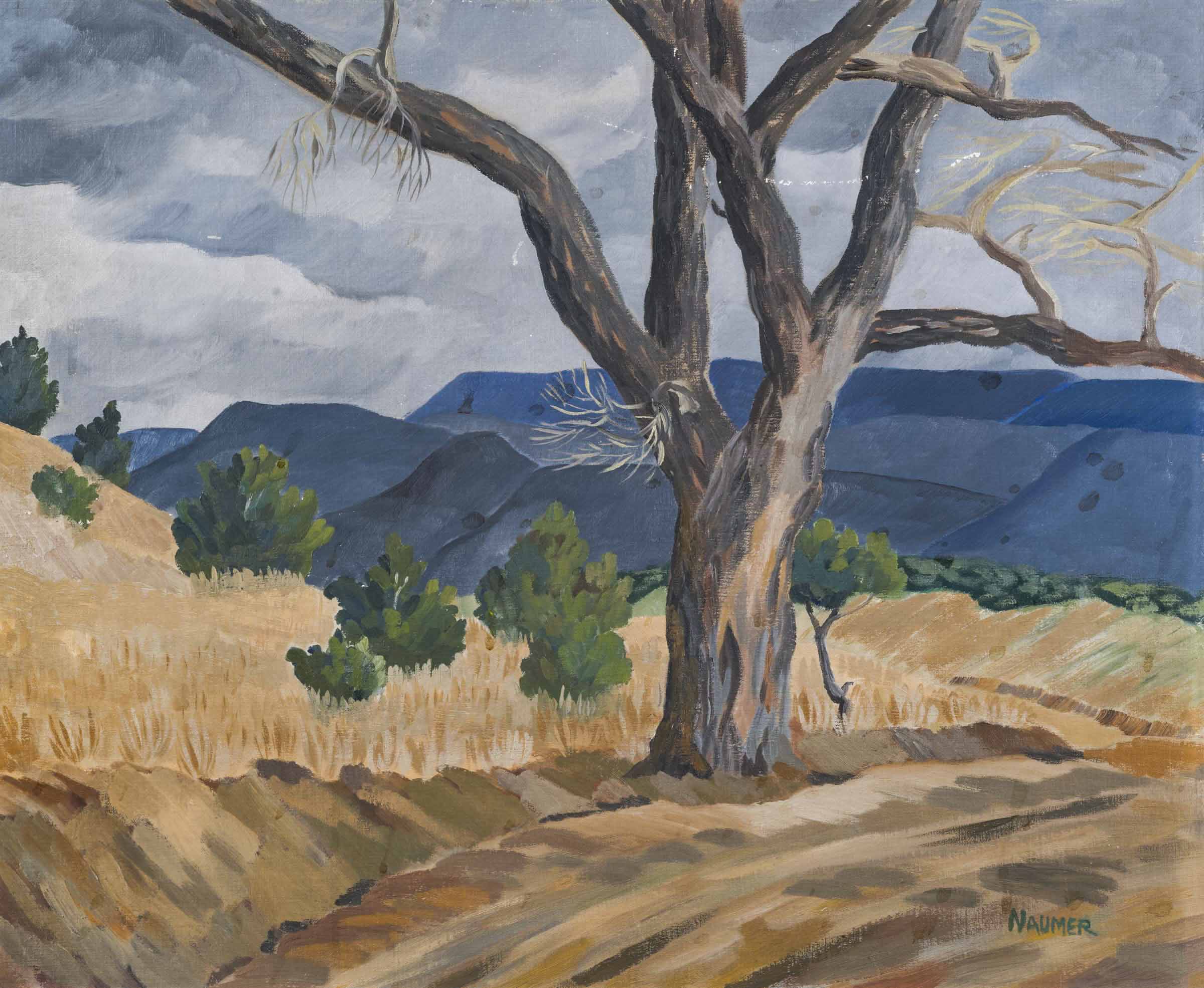
Dead Cottonwood is an unusual painting for Helmuth Naumer, Sr. First, it is in oil, while Naumer mostly worked in and was best known for his pastels. Second, it is relatively drab. One reason Naumer’s pastels were (and are) so popular was that he created them on black paper, which made his vibrant color palette really “pop.” There are inklings of Naumer’s proclivity for complementary colors in Dead Cottonwood: the blues of the mesas in the background complement the yellow hues of the grass in the foreground, and he defines the grain of the cottonwood’s trunk by weaving dabs of terracotta through twists of gray. Yet it is different enough from most of his work to raise questions about what he was thinking. Naumer always said that the Southwest felt instinctively like home, but he was born in Germany. Replying to a question by a journalist in 1938, he expressed concern over Adolf Hitler’s rise to power and predicted the outbreak of a large-scale war.1 Given the time period this work was made—between 1939 and 1943—and the somber subject, title, and colors, perhaps events in Europe weighed heavily on Naumer’s mind when he painted this piece.