
Untitled (Wagon and Campfire) is an ambitious and tightly composed painting involving twenty-two figures, four covered wagons, and four horses. The painting has an architectural quality, with the elements organized in layers: a sequence of mesas establishes the background, a row of wagons comes next, and then a line of people standing, before the layers conclude with a seated group huddled together in the foreground. The saddle purposefully tucked in the lower right corner enhances this “paper peep show” effect. Within each layered grouping, figures are carefully considered in terms of individual posture and relationship to each other. The warm glow emanating from the campfire directs the viewer’s attention, illuminating details such as the glint of the coffee pot, a man’s pensive expression, the spokes of a wagon wheel, a horse’s ear hairs, the tie of a tsiiyééł (hair bun), and the turquoise earrings that dot the scene. Details outside the reach of this central light source are present but relaxed, as the harmonious earth-toned color palette unifies the composition.
Scenes of Diné (Navajo) people traveling by wagon and horseback were a favorite subject of Lloyd Moylan’s. See also in Gallup’s New Deal Art Collection: Prelude to Dust, Appointment in Gallup, and Journey Through Longhouse Valley.

In general terms, New Deal art programs sought to create a visual record of American life and American spirit. Artists across the country were deployed to document their communities, and Storage Barn is part of that rich tapestry of “the American scene.” Here, Lloyd Moylan memorializes a specific place at a specific moment in time. The artist must have known this particular subject well to have rendered it with such precision. Notice the six-paneled windows, the water trough slightly askew, and the individual blades of grass—even the weed poking up on the left edge of the building. Something outside the picture to the left casts an elongated, funnel-shaped shadow up the side of the barn and across its roof. Moylan also pays attention to each slope, plane, and crevice of the uniquely formed mountain towering over the barn.
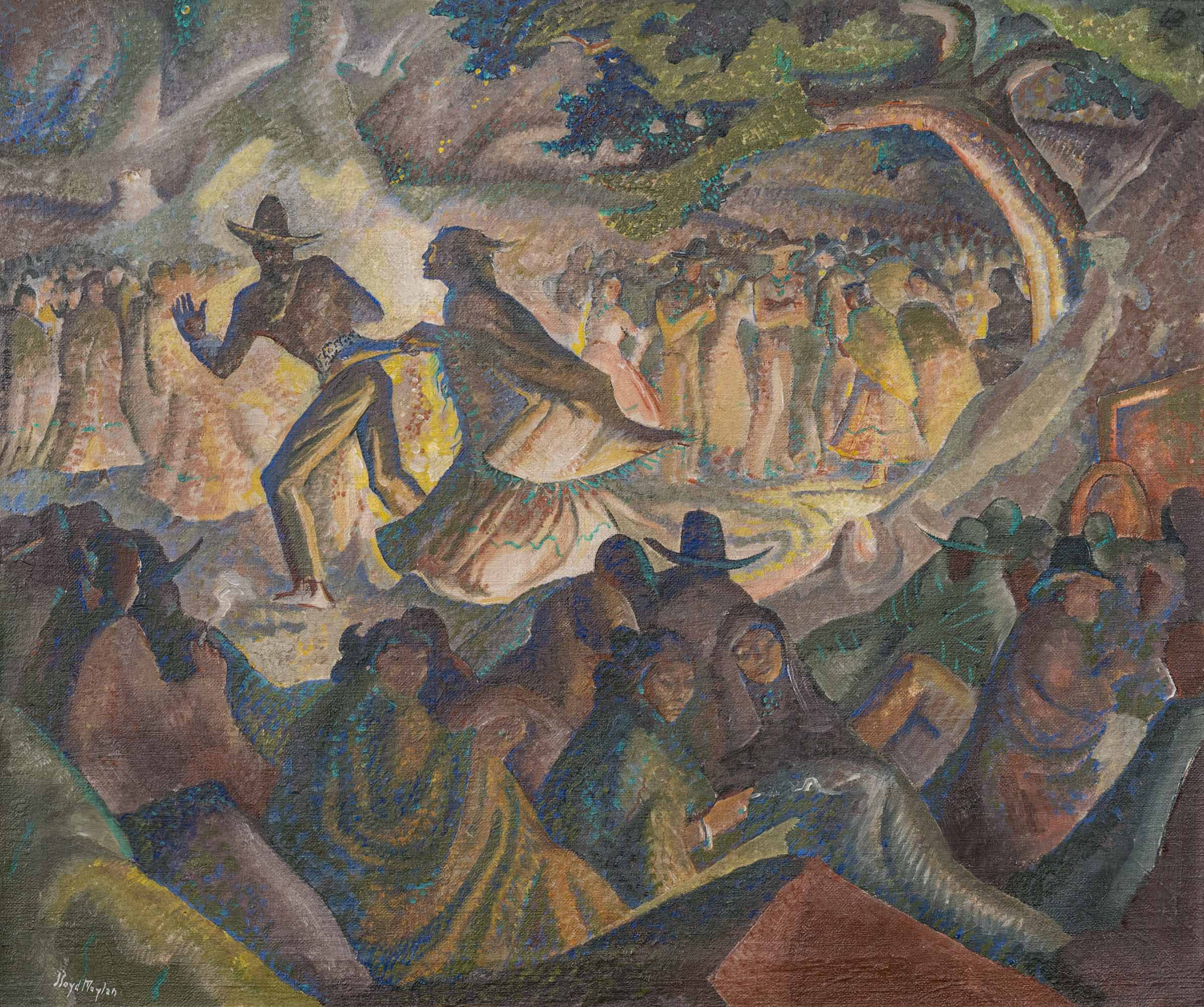
Lloyd Moylan was known by his contemporaries as a “specialist in Navajo subject matter.”1 It is believed that, in the spirit of the Western American self-styled artist-explorers who preceded him, he spent a significant amount of time visiting the Navajo Nation. Indeed, his paintings, presumably of people he met and events he attended, communicate first-hand experience. In Squaw Dance,2 Moylan takes a documentary approach both in the way he positions the viewer as an onlooker removed from the action and also in details such as the curls of cigarette smoke. (The lived experience of this piece is highlighted by comparison to Moylan’s Dance at San Felipe.)

In keeping with the early 20th-century practice of Native American portraiture in Western American art, Slim Woman and Chewing Tobacco Begay is not so much a portrait of two individuals as it is a stereotyped portrait of a culture. The painting reads like a fashion magazine spread, with the sitters relegated to the role of models, posed so that their jewelry is the center of attention (notice how their hands are unnaturally positioned to show off their rings). In this way, the painting reflects and promotes a superficial understanding of Diné (Navajo) culture.

Though Lloyd Moylan’s artistic focus skewed heavily toward northwest New Mexico and Diné (Navajo) subjects, in The Rio Grande Country he shifts his gaze to the area around Alcalde, NM, where he had a home and studio. Many Western American artists have been drawn to the Rio Grande valley since the late 1800s, in part because of its famous natural light. Here, Moylan captures the drama of the sun streaming through a break in storm clouds: the cross atop the church and bent tree appear spotlit, while the bent figure of a woman and the foreground are cast in deep shadow. The play between the jewel tones of the sky and trees and the earth tones of the buildings and hill enhances the extreme lighting effects.

In Rain on the Reservation, Lloyd Moylan revels in the light-bending, prismatic effects of a New Mexico monsoon falling in swaths on high mountains and mesas. Moylan’s watercolor technique highlights the geometry of the topography: he lets hard edges of paint form, strengthening the outlines and bulky contours of the shapes. He also paints in layers, so that areas of overlap create a multiplicity of triangles in a kaleidoscopic manner. Moylan loved to experiment with different styles, and in this painting, he plays in the space between realism and abstraction.

Prelude to Dust pictures a Diné (Navajo) family grouping—a man, two women, and two children—huddled together with their animals against the wind. The force of the gale is shown through the billowing wagon bonnet, the man’s up-turned hat brim, the tipped-over coffee pot, and the blown-back hair of both the women and their horse. The streaks of line and color in the sky above and the valley below add to the windswept effect. The painting captures a defining feature of life in northwest New Mexico, “high wind events,” and speaks to Lloyd Moylan’s close study of the area and its inhabitants, which distinguished him among contemporaries in Western American art during his career.
Moylan occasionally created variations on a theme, and Prelude to Dust is an interesting parallel to From Shiprock to Shonto (also made in 1942) in the University of Arizona Museum of Art collection. From Shiprock to Shonto portrays the same or a similar family, again contending with extreme gusts as they journey across the high desert of the Navajo Nation. Though not entirely accurately depicted, the titanic rock formation in the background of Prelude to Dust may also be that of Shiprock.
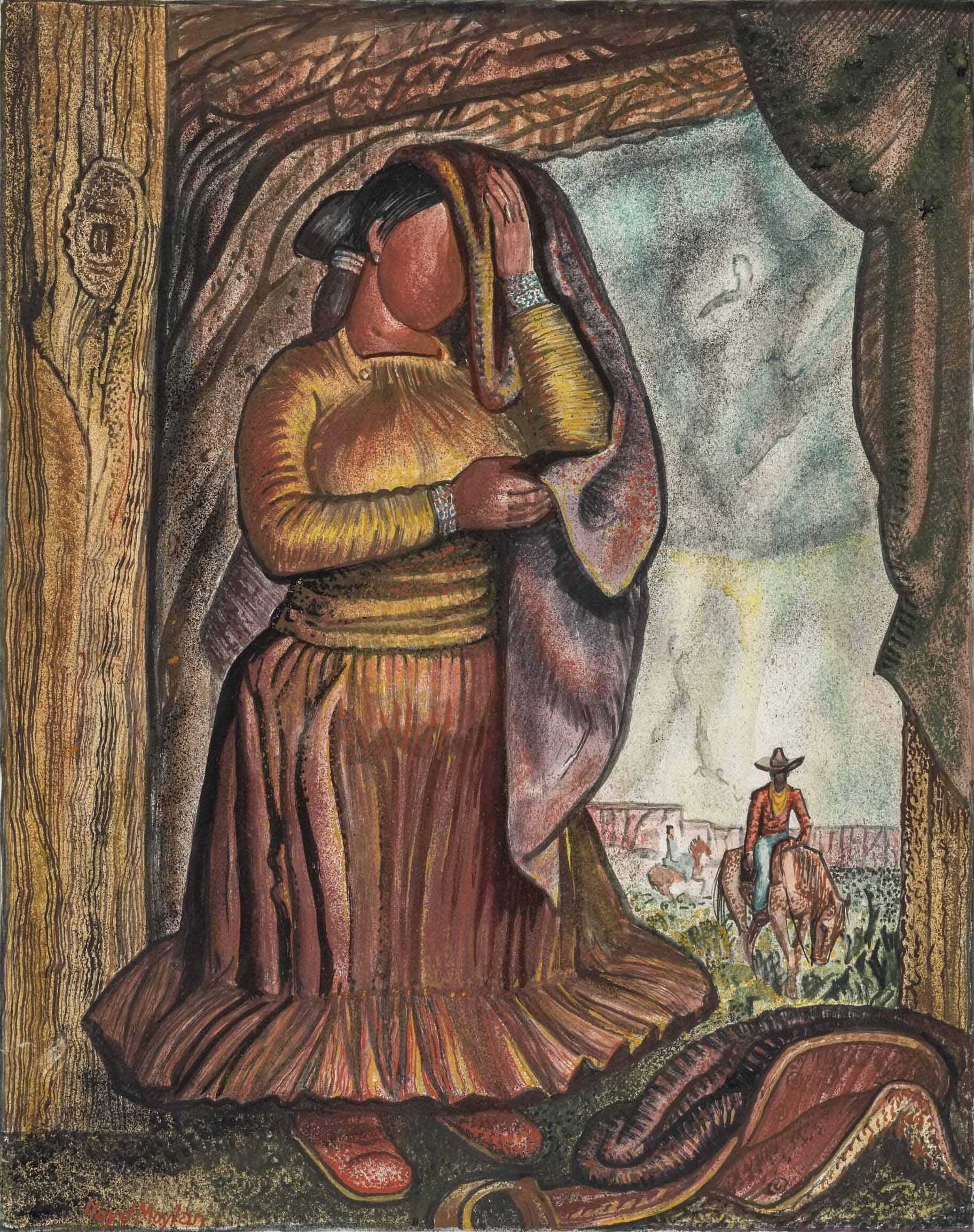
One way to view Navajo Mother-in-Law is as a two-dimensional anthropological diorama. It is Lloyd Moylan’s attempt to depict an archaic Diné (Navajo) custom of mothers-in-law avoiding contact with their sons-in-law. With this painting, Moylan puts culture on display in an exoticizing fashion, as is the case with so many early 20th-century Western American artworks. Here, the subject is quite literally “staged” by means of its theatrically framed composition.

Best known as a printmaker, Gene Kloss was a multitalented and prolific artist for whom Taos, NM, was an ample and consistent muse, providing a career’s worth of inspiration. Writing that “an artist must keep in close contact with nature and man’s fundamental reliance on nature in order to produce a significant body of work,” 1 Kloss was interested in rendering the changing seasons of the Taos landscape. In Untitled (Aspens), she captures the blazing yellow of fall in the Sangre de Cristo mountains, the foliage set alight by the slanting, intense rays of the late afternoon sun. (See her 1936 painting Midwinter in the Sangre de Cristos in the Smithsonian American Art Museum’s collection for a compelling comparison.)

Trained in the Studio Style by Dorothy Dunn at the Santa Fe Indian School between 1936 and 1937, Allan Houser (Chiricahua Apache) worked in this “flat” style during the New Deal and at the start of his career, on his way to becoming a trailblazing 20th-century artist. Even in this early work, one can see Houser pushing the boundaries of the conventions of the era, painting the dancer’s movements with palpable energy and power.

