


As a decorative art, tinwork has been practiced in the area that is now New Mexico for over 300 years. Originally developed by 18th-century Spanish colonists, it is a mestizaje, or hybrid, art form. As seen here, the practice combines Spanish motifs of rosettes and scallops with Indigenous designs of parrots and rainbows to create a distinctly “New Mexican” cultural expression.
Artist Demographic: Hispano
Tinwork Light

New Deal art programs were broadly interested in cultivating a unique American artistic identity and in establishing the United States as an arts and cultural center with its own rich legacy and heritage separate from that of Europe. Toward that end, New Mexico’s Federal Art Project (FAP) heavily promoted Spanish Colonial art forms specific to what is now the Southwestern United States. Tinwork was developed by Spanish colonists in what is now New Mexico in the 1700s and became widely practiced after the opening of the Santa Fe Trail in 1821 and the corresponding increase in trade. The New Mexico FAP picked up the mantle of the tradition by directing the state’s workshop programs to train artists in the craft and to produce objects such as this light fixture, frames, and other decorative arts for newly constructed buildings.
Bench

The New Deal famously built a great number of public buildings. It also furnished those buildings, turning out an incredible quantity of decorative arts. In New Mexico, the Federal Art Project worked in concert with other New Deal programs and state vocational schools to set up workshops employing mostly Hispano artists to produce Spanish Colonial–style furniture and other items for newly constructed buildings across the state. This bench and an identical duplicate were created for the historic McKinley County Courthouse, which was built through the Public Works Administration in 1938.
Bench

In all likelihood, this bench was made at a 1930s State of New Mexico vocational school. During the New Deal, the state’s vocational schools and the Federal Art Project teamed up to manufacture furniture and decorative arts for newly constructed public buildings such as the 1938 McKinley County Courthouse, where this bench and an identical copy are housed. Schools operated according to a workshop model: students/artists were supplied with instructional bulletins, or production manuals, and worked individually and/or collaboratively to create pieces. Although designs were regulated, students/artists found ways to express original artistry. Unfortunately, the New Deal did not credit these students/artists—most of whom were Hispano—for their work.
Trastero
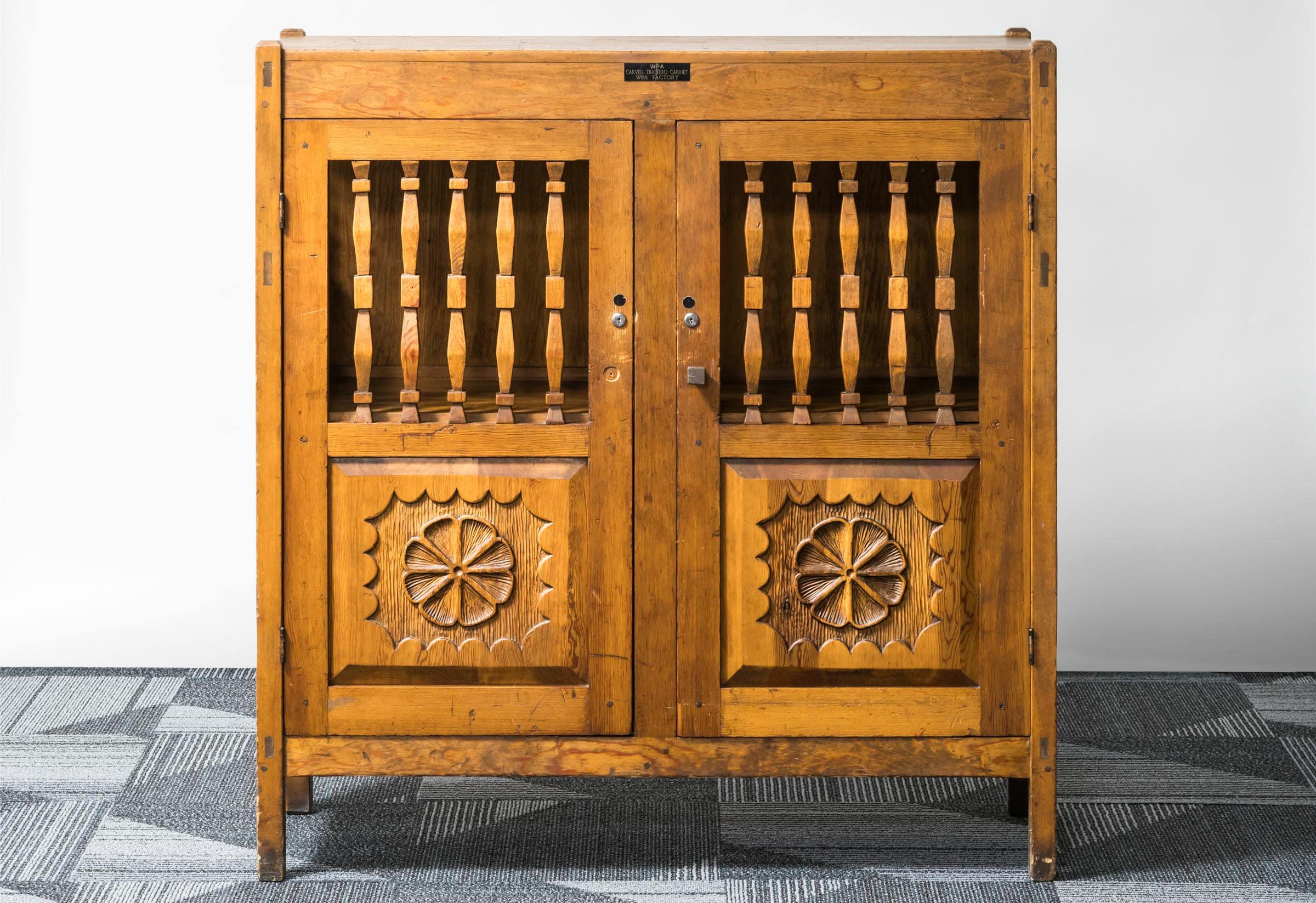
New Mexico’s New Deal programs worked in concert with the State’s vocational schools to produce countless pieces of furniture and decorative arts to fill public buildings. In New Mexico, that program dovetailed with efforts to revive 18th-century Spanish Colonial traditions. The resulting proliferation of Spanish Colonial–style interior décor cemented New Mexico’s visual identity. Take this trastero (cabinet), for example. It was likely produced in a New Deal workshop employing Hispano artists to recreate Spanish Colonial furniture designs, with an emphasis on certain features and motifs such as those seen here: turned spindles, scalloped edges, rosette carvings, and visible joinery. In this way, the New Deal cultivated a visual vocabulary that has since been perceived as looking characteristically “New Mexican.”
Trastero

This trastero (cabinet) is unique in terms of its design, which draws from the confluence of cultures that is New Mexico. It combines “imported,” traditional Spanish Colonial motifs such as the scalloped border and rosettes carved into the lower part of each front door panel with “local” ideas. By decorating the top half of each panel with images of corn stalks, the artist “Indigenizes” the piece—corn is a crop native to the Americas and it continues to be significant to the Indigenous peoples of what is now the Southwestern United States. Unfortunately, New Deal and associated programs generally categorized woodworkers as “craftspeople” and not artists, and did not credit the maker(s) of this hand-built, original work.
Quenching Their Thirst

Eliseo Rodriguez1 is best known for reviving the 18th/19th-century Spanish Colonial art of straw appliqué as a New Deal artist, but he was also a highly accomplished painter, though few of the paintings he made for the Federal Art Project are credited to him. Despite the lack of credit often afforded artists of color by New Deal art programs (and conventional Eurocentric art historical scholarship), Rodriguez was a multitalented modern artist who significantly contributed to the development of the Santa Fe art colony in the first half of the 20th century and beyond. In Quenching Their Thirst, Rodriguez employs confident, bold lines and a primary color palette to show a scene of everyday Hispano life in New Mexico and at the same time refer to the biblical parable of Jesus and the woman at the well. Author Carmella Padilla explains that “Rodriguez’s devout spirituality and personal religious experience infused his paintings with a special soulfulness.”2
County Commission Desk
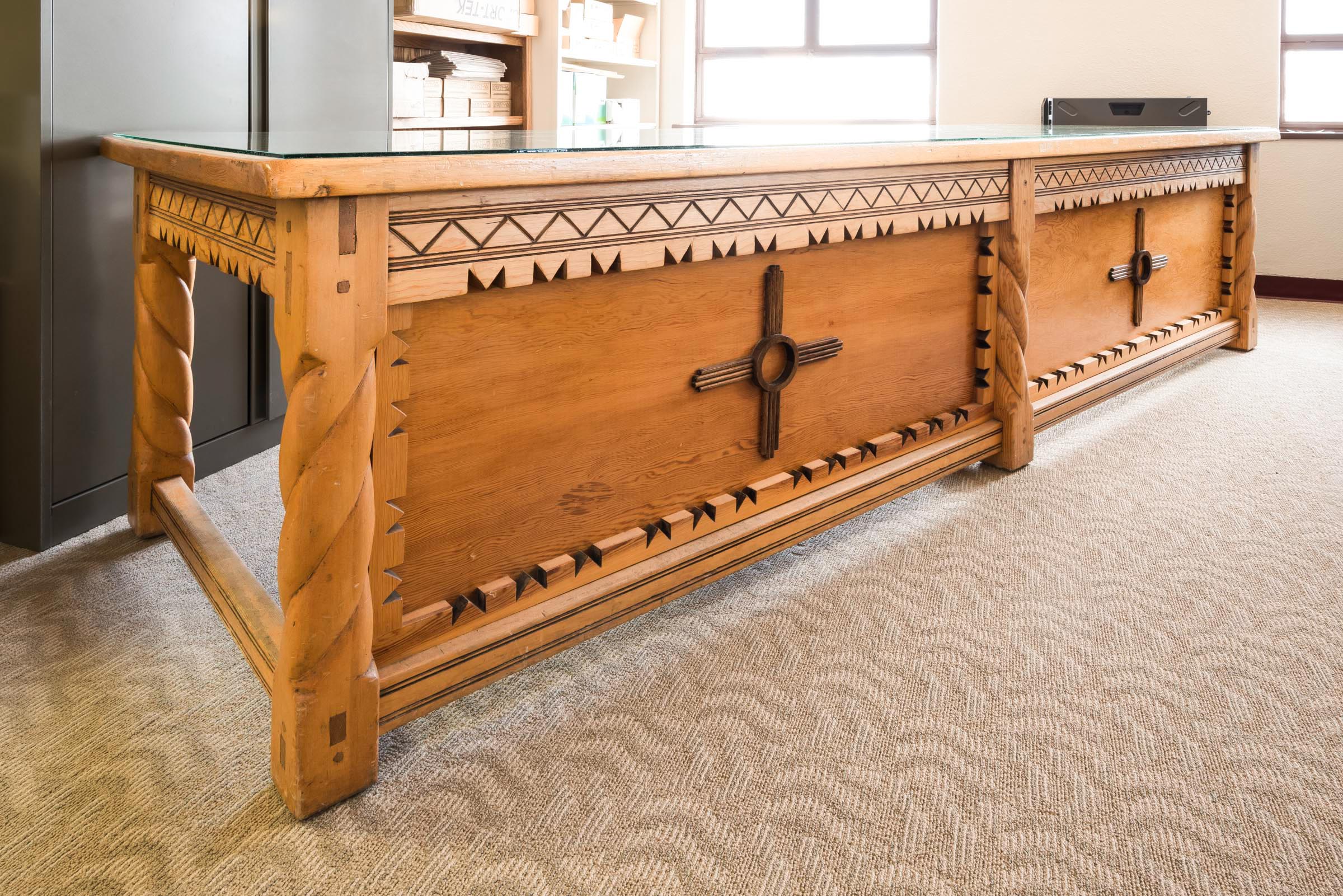
This large desk was likely custom-built by Elidio Gonzales at the Taos Vocational School, which served as a New Deal furniture workshop, for use by the County Commission when meeting in the historic McKinley County Courthouse (a New Deal building). It was used for that purpose for decades, and at some point, panels with the Zia symbol from the state flag of New Mexico were added (the ones you see are not original to the piece).
Chair

There are a number of woodworking techniques seen in this chair, which was likely made by Elidio Gonzales at the Taos Vocational School, which functioned as a New Deal-era workshop. It was made to furnish (along with its identical twin) the historic McKinley County Courthouse, built in 1938. The exposed joinery is done in the mortise and tenon technique. The linework on the top rail of the chair back, and the apron of the chair seat, showcase two different styles of groove carving. There are rounded forms and sharp angles, curved contours and straight lines, repeating elements and a variety of forms. Gonzales (or the artist or artists) took every opportunity to elaborate on the basic chair design to create a symphony of patterns.
Chair
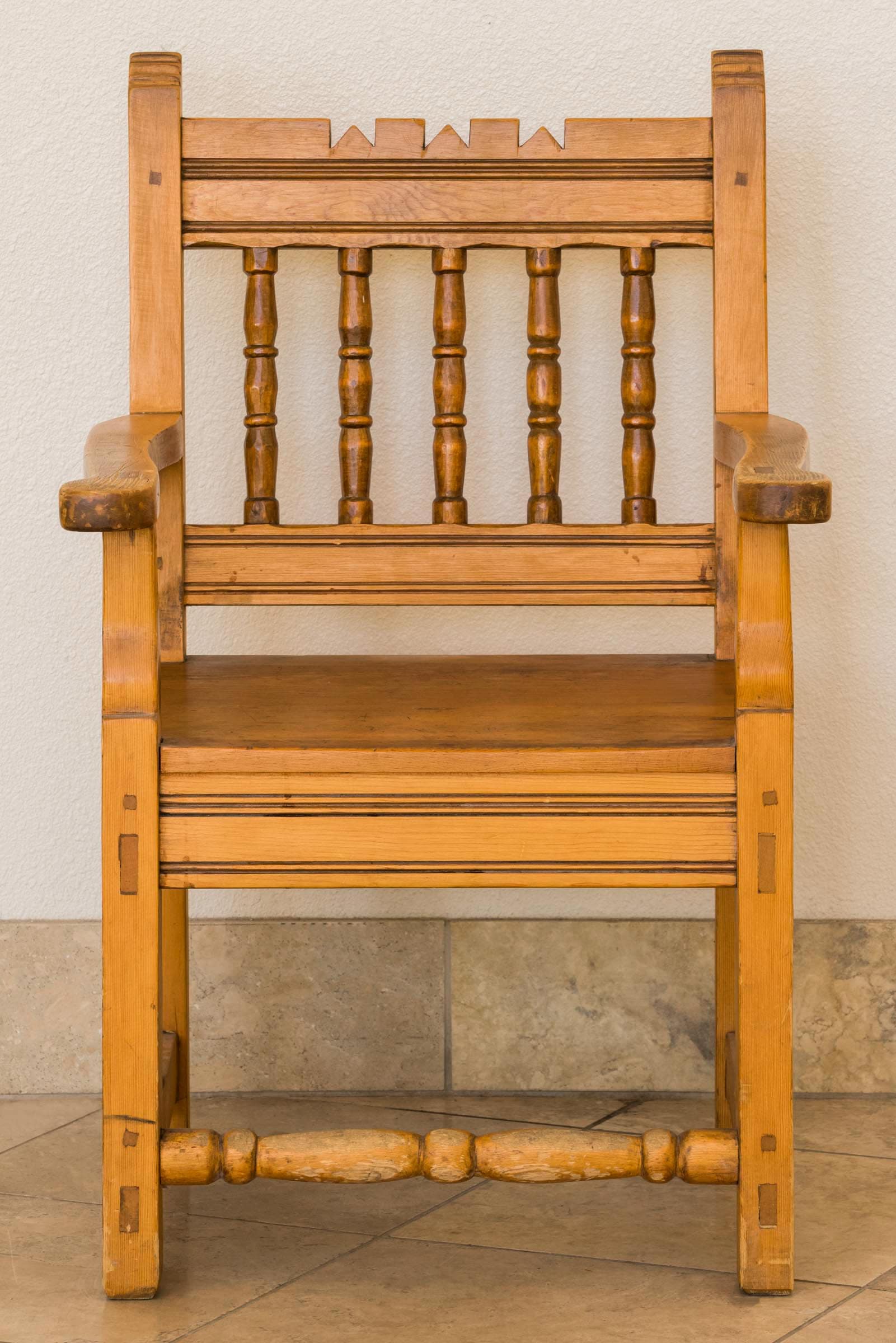
A contingent of Santa Fe’s intellectual and philanthropic elite spent the first three decades of the 20th century working to preserve what they perceived as pre-industrial cultural and artistic practices. Their cause found a home in the New Mexico Federal Art Project (FAP), which sought to advance craftsmanship in the Spanish Colonial tradition. The New Mexico FAP teamed up with the state’s vocational schools and other New Deal programs to train artists in 18th-century Nuevomexicano art forms, including specific styles of woodwork and furniture, and to produce decorative arts for New Deal buildings.This chair and its identical twin (not pictured) are likely the product of one such workshop, perhaps the Taos Vocational School, where artist Elidio Gonzales trained as a woodworker.
This chair and its match were made to furnish the historic McKinley County Courthouse. In it, we can see the value the New Deal placed on the concept and qualities of hand-craftsmanship. The chair’s visible joinery, the slight variations in the turns of its spindles, and the delicate gouging where the spindles meet the frame are all details that call attention to the fact that this piece was made by hand.