Lloyd Moylan: The Evolution of Gallup’s Principal New Deal Artist

Moylan's Monumental Mural

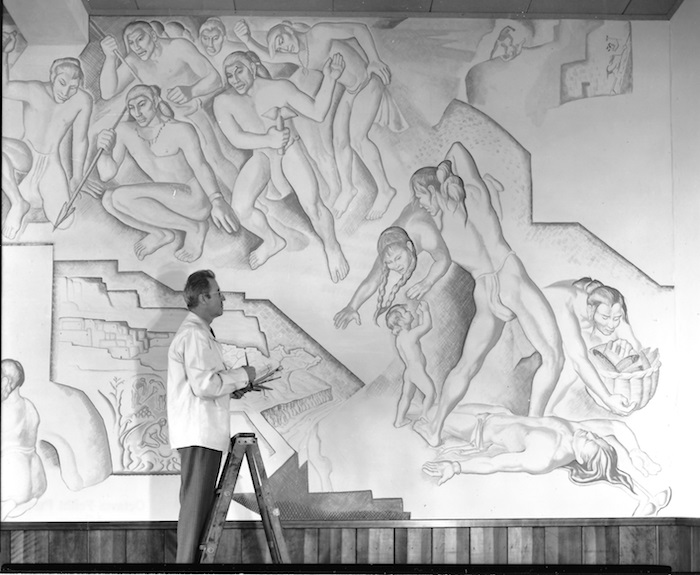
Lloyd Moylan’s creative philosophy and worldview are fully realized in his greatest artistic achievement, a 2,000-square-foot historical mural created for the courtroom of the historic McKinley County Courthouse. Moylan spent between six months and a year creating the mural, completed in 1940. It is believed this mural was Moylan’s last major New Deal art project. By the time he painted it, Moylan was an accomplished muralist who had completed several mural commissions in Colorado Springs prior to moving to New Mexico. He was employed by New Mexico’s Federal Art Project to paint two other major public murals: one at Eastern New Mexico University in Portales and another at Highlands University in Las Vegas (NM). Gallup’s mural is, however, his most ambitious by far, in size, scope and aspiration. It also embodies the issues of perspective that create undercurrent of tension running through Moylan’s work.
Another hotspot Another hotspot Another hotspot Another hotspot Another hotspot Another hotspot Another hotspot Another hotspot

Mural Ideals

The subject of Lloyd Moylan’s mural is Southwest history from prehistoric times through the turn of the 20th century. In telling this story, Moylan did his best to achieve the ideals for public art that he laid out in an essay, “Mural Opportunities,” written for the New Deal in 1943.

Art as Place

One ideal Moylan espoused relates to the form and content of public art.

Art as Dialogue

A second ideal Moylan espoused relates to the process of public art, and how meaning is created between the artist, artwork, and audience.

What Now?

Recently, several New Deal murals have been the subject of debate over how we collectively reckon with identity, history, and public memory. Do we remove artworks that are offensive? Would doing so be erasing history? Can we use them as “teaching moments”? 

Consider the simultaneously problematic and progressive nature of Untitled (Allegory—History of the Region) as well as two additional case studies. 

What is the best path forward? What would be your preference in terms of stewarding controversial New Deal murals through the next century? (Select all that apply.)

What is the best path forward?

Figure 1.

Figure 2.

Figure 3.

Figure 4.

Art as Place

Lloyd Moylan believed that “a mural painting has a definite place. The architectural forms surrounding it establish an objective, and if the intention is at all apparent, a sympathetic relationship is obvious.”9

The sympathetic relationship between Untitled (Allegory—History of the Region) and the courtroom in which it was painted is, indeed, obvious. Moylan uses the architecture of the room in several ways. For example, the ceiling beams flow seamlessly into painted adobe structures (Figure 1). A door frame makes the perfect landing for a revolutionary’s foot (Figure 2).

Moreover, Moylan uses the room’s architecture to frame his narrative. While not entirely chronologically accurate, each wall represents a major historical chapter, with each corner turning the page. The mural begins with the section of wall in the northeast corner of the room. Moving clockwise, the first corner makes the transition from pre-human history (dinosaurs and saber-toothed tigers) to human history, with the east wall picturing the practices of ancient peoples and the development of Indigenous societies and civilizations. The next corner moves the chronicle from the pre-contact period to colonization, first depicting Spanish conquistadors, including Fransisco Vásquez de Coronado (1510 – 1554), on the hunt for the “Seven Cities of Gold” and then the 1860s Navajo Long Walk. The next corner shifts to the story of Western settlement and economic development in the 1800s with visions of fur trapping, mining, and trading. The fourth and final corner marks the arrival of the railroad at the turn of the 20th century.

Moreover, Moylan uses/inserts additional architectural features to further demarcate the timeline. For example, on the west wall, the judge’s bench distinguishes between the pre-industrial “wild West” of miners and trappers and the growth of settlements (Figure 3). On the opposite (east) wall, Moylan created symmetry by painting a stepped wall to mirror the shape and size of the judge’s bench (Figure 4). This wall marks the transition from hunter/gatherer nomadic cultures to agriculture-practicing sedentary societies. 

In its use of the room’s architecture, Moylan’s mural is positively “in situ.” It is also place-specific with regard to content: Gallup is situated in the middle of the action of the history of the Southwest. The events Moylan depicts all occurred where Gallup is located or within a 100-mile radius.

Figure 1.

Figure 2.

Figure 3.

Figure 4.

Art as Dialogue

Lloyd Moylan believed that the highest purpose of public murals is to engender “universal understanding,”10 and he saw in murals a unique opportunity for public dialogue. Quite literally, he understood the process of mural-making as a chance for artists to respond in real time to public reactions to their work. Newspaper records attest that Moylan practiced what he preached and entertained visits by school children while he was working on Untitled (Allegory—History of the Region).

Moylan’s desire to create a public dialogue also manifests in attempts to relay a more inclusive and representative version of Southwestern history than was the norm for the time (one need look no further than a 1940 newspaper article, “New Courthouse Murals Art Complete History,” by Gallup booster Ruth F. Kirk for the typical dominant narrative). This is not to say that Moylan’s rendition does not trade in stereotypes—it does. For example, rather than portray the tremendous engineering, architectural, and logistical achievements of the Ancestral Puebloans at Chaco Canyon—the hub of a vast trade network notable for its astronomological organization—on the east wall as a reflection of “pre-contact” cultures, Moylan pictures inter-tribal raiding, emphasizing exaggerated notions of warlike Indigenous peoples (with the buildings of Chaco Canyon at best hinted at in the distant background; see Figure 1).

Yet, Moylan also goes against the grain in significant ways. Notably, he gives pride of place to the Pueblo Revolt of 1680 (Figure 2), when nineteen Pueblo communities banded together to drive the Spanish out of what is now New Mexico—an event glossed over, at best, in histories of the time (and even today), despite being the only successful Indigenous uprising against a colonizing power in North America. He also alludes to the resilience of Navajo and Zuni cultures, showing how traditions such as artistry and ceremony were sustained despite the forced removal and internment (Figure 3), at a time when popular ideology mainly (and wrongly) conceived of Native peoples as being a “thing of the past” and/or as having become shadows of their former selves, pitifully unmoored from their cultural bearings.

These attempts to account for a Native perspective are faulty. For example, Moylan’s telling of the Pueblo Revolt is rife with scalping scenes. While scalping practices of Native peoples was a hot topic amongst (non-Native) historians and even doctors circa 1940, current scholarship indicates that the story that Pueblo revolutionaries scalped Spanish colonizers is a fiction.

Perhaps the most strikingly progressive aspect of Untitled (Allegory—History of the Region) is Moylan’s treatment of the events of Fort Sumner, where Navajo people were imprisoned after being violently marched from their homelands in northwestern New Mexico to a preliminary reservation in the eastern part of the state on what is known as the Long Walk. We see a group of Navajo women huddled together at the feet of US Army soldiers bearing rifles. One of the women looks directly out from the scene, as if to implicate the viewer in the event (Figure 4). She is the only figure in the mural to address the viewer, as if to say “you be the judge of history” and to thereby endeavor another of Moylan’s ideals for public art: to “bring to the surface much that is growth-provoking in the spirit of humanity.”11

Image Use Notice: Images of Gallup’s New Deal artworks are available to be used for educational purposes only. Non-collection images are subject to specific restrictions and identified by a © icon. Hover over the icon for copyright info. Read more

What are you looking for?

Main Menu

Art Collection

Gallup’s New Deal art collection consists of over 120 objects created, purchased, or donated from 1933 to 1942 through New Deal federal art programs administered by President Franklin D. Roosevelt to support artists during the Great Depression.