




Home » Special Exhibits » Lloyd Moylan: The Evolution of Gallup’s Principal New Deal Artist » Navajo Subjects
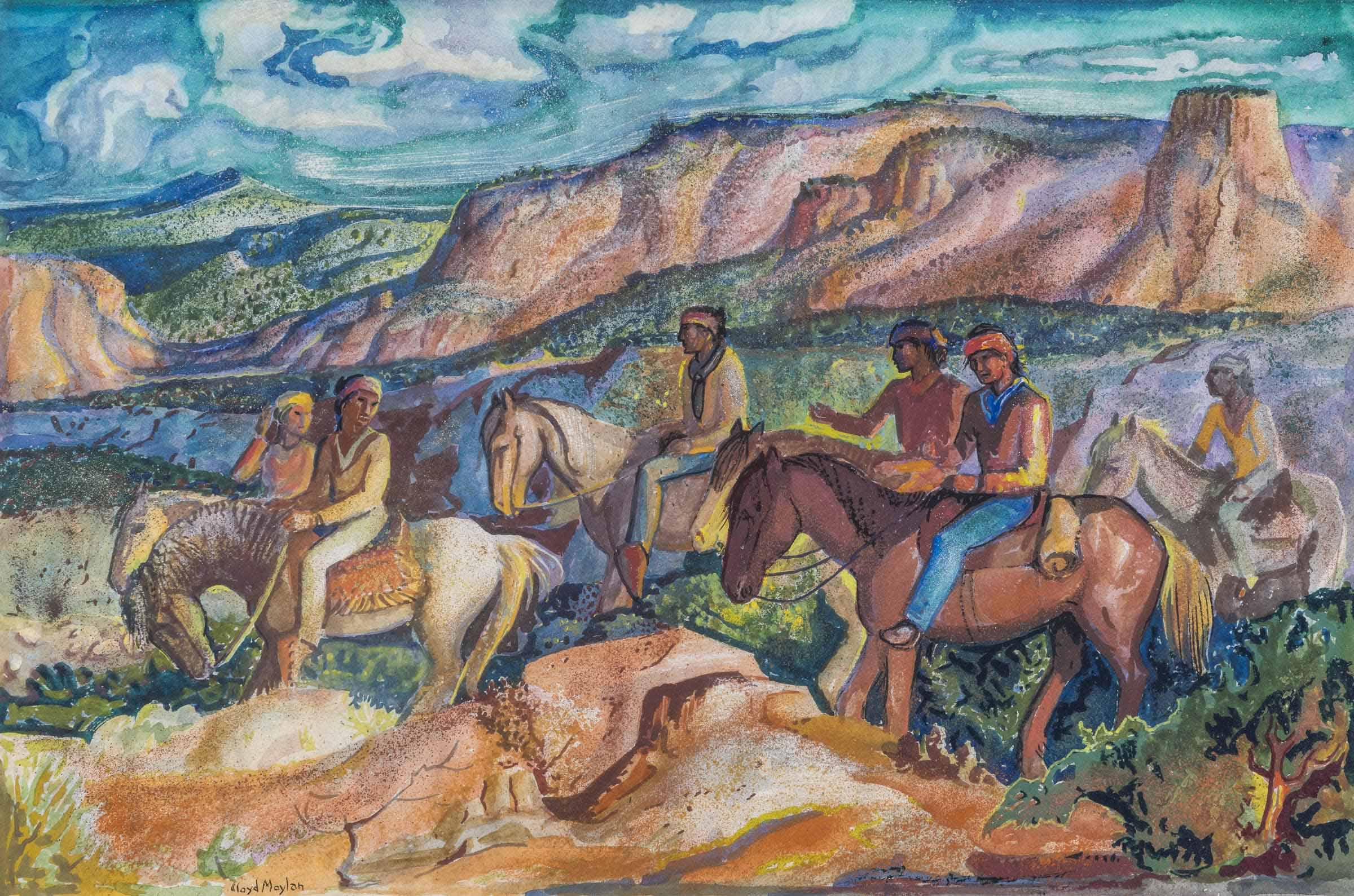
Lloyd Moylan’s paintings of Navajo subjects represent the final step in his artistic development in which he took an integrated approach. These paintings are not experiments—they are fully formed in a way that his other works are not. Russell Vernon Hunter, the director of New Mexico’s Federal Art Project (FAP), noted this shift at the time, writing in 1942 that “For [his] interpretations of his experience in Navajo country, Moylan has evolved a technique that welcomes the subject… In his world of painting he has grown to esthetic maturity after long and sympathetic association with Navajos.”3
What defines Moylan’s “mature” style? A documentary approach, both in terms of style and substance. Here, Moylan abandons “-isms” to paint from personal experience. Let’s take a look.
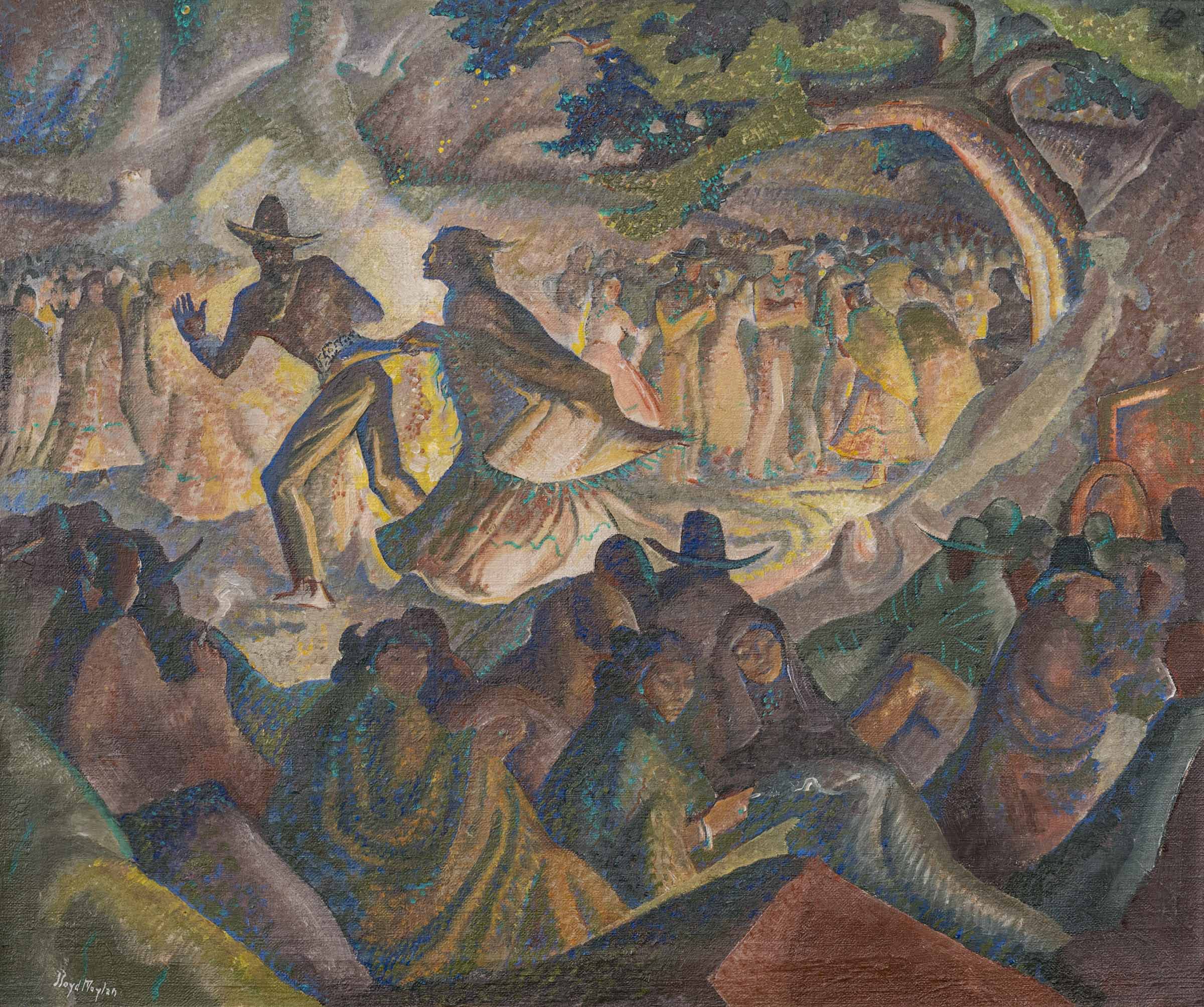
Notice how this painting positions you. What is your literal place in relation to the action? What place does it assign you metaphorically speaking?
In his depictions of Navajo life, Lloyd Moylan’s perspective—the one he paints from and the one he provides his viewers—is that of an outsider observer. He (and we) are separated from the action, which takes place in the middle ground, by some kind of barrier in the foreground, which is usually quite sculptural. In Squaw Dance, it’s a deep red rock or mound of sand. He also often, as is this case here, encloses the action within a circle that keeps the viewer on the periphery. Additionally, in Squaw Dance he emphasizes the separation of the viewer through dramatic lighting.
At the same time, Moylan includes strategic details to establish the authenticity of his work. Details such as the two women holding cigarettes in the foreground of Squaw Dance indicate that this is not simply an imagined scene of daily life, but an expression of lived experience. Squaw Dance is Moylan’s attempt to re-create his firsthand experiences with Navajo culture for his audience. In it, he carefully constructs a window on the scene for the viewer and imbues his work with documentary authority.
Lloyd Moylan’s documentary style raises the question: for whom was he painting? These paintings of Navajo subjects were clearly intended for a non-Navajo audience: Moylan was established with the Santa Fe art gallery scene, and, during the New Deal, the Federal Art Project organized a traveling exhibit of Moylan’s paintings which followed the Federal Art Center circuit around the country.
In his desire to document Navajo life, he was most likely inspired—and aided—by his close association with Mary Cabot Wheelwright, a wealthy Boston heiress who settled in Alcalde, NM, in 1923, where Moylan moved a decade later. Moylan became a regular collaborator of Wheelwright’s, assisting in her efforts to study and share Navajo culture.
After moving to New Mexico, Wheelwright became keenly interested in Navajo spirituality. She was introduced to esteemed Navajo singer (or “medicine man”) Hastiin Klah in 1921 by Arthur and Frances Newcomb, who operated a trading post on the Navajo Nation about 50 miles north of Gallup in a town now called Newcomb. Over the next decade, Wheelwright worked with Klah to record, document, and preserve Navajo sacred knowledge and ritual practices. In 1937, she founded the Museum of Navajo Ceremonial Art (now called the Wheelwright Museum) in Santa Fe, and in 1942 hired Moylan as its first administrator/curator. Moylan also illustrated Wheelwright’s 1956 book A Study of Navajo Symbolism.
Moylan was likely introduced to Navajo people and culture by Wheelwright and undoubtedly accompanied her on visits to Navajo country. Moylan’s paintings are evidence that his artistic aims were ultimately aligned with Wheelwright’s anthropological interests. In fact, he is reported by New Mexico FAP Director Russell Vernon Hunter to have “lived in Navajo country” prior to 1938.
In this way, Moylan also followed in the steps of the Western American artists who came before him. Like the turn-of-the-20th-century artists determined to capture what they considered a “vanishing race,” and the Taos artists who continued to romanticize Indigenous peoples in the 1920s, Moylan too assumed the position and perspective of artist-ethnographer. Indeed, he gained a reputation following his time in Gallup as a “specialist in Navajo subject matter”4 who had “labored long and hard in the vineyards of Indian culture.”5
The way that Moylan’s work was received at the time it was made is revealing. In his critique, Hunter observed an artist at one, so to speak, with his subject. Other critics saw that same: Moylan “expresses a universality by interchange of Indian and Caucasian myths in his design forms,” wrote one.6 “His paintings are a successful combination of two cultures,” wrote another.7 Contemporary viewers interpreted harmony and, by extension, truth and understanding in Moylan’s paintings of Navajo subjects.
Yet, returning to Squaw Dance as an example, what was lost on a 1940s viewer is not on a 21st-century one: a low-key disharmony lurks in Moylan’s paintings. His documentary style pivots on the problematic relationship of non-Native “observer” and Native “subject.” Yet it also diverges from the convention of the all-knowing, paternalistic and/or consumerist Euro-American gaze by calling attention to that dynamic, first by restricting the viewer to “outsider” status and then by elaborating on the limitations of that role.
Moylan’s images have enough detail to be intelligible and evocative, but upon closer inspection the details dissolve. The overall lack of precision means the viewer can only get so far “into” the painting. The longer you look, the less you comprehend and the more you wonder. A creeping self-awareness, if only subconscious, creeps into Moylan’s paintings, conferring the same uneasiness onto viewers and making us cognizant of our role as interlopers. Moylan’s paintings convey not only their intended subject, but the experience of being an outside observer.
This tension between observer and observed at play in Moylan’s paintings of Navajo subjects reflects the socio-political and socio-economic contexts in which he worked. For today’s viewer, they reveal much more about the complexities of cross-cultural exchange then and now than they do about Navajo culture itself.
A photograph of a 1940s or 1950s Gallup Inter-Tribal Indian Ceremonial Parade on Coal Avenue in downtown Gallup.
Gallup is located on the ancestral homelands of the Diné (Navajo), A:shiwi (Zuni), Hopi, and more Indigenous peoples. It is a “border town” situated on the south-eastern edge of the Navajo reservation and directly north of the Zuni reservation. The city grew with the railroad, becoming home to settlers, their descendants, and more recent immigrants.
The Gallup that Lloyd Moylan knew was essentially a colonial outpost. According to the 1940 US Census, the small town of just over 7,000 inhabitants was 97% white and only 1.34% “Indian.” The city proper, however, was surrounded by majority-Native unincorporated communities, meaning that the Gallup “metropolitan” area was essentially segregated at the time. While a trading relationship developed between newcomers and the area’s original inhabitants, Indigenous culture played a role in town life only to the extent that it could be commodified for sale to tourists.”8 The optics of a 1940s/50s Gallup Inter-Tribal Indian ceremonial parade in the above photograph—Native culture on display for a white crowd—perfectly encapsulate the border town arrangement.
Lloyd Moylan’s portraits of Navajo people elucidate the complexities of the lived experience of 1930/40s Gallup. As has been established, Moylan probably spent a decent amount of time with Navajo people. He probably harbored a genuine desire to know and understand their culture and learned a lot about it. He probably knew enough to know what he didn’t know.
At the same time, he also participated in a Western American artistic tradition defined by biased consumerist and capitalist impulses, and operated within a cultural economy predicated on an inequitable, exploitative producer/distributor relationship.
Together, these three portraits reveal an artist wrestling with these contradictions, forming a continuum from outright objectification of the subject on the one hand (see Navajo Mother-In-Law) to intimate characterization on the other (see Navajo). Much like the subtle subversion of Squaw Dance (above), Moylan’s Navajo portraits conform to the mold while also splintering it.
To learn more about a portrait, click the arrow in the top right corner.
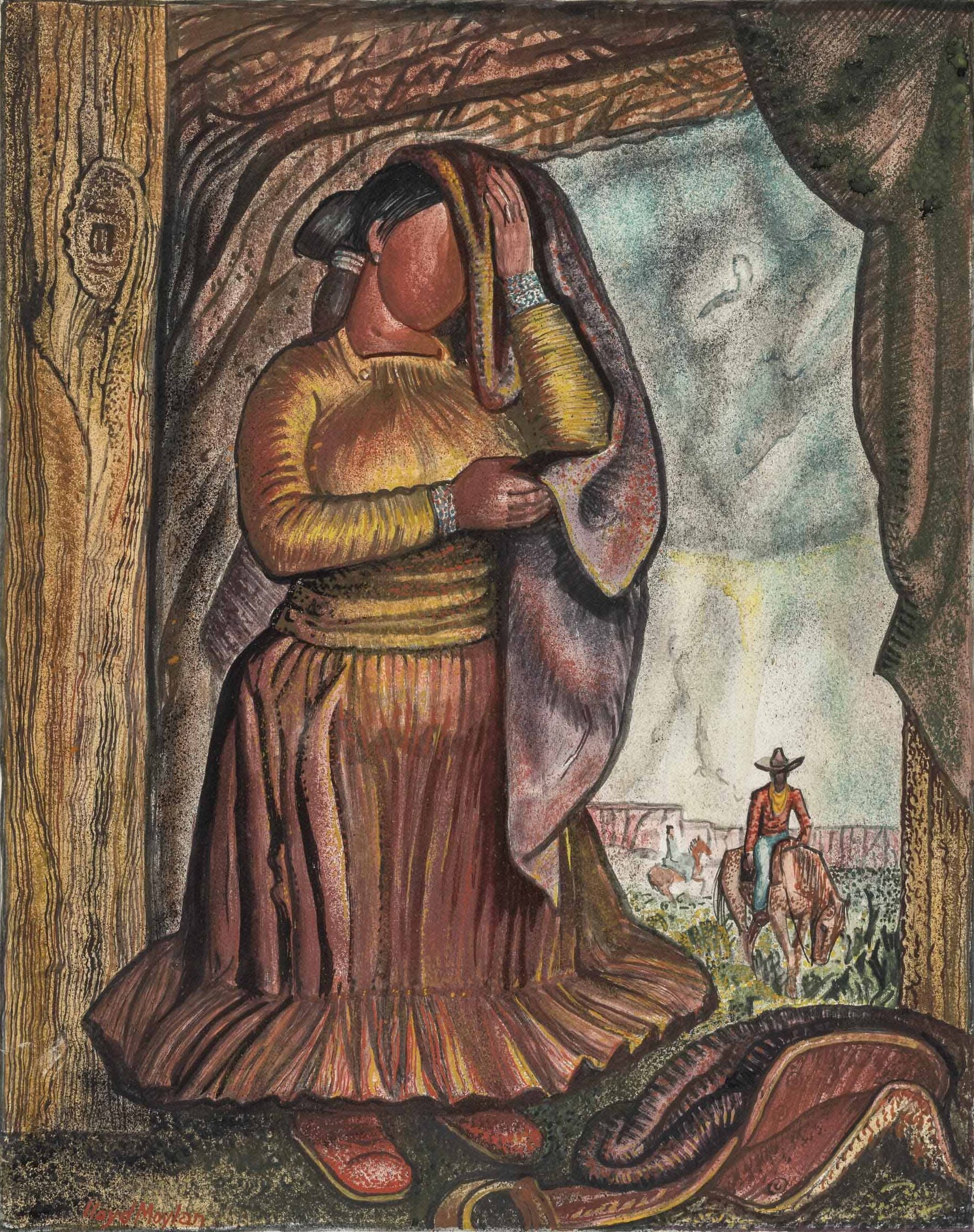
Navajo Mother-in-Law is a clumsy attempt to visualize the Navajo practice of having no direct interaction between mothers-in-law and their sons-in-law. A traditionally dressed Navajo woman (the title figure) turns her head and covers her face with a shawl as a man on horseback (presumably her son-in-law) approaches. The painting is not meant to be a portrait of an individual, but a diagram of a cultural ethic.
Indeed, the mother-in-law is portrayed without any facial features, rendering her purely symbolic. The theatrical framing—timber posts and drapery create a kind of proscenium arch with the fabric mimicking the appearance of stage curtains—underscores the painting’s performative qualities.
Moreover, Navajo Mother-in-Law has attributes of a still life painting: the incidental saddle carefully positioned in the corner; the stiffness of the woman’s skirt, which looks chiseled from wood, almost giving her the impression of a doll or carving. A generous reading of Navajo Mother-in-Law is that it is the artist’s attempt to record/convey a foreign custom. But in the ways that it makes spectacle of, packages, and peddles Navajo culture, Navajo Mother-in-Law epitomizes the socio-economic dynamics of 1940s Gallup.
What aspects of Slim Woman and Chewing Tobacco Begay stand out to you? What most catches your eye?
In all likelihood, your answer includes one or more of the following: the glinting turquoise jewelry worn by the sitters, the strong angles and curves of their facial features, the wide brim of man’s hat and the neatness of his hair bun (or, tsiiyéél in Diné/Navajo), the serrated edge of the blue mesa in the upper left corner.
The painting draws your attention by design. Take the sitters’ clothing, for example. It is configured to accentuate their turquoise jewelry. The draping of the woman’s shawl and the man’s scarf give Moylan the perfect pretense for positioning their hands so as to enunciate the rings on every finger. Moylan chose turquoise’s exact complementary colors—red for the woman’s shirt and yellow for the man’s scarf—to make the jewelry stand out all the more. The skin on the sitters’ hands and cheeks is bathed in yellow highlights for the same purpose-to set off and thereby draw the gaze to their jewelry.
While, unlike Navajo Mother-in-Law, Slim Woman and Chewing Tobacco Begay clearly depicts specific people—the title references the sitters’ names or nicknames—the two paintings ultimately function much the same. Slim Woman and Chewing Tobacco Begay is a carefully composed studio portrait that, given the figures’ contrived poses and deferent downcast glances and the overwhelming emphasis on attire, reads more like a fashion spread than a character study. Ironically, this painting of two individuals is mostly lacking in individuality.
More to the point, the painting teeters on stereotypical. In pinpointing and spotlighting such recognizable cultural signifiers as traditional adornment and hairstyles and particular geographical features, Moylan is not “wrong,” per say. Though the sitters’ exaggerated physiognomies—high cheekbones, wide noses and large lips—nearly cross the line into prejudice (think: cigar store “Indians” or sports team mascots), the turquoise, the mesa, and the tsiiyéél, are inextricably Navajo. It is no wonder a painting like this would scream “Navajo” to (non-Navajo) 1930s art critics.
Yet it is what might be termed “tokenized Navajo.” Slim Woman and Chewing Tobacco Begay projects superficial aspects of Navajo culture (that which can be gleaned through observation), which also happen to be the most commodifiable, and therefore the most valued, aspects within an extractive cultural economy such as that of 1940s Gallup. Rather than a true representation of Navajo culture, the painting is thus a representation of a non-Native person’s appreciation of Navajo culture. In this way, Moylan’s portraits align with the turn-of-the-20th-century tradition of reductionist Native portraiture.
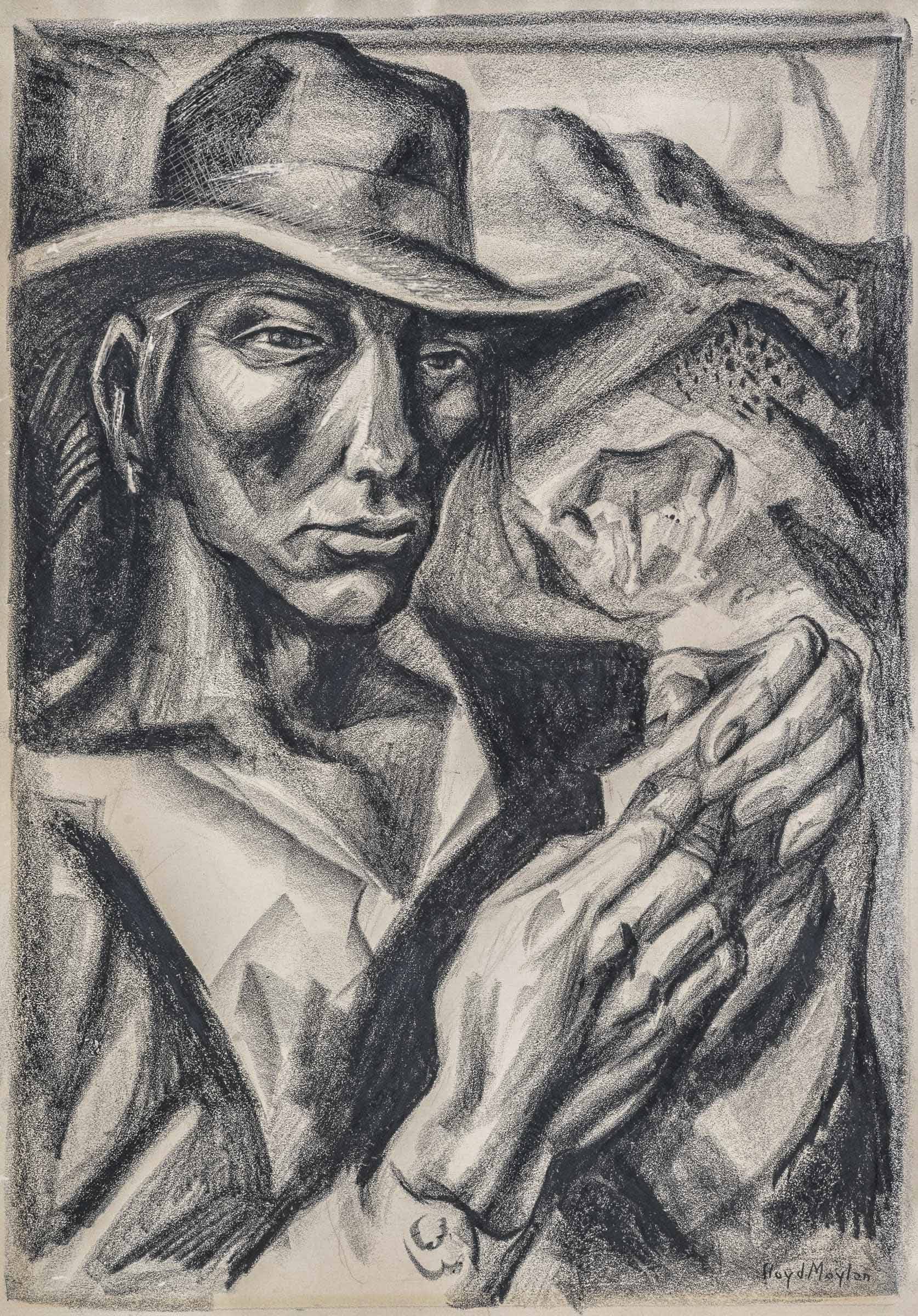
Rendered in black and white, Navajo is stripped of much of the pretext and pretense of Navajo Mother-in-Law and Slim Woman and Chewing Tobacco Begay. While also a posed studio portrait of a model—perhaps the same man pictured in Slim Woman and Chewing Tobacco Begay—it presents more naturally, as if the viewer has casually encountered a horseman taking a break on the side of a trail to loosen his collar and roll a cigarette.
The figure appears completely in his element, wearing a broken-in cowboy hat the shape of which precisely mirrors the hills that stretch out behind him. The aspects that are emphasized through composition—the sitter’s strong hands and thoughtful expression—are strikingly authentic.
While thoughtfully composed, Navajo is far less engineered than its counterparts. It is essentially the obverse of Slim Woman and Chewing Tobacco Begay—although it would be easy to believe Navajo is a portrait of a friend, its title indicates none of the individuality it actually possesses.
Image Use Notice: Images of Gallup’s New Deal artworks are available to be used for educational purposes only. Non-collection images are subject to specific restrictions and identified by a © icon. Hover over the icon for copyright info. Read more

Gallup’s New Deal art collection consists of over 120 objects created, purchased, or donated from 1933 to 1942 through New Deal federal art programs administered by President Franklin D. Roosevelt to support artists during the Great Depression.
The Gallup New Deal Art Virtual Museum features three types of exhibits, combining traditional and non-traditional approaches to illuminate academic, creative, and individual understandings.
Gallup’s New Deal art collection includes works by a demographically, professionally, and stylistically diverse group of named and unnamed artists.